Happy Food Diversity Day!
On Friday January 13th, from 9am to 7.30pm, some of the UK’s leading scientists, writers, chefs, farmers, campaigners and entrepreneurs will be taking part in a continuous feed of discussions, storytelling and information sharing – all about the wonders and importance of food diversity. These discussions will be made available for free via Eventbrite, live-streamed on YouTube and available to view after the event. Explore the resources for each of the sessions here.
This seems to be the brainchild of Dan Saladino, who recently published the wonderful Eating to Extinction.
LATER: And then there’s this talk from the Seed Detective on the 25th to round things off.
Liberating seeds — and climate matching tools
I hit “publish” too soon yesterday. If I had waited a couple of hours, I could have done a deeper dive into how Jeremy spent his holidays, by adding his just-dropped podcast on the “Let’s Liberate Diversity” Forum held in Budapest back in October to his last newsletter of 2022.
In the podcast, Jeremy muses on the new EU Organic Regulation (Regulation (EU) 2018/848), which finally allows the marketing of organic heterogeneous material (OHM), and interviews two beneficiaries of this welcome change in the law. Spoiler alert: Belgian beer is being re-Belgianized, and everybody seems very happy about it.
Incidentally, if you’re interested in doing the kind of climate matching Jeremy mentions in his third note, you could check out this website, though it only covers Europe. If you want global coverage, you might have to brush up on your R. 1
Mo’ better agrobiodiversity graphics
Wouldn’t want you to miss out on this nice find from Jeremy’s last Eat This Newsletter of 2022, just because we’re in a new year now. But why not subscribe, eh? Incidentally, since we’re talking about the movement of crops around the world, and fancy graphics, you might as well also check out Bloomberg’s cool re-visualizations of the data in the 2014 paper “Increasing homogeneity in global food supplies and the implications for food security.”
In the decades after 1492 “a massive multidirectional transfer of biota, diseases, technology and humans occurred between Afro-Eurasia and the Americas”. But if you look at the standard maps of these movements, collectively known as the Columbian Exchange, you miss almost all the complexity and context of what moved, where, why, and what else was going on.
That’s the conclusion of a new paper: (Re)Mapping the Columbian Exchange. Suggestions for an Updated Cartography. The paper itself is behind a paywall, although one of the authors is a friend of the podcast so I may well invite him on to discuss the story in more detail. Thankfully, the maps themselves are available to download, and even a superficial glance shows that the story is much more interesting than the standard maps imply.
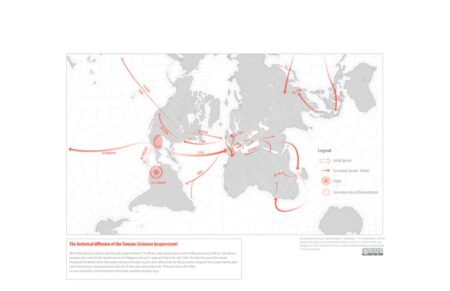
Each of them overcomes the “overly constrained geographic scope, chronological compression, non-depiction of the contemporaneous movement of important cultural, technological and biological elements of each product, ethnocentrism and the obscuring of human consequences” of the standard map, and I look forward to reading the new plant biographies just as soon as I get hold of the paper.
Nibbles: Diets, Millet seedbank, Healthy rice, Kazakh genebank, Decentralized seeds, Planet Local, White sage, White olive, Talangana collecting, Nature-based, Italian food, Citron, Indian quinoa, Crop expansion
- And…we’re back!
- Nice new infographics derived from that classic paper “Increasing homogeneity in global food supplies and the implications for food security.”
- Video on a millet community seedbank in India.
- I hope all these healthy Indian rices are in seedbanks somewhere, community or otherwise.
- Kazakhstan is getting a new genebank, and I don’t mean a community one.
- yeah but genebanks are not enough: enter INCREASE.
- Wait, there’s a World Localization Day?
- Looks like white sage might need less localization and more seedbanks.
- I see your Mexican white sage and raise you the Calabrian white olive.
- The Telangana equivalent of white sage is probably safe, though, if this collecting programme is anything to go by.
- IFAD pushes nature-based farmers. White sage unavailable for comment.
- The localization narrative meets Italian food. And yes, spoiler alert, Italian food does exist. Despite the increasing homogeneity in global food supplies. And it doesn’t need white olives either.
- Let the hand-wringing about the Italian-ness (Italianity?) of citrons commence. But not until I’ve left the room.
- Ah, but is there such a thing as Indian food? I mean, if there’s quinoa in it. I look forward to the eventual quinoa community seedbanks.
- All those crops are not being locally grown for food anyway.
- Have a happy new globalizing, localizing year, everyone.