I’ve done a fair amount of reading and thinking about the theory and practice of germplasm collecting in my time, but I don’t think I’ve ever come across an example similar to the one described in a recent paper in Genetic Resources and Crop Evolution.
In it, Swedish researchers describe how they took advantage of a couple of interesting quirks in the history of Sweden to devise what I think is a pretty novel strategy for sampling agrobiodiversity. They were interested in collecting germplasm of hops (Humulus lupulus) for a new genebank that’s under development. Now, the thing is that, although this crop is no longer grown in Sweden now, for 400 years from 1442 doing so was compulsory, in order to guarantee sufficient domestic production for beer-making. Very sensible, too.
Initially, all peasants were required to grow at least 40 hop poles. By 1483, the quantity was increased to 200 hop poles. The law was not formally repealed until 1860. As a result of this law, the plant has left several financial, fiscal and legal imprints on Swedish history.
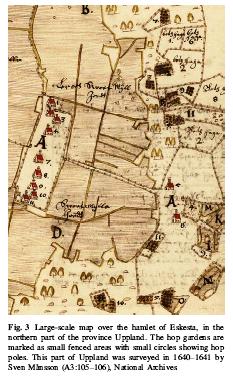
The second historical curiosity about Sweden is that it boasts a unique set of some 12,000 large-scale maps dating back to the mid-17th century. Because of the hops law, hop gardens are actually marked on these maps in some detail (click to enlarge).
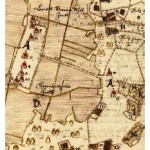
So the collectors used what they call a “history to plant” method to identify likely areas for collecting, using not only maps such as the one reproduced above, but also…
…medieval charters from the fifteenth century files of land belonging to the abbey of Vadstena, documents from the expeditions of Carl von Linné and his pupils from the eighteenth century and also documents from the breeding program in Svalöf from the beginning of the twentieth century.
And a pretty successful strategy it was too.
We found no hop plants at locations which were not indicated in the maps as hop gardens. Today living plants were possible to find in more then 33% of the total inventoried sites, indicated as hop gardens on large-scale maps.
As I say, I can’t think of another example of the use of historical maps to locate specific crops for sampling. No doubt the specific circumstances that made this possible in Sweden are not all that common around the world. Anyway, if you know of similar work, let me know. Always interested in keeping up to date with the latest in germplasm collecting.