- Pickling facts.
- Trouble for the French oyster.
- Grow-your-own hops.
- Saving the coconut crab.
- Korea launches website of traditional recipes. Looks great, but all in Korean, alas.
- Our friend Karen Williams’ work on agrobiodiversity conservation in Ecuador highlighted.
Breadfruit goes mainstream
Well I must say I never thought breadfruit would make it to Newsweek, but it has. Well done, Diane!
More on Enola
Multiple origins of agriculture debated
The point is that agriculture, like modern human behaviour, was not a one time great invention, but the product of social and environmental circumstances to which human groups with the same cognitive potential responded in parallel ways. The question in both cases is: what were the common denominators of those circumstances?
That’s from a post over at The Archaeobotanist which starts by talking about “modern human behaviour” rather than agriculture, but sees parallel processes at play in the origin of both. So, in the same way that “the cognitive architecture for modern behaviour was around but the innovations that we regard as ‘modern’ emerged when social and environmental circumstances demanded,” and this happened in different places at different times, so likewise the “cognitive architecture” for agriculture was widespread and there were therefore many “centres in which societies converged on agriculture,” with the concomitant “behavioural changes towards manipulation of the environment in favour of the reproduction of a few food species,” triggered by particular “social and environmental circumstances.”
Fair enough, but how is this new? There’s a comment on the post in which Paul Gepts makes this very point
…I am somewhat surprised that the issue of parallel inventions of agriculture is still an issue. The concept of centers of origin/domestication has been around for a century, thanks to Vavilov, Harlan, et al. … I must be missing something here, because for some time agriculture has been considered an example of multiple, independent inventions.
I’m looking forward to following this heavyweight exchange.
Report on the future of inland fisheries in Central Asia is out
This is what’s happened to inland fisheries pretty much throughout Central Asia since the fall of the Soviet Union:
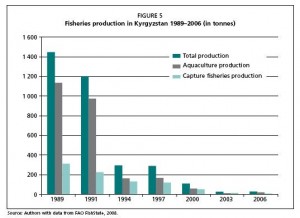
According to an FAO report just out, that is. There’s some limited scope for optimism, though.
Somewhat belatedly, attention is now being focused upon the reactivation of the fisheries sector with the emphasis very much on aquaculture as it is unlikely even in the Caspian Sea that capture fishery could ever again assume the same importance as in yesteryear. Led by private entrepreneurs, and with the active prompting of national fisheries departments and foreign donors, fisheries are being slowly restored to the developmental agenda. This is no easy task, given both the general failure to recognize the role the sector can play in national development and poverty alleviation strategies and the continued lack of legislative clarity, although the latter is gradually being rectified in a number of the countries.
It will be interesting to see whether any recovery is based on a reasonable foundation of fish diversity (Kazakhstan has 150 fish species), or just the usual one or two aquaculture suspects.