- Ex-ILRI staff member Robin Reid on “60 Minutes” explaining the Masai Mara migration.
- GM taro banned.
- All about Cryphonectria parasitica, cause of chestnut blight.
- The ins and outs of cooperage.
- I’m the urban beekeeper and I’m ok…
- Did I already announce this new plant breeding forum?
Chewing up Kenyan gums
This strikes close to home. The Ministry of the Environment in Kenya has instructed farmers in Central Province to cut down eucalyptus trees growing near water courses. Apparently, this constitutes “an attempt to lessen the impact of the drought that is ravaging the country,” because eucalypts are “thirsty.”
The mother-in-law has been managing (by coppicing) a small eucalyptus stand for years. The firewood is what keeps her — and us, when we visit — warm during the cold season. And she sells a few poles every now and then for extra cash. You can see how important gums and other exotic trees are around her place in the Limuru highlands in this picture:
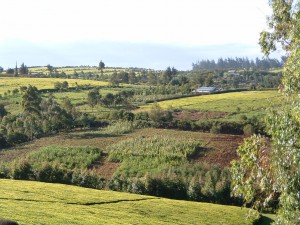
Now, I’m all in favour of indigenous trees, but the seeds haven’t been available in sufficient quantities until recently (to say nothing of awareness and policies). And the hydrological case against eucalypts is subtle: they certainly use a lot of water, but they are efficient in its use, and a very valuable resource in many places.
It seems unfair to blame and penalize farmers for choosing eucalyptuses and Australian acacias when they needed to plant some trees many years back and those were the species that were available, and were being pushed. I hope the mother-in-law gets to keep her eucalypts, at least until she can get some grevilleas growing. We’ll need them when the cold comes.
Berry Go Round #20
Welcome to all who landed here from Berry Go Round #20, over at the excellent Further Thoughts. And if you’re one of our regular customers, head on over to Ian Ramjohn’s blog for a great botanical roundup, including a couple of examples of agricultural biodiversity.
Nibbles: Kenyan drought, Ugandan agroforestry, American foodways, Beans, Forages, Bees to the nth, Indigenous farming, Brazilian and Cuban farming, Chinese aquaculture, Nigerian seedlings, Belgian dukes, IFPRI climate change study, Phytophthora
- Internets all aglow today, so hang on to your hats, here we go. Drought forcing Kenyans out of maize, towards indigenous crops, wheat and rice. Wait, what?
- Making money from tree seedlings in Uganda. Including indigenous stuff. Damn you, allAfrica, why are you so good?
- ‘Turkey’ Hard Red Winter Wheat, Lake Michigan Whitefish, the Hauer Pippin Apple, and the St. Croix sheep, among others, added to Ark of Taste. Ok, I’m gonna have to see some explanation for that wheat one.
- Singing the praises of pulses. Even Virgil gets a namecheck.
- Tall Fescue for the Twenty-first Century? Seriously, who writes these titles?
- nth study on bees announced. And n+1st reports. And n+2nd called for. CABI does a bit of a roundup. Bless you.
- Declaration calls for “…the creation of democratic spaces for intercultural dialogue and the strengthening of interdependent networks of food producers and other citizens.” Interesting.
- Small scale farmers produce most of what Brazilians eat. And no doubt manage most of the country’s agrobiodiversity. And Cuba?
- Chinese aquaculture goes green? Riiiiight.
- “Earlier this year, farmers from the north who had benefitted from previous improved seedling activities by the International Institute of Tropical Agriculture (IITA) demanded for more improved seed varieties from scientists.” Oh come on, gimme a clue. What crop? Improved how?
- Medieval Bruges palace cesspit reveals dukes ate Mediterranean honey. Sybarites even then, the Belgians.
- Scientific American says IFPRI says “traditional seed varieties and livestock breeds that might provide a genetic resource to adapt to climate change are being lost.”
- Late Blight 101.
Featured: Neotropical fruits
Xavier sets Jeremy right on that carob-like fruit in Ecuador:
Must have been an Inga species (called guaba in Ecuador, not to be confused with guava, the English name for Psidium guajava, or guayaba (its Spanish equivalent). In English the species is referred to as pacay or, more attractive, ice-cream bean (I hope you had a chance to try it…)