- Jacob alerts me that our “throw duplicates of all accessions from an airplane flying across Africa” Gedanken experiment may be closer to realization than we thought.
- Reindeer in trouble. In other news, there are 7 subspecies of the things.
- Indonesia looks to its threatened livestock wild relatives.
- Agriculture (among other things) in North Korea.
- Buffalo distributed in Myanmar. From where?
- Local vegetables promoted in the Philippines.
- More inspirational stuff on the Millennium Seed Bank from Jonathan Drori.
- Organizations Involved in Organic Plant Breeding Projects and Education. Not as many as you’d think.
- “Learning centres” helping farmers identify challenges, adapt to climate change.
Conserving evolution
Salvatore Ceccarelli, for many years a barley breeder at ICARDA, tells us about evolutionary-participatory plant breeding, a holistic approach to adapt crops to agronomy, climate changes and people.
That the climate is changing is now accepted by most, and certainly by old farmers in developing countries who are telling us of less snow falls, less ice in winter, less rainfall, more dusty days, and more importantly declining crop production in face of increasing production costs (fuel to pump irrigation water, fertilizers, etc.).
One question farmers often ask is if and how the crops and the varieties of the crops they grow today, and which provide us with food and feed, will cope with the future climate. The question is not an easy one to answer because while we all know that the climate is going to be drier and hotter, nobody can tell the farmer who asks the question how precisely much drier and hotter it will be in the place where he/she lives. But the same farmers who ask this question also help us to find an answer when they tell us that in years of drought only those farmers who are still growing the old traditional varieties (landraces) are able to harvest something.
Many of these landraces, even when they are no longer cultivated are still kept in genebanks, under very special conditions (low temperature and humidity) to keep them alive for a long time. However, by “freezing” seeds genebanks also “freeze” evolution at the time the landraces were collected, and this is not ideal at a time when we need the crops to be exposed to the changing climate so that they can slowly evolve (adapt) and produce new types that can better endure the future climate. Even if we do not know precisely what the climate will be, we should give the plants the opportunity to find out.
These are the principles of “evolutionary – participatory plant breeding”, a program by which we make available to farmers of different countries populations made by mixtures of landraces of the most important (to the farmers) crops available in genebanks. The mixtures will be planted in contrasting locations, particularly those representing high intensity of abiotic and biotic stresses.
In each location, the population will be left to evolve under the joint forces of natural and artificial selection operated by the farmers — but also by breeders (this is why we call it “participatory”). The system can be considered as a sort of “evolving genebank”. Because the mixtures can be planted in a very large number of locations – and with time can be shared by an increasing number of farmers – the populations are expected to evolve differently, responding not to only to climate changes but also to different types of soil, different agronomy, different uses of the crops and different farmers’ preferences etc. Therefore, in addition to the most obvious benefit of generating better crops for the future climate, this program will give a major contribution to increase agricultural biodiversity with all the associated benefits.
As the populations evolve in different directions, genebanks can periodically store samples of these evolving populations, thus “conserving evolution”.
Striga beater awarded 2009 World Food Prize
Dr Gebisa Ejeta of Purdue University has won this year’s World Food Prize for his work on sorghum breeding, in particular breeding for resistance to the parasitic weed Striga.
Dr. Ejeta’s scientific breakthroughs in breeding drought-tolerant and Striga-resistant sorghum have been combined with his persistent efforts to foster economic development and the empowerment of subsistence farmers through the creation of agricultural enterprises in rural Africa. He has led his colleagues in working with national and local authorities and nongovernmental agencies so that smallholder farmers and rural entrepreneurs can catalyze efforts to improve crop productivity, strengthen nutritional security, increase the value of agricultural products, and boost the profitability of agricultural enterprise — thus fostering profound impacts on lives and livelihoods on broader scale across the African continent.
Couldn’t have happened to a nicer person either. Congratulations, Dr Ejeta.
Talking turkey data
So I was playing around with the agriculture data on WRI’s EarthTrends the other day. Actually it’s mainly — though not entirely — data from FAOStat, and there are the usual provisos about the methodology. 1 But look at what has been happening to turkey numbers in developed countries lately.
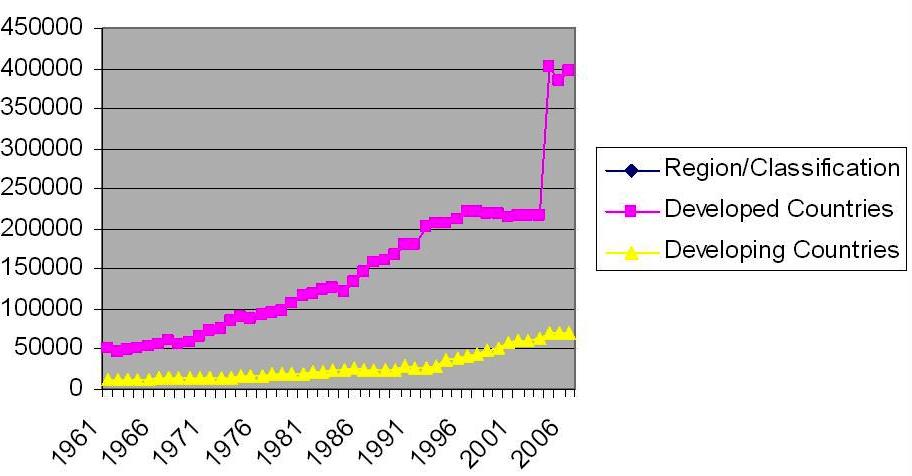
Numbers doubled between 2003 and 2004! Is that real? If so, what’s been driving the trend?
Tunisian genebanks starts to fill up
Help me out here. What is so “worthy of praise” about getting duplicates of several hundred wheat accessions from the USDA and ICARDA genebanks and putting them into another genebank? Surely the Tunisian genebank is up to much more praiseworthy stuff.