- Do Pharaohs’ cattle still graze the Nile Valley? Genetic characterization of the Egyptian Baladi cattle breed. Maybe.
- Lessons on textile history and fibre durability from a 4,000-year-old Egyptian flax yarn. Pharaohs’ flax still being woven though.
- Wild cereal grain consumption among Early Holocene foragers of the Balkans predates the arrival of agriculture. Which made it easier to adopt cultigens when farmers arrived.
- The origins and spread of domestic horses from the Western Eurasian steppes. Horses from the lower Volga-Don spread all over Eurasia starting around 2000 BC along with equestrian material culture.
- The Japanese wolf is most closely related to modern dogs and its ancestral genome has been widely inherited by dogs throughout East Eurasia. Kinda too bad it’s extinct, but maybe it can be reconstructed?
- Late Pleistocene/Early Holocene sites in the montane forests of New Guinea yield early record of cassowary hunting and egg harvesting. Amazing. From looking at eggshells.
- Hallstatt miners consumed blue cheese and beer during the Iron Age and retained a non-Westernized gut microbiome until the Baroque period. Amazing. From looking at, well, there’s no easy way of saying it, paleofeces.
Nibbles: Crop change, Chinese chocolate, Food system, Eating local, Heritage wheat, NTFPs, Distinguished ethnobotanist, Pumpkins, Garum recipe, Fermentation, Archaea, NBPGR interview
- IFAD says farmers might need to change crops. Farmers unavailable for comment as presumably they’re too busy changing crops.
- Case in point: China moves into cacao.
- The food system is at the centre of all our ills. But I’m not sure switching from maize to sorghum is going to cut it.
- And neither will watching those food miles, alas.
- Example of a farmer changing crops, watching food miles and diversifying the food system.
- I suppose we could also just eat more trees?
- We’ll need ethnobotanists for that.
- And there’s clearly plenty of pumpkins out there.
- Maybe garum would go well with some of those NTFPs, and pumpkins.
- Do they teach garum at Fermentation School?
- Whoa, I did not realize archaea in the vertebrate gut feed on bacterial fermentation products.
- And let’s not forget to put everything in genebanks before it’s too late so we have a chance to do all of the above.
Talkin’ ’bout my generosion
What’s that you say? You don’t have time to slog through dozens of pages of text, diagrams, tables and supplementary materials on genetic erosion? Ok, then, have you got time to listen to lead author Colin Khoury talk about the paper in question for an hour or so? Of course you do. This is just the latest of a great series of webinar, see all the others on the Genebank Platform page.
Questioning maps
As regular readers know all too well, I can’t resist a map mashup. So when I saw the latest data on deforestation in the Amazon, I fired up MapWarper and GoogleEarth and got to work.
And here’s a look at how recent deforestation in Brazil relates to the localities of past cassava collecting, at least as far as Genesys knows about it.
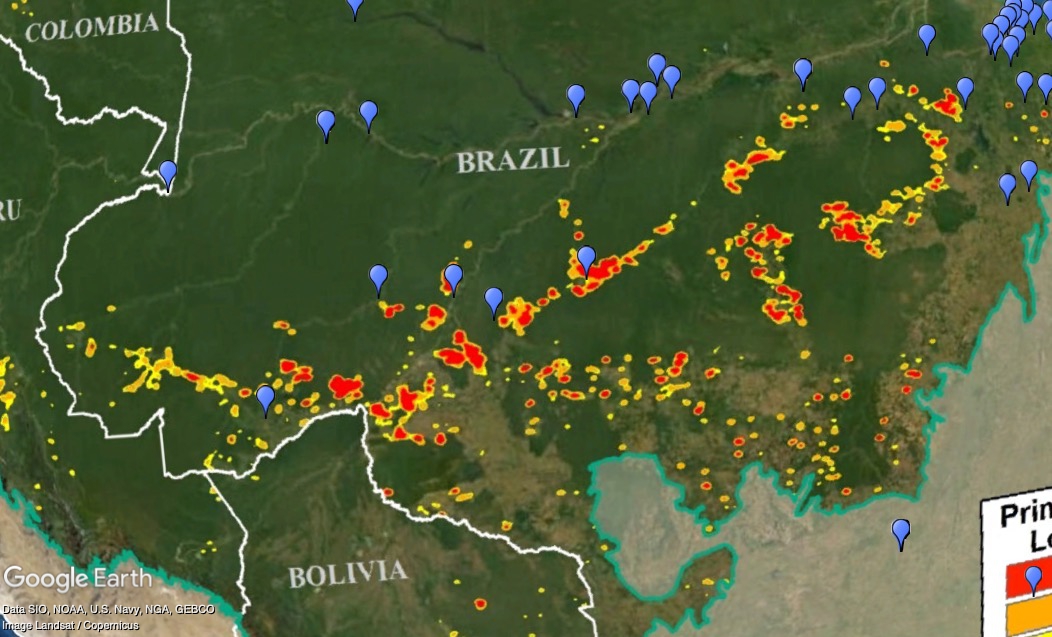
Now, I don’t know in what way deforestation (and associated disruptions) relates to loss of cassava diversity, but there’s a chance that it might. Could make an interesting PhD project for someone.
Anyway, encouraged by my pretty result, and remembering that I wanted to do something with some shiny new maps I had heard about, I next mashed up sorghum accessions and poverty in Burkina Faso. Here’s what I got.
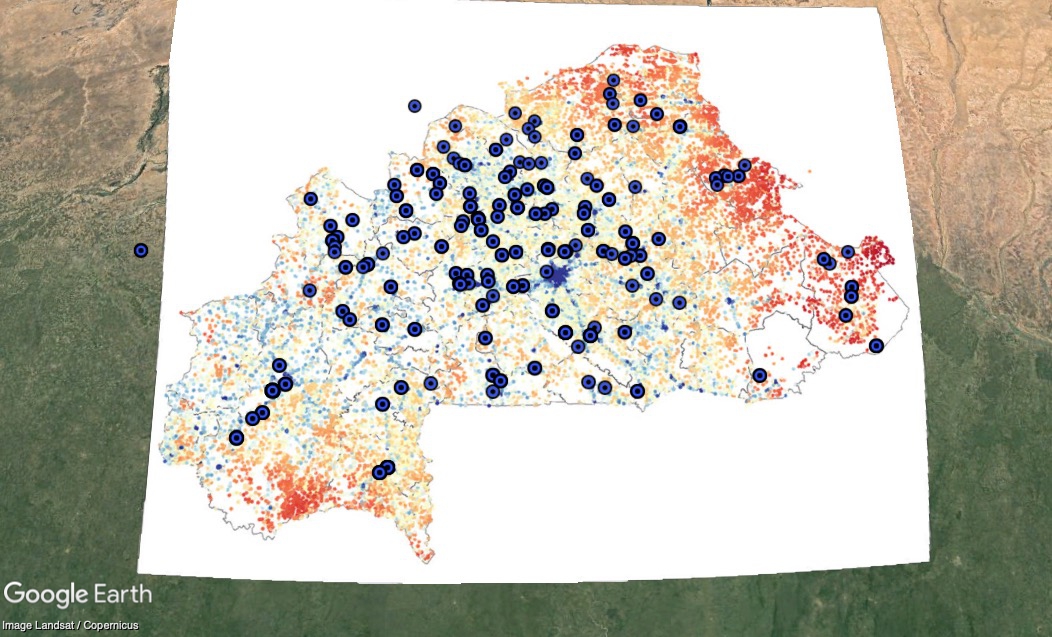
What’s going on? Why are there relatively fewer sorghum accessions where poverty is higher (more red)? Are those places just harder to reach? Or do people there really grow less sorghum.
Again, I don’t know. But I think it would be interesting to find out.
All speculation welcome in the comments.
Brainfood: RICA, AEGIS, CWR, Agrosavia, DSI, CRISPR, Tradition, SNS, Stability, Birds, Sparing, Genetic erosion
- RICA: A rice crop calendar for Asia based on MODIS multi year data. RiceAtlas validated. Still trying to figure out how to mash it up with genebank accession locality data though. Any GIS geniuses out there to help me?
- AEGIS, the Virtual European Genebank: Why It Is Such a Good Idea, Why It Is Not Working and How It Could Be Improved. Certify genebanks, that’s how.
- Reap the crop wild relatives for breeding future crops. Needs good data and certified genebanks. Plus gene editing.
- Opportunities and Challenges to Improve a Public Research Program in Plant Breeding and Enhance Underutilized Plant Genetic Resources in the Tropics. Needs better social networking. Plus better data and certified genebanks, presumably.
- From seed to sequence: Dematerialization and the battle to (re)define genetic resources. Ah yes, data.
- Current Advancements and Limitations of Gene Editing in Orphan Crops. Ah yes, gene editing.
- Revitalizing Traditional Agricultural Practices: Conscious Efforts to Create a More Satisfying Culture. Meanwhile, in Sweden…
- Sacred natural sites and biodiversity conservation: a systematic review. Of course sacred sites are good for biodiversity. But it’s always good to have the data.
- Global relationships between crop diversity and nutritional stability. Sacred sites are not enough, alas.
- Preserving local biodiversity through crop diversification. Crop diversity is even good for birds…
- Concentrating vs. spreading our footprint: how to meet humanity’s needs at least cost to nature. …but, overall intensification of agriculture coupled with sparing land for conservation (maybe even in sacred sites) is the best approach for wildlife. And humanity, for that matter. So, back to needing better data from certified genebanks, so we can get that intensification done, right?
- Quantifying the scale of genetic diversity extinction in the Anthropocene. Right!