“Ex-situ gene banks have an important role to play. But we’ve been trying to save seed in gene banks for the last half century, with more failures than successes. To ensure a sustained supply of useful germplasm and a more dynamic system of keeping diversity alive, we must support farmers in maintaining seed in their field. If we lose this living diversity Africa and the world will not be able to adjust to climate change,” Worede said.
Identifying plants online
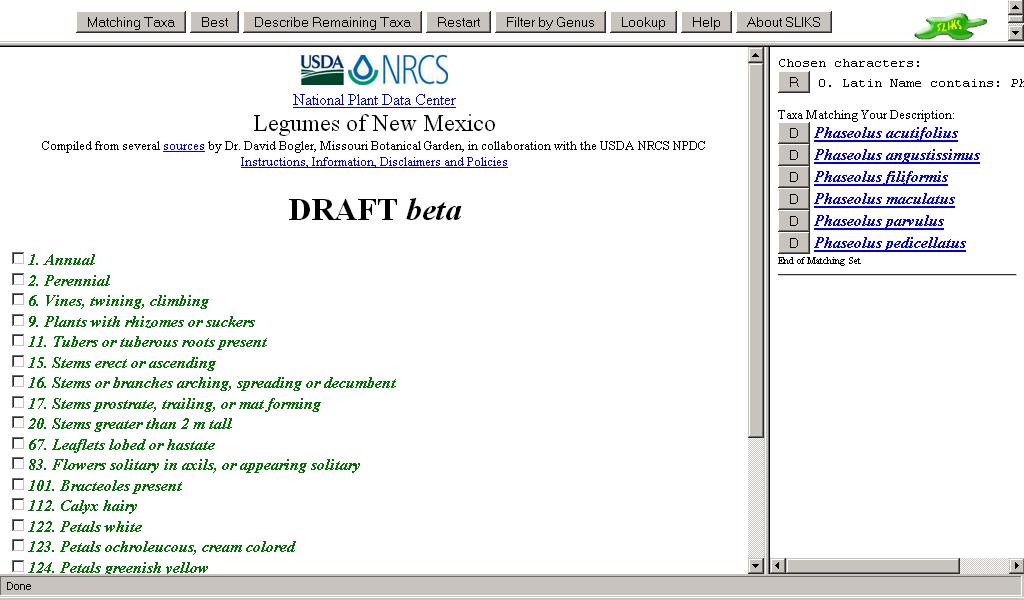
The USDA’s Natural Resources Conservation Service has online (and, indeed, downloadable too), interactive, polyclave identification keys for American grasses and legumes, by state. It’s unclear to me from the introduction whether these cover all grasses in each state, or only the ones which occur in wetlands. In any case, they are for testing purposes only at this stage. But the multi-entry keys are much easier and efficient to use than conventional dichotomous keys. And there are a lot of crop wild relatives included (e.g. see Phaseolus in New Mexico in the screenshot thumbnail below). I don’t think the keys have been build using LUCID (at least I don’t see any reference to it), which seems a bit like re-inventing the wheel, but anyway, better keys are always worth having.
African cooking in the spotlight
…there is no African cuisine.
What? Hang on, take it easy, don’t jump to conclusions, read the rest of the post at BetumiBlog.
Nibbles: Coca to cacao, BXV, Chinese gardening, Forest conservation, Amazon, Soil bacteria, Prairie, Genetics, Wildcats, Milk product
- “No a la droga, si al caucho y al cacao.”
- Spotting banana Xanthomonas wilt (BXW) with biochemical tests.
- The tree that owns itself. Take that, lawyers!
- “The old Chinese gardener in ragged blue coat and trousers with a wispy white beard who potters around smoking one of these long pipes with a tiny bowl — and a mongol cap, periodically performing elaborate grafting techniques on the plum tree.”
- Mexican coffee growers protect surrounding forest. Nepal forest community moving in similar direction?
- Mapping the competition between soy and forest in Brazil.
- Weird agrobiodiversity corner: pseudomonad bacteria help maize take up nutrients.
- Using herbicides to help prairie establishment (including sunflower wild relative).
- Stop press: “Agricultural genetics is one of the easier parts of the solution.”
- “…wildcats preferred resting sites in shelter structures near forest edges.”
- Video on Greek yogurt. Jeremy comments: “I’m going back to Crete.”
The Indian mango problem
What’s going on with mangoes in India? It seems I can’t fire up my feed reader these days without some tale of mango woe popping up. If it’s not Noor Jahan being down to its last four trees, it’s the Kesar variety being cut down in Gujarat. And the Mango Mela — an agricultural fair held in Bangalore — only featured 20 varieties last year, after a really bad, low quality harvest. The latest thing is that Malihabad in Uttar Pradesh has gone from 700 varieties to just a few due to market pressures:
“The reason for certain mango varieties facing extinction threat is the fact that mangoes like Dussheri, Chosa, Lucknowi have taken over the market in a big manner. Mango growers get a good price for these varieties. However, mango varieties that are facing extinction are not able to make their presence felt in the market as there are few trees grown of these varieties,” Haji Kalimullah Khan, a veteran mango cultivator said.
It might be the season, I suppose. There does seem to be a spike of interest in mangoes in March-May. But are things really as bad as all that? Or is the press just focusing on the bad news and ignoring the good, as usual? And if things really are bad, is anything being done about it? Perhaps an expert on Indian mangoes will explain it all to us.