There’s been an item in the news the last couple of days to the effect that “[a] report by the European Commission shows that habitat and wildlife protection targets across Europe will be missed…” Digging a bit deeper into that seemingly simple statement led me to a hitherto unknown (to me) world of EU rules and regulations and reporting requirements.
Let’s start at the beginning. There’s a thing called the Habitats Directive (1992). This requests all Member States “to monitor habitat types and species considered to be of Community interest.” It’s unclear to me how they were selected (perhaps someone out there can tell us), but these species are listed in various annexes to the Directive, though that sounds more simple than it is:
Where a species appears in this Annex but does not appear in either Annex IV or Annex V, the species name is followed by the symbol (o); where a species which appears in this Annex also appears in Annex V but does not appear in Annex IV, its name is followed by the symbol (V).
Anyway, Article 17 provides for regular reports on implementation of the Directive, and the report “for the period 2001-2006 for the first time includes assessments on the conservation status of the habitat types and species of Community interest.”
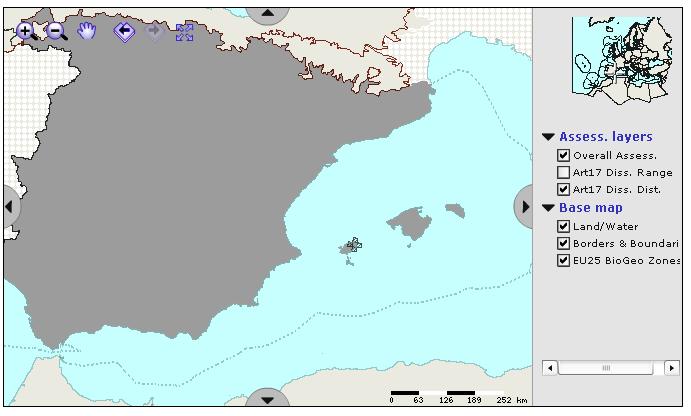
The website which houses the Article 17 reports is, well, complicated, but well worth exploring. The most interesting bit from an agrobiodiversity perspective is the page from which you can get species reports. These include all kinds of information about the status of those “species considered to be of Community interest,” country by country (there’s also an overall summary). Some of these species “of interest” are crop wild relatives such as Allium grosii, an endemic to the Balearic Islands (click the map to enlarge it).
There’s a few more CWRs in those annexes, though not all that many. A Hungarian Pyrus, for example. Any chance to get a few more on there? The bureaucratic infrastructure and mechanism for regular monitoring and early(ish) warning of any threats would seem to be well and truly in place, European Union-style.