- Cytotaxonomic investigations to assess diversity and evolution in Amorphophallus Blume ex Decne. (Araceae). Out of 25 accessions and 7 wild species, “A. dubius may be the immediate ancestor of cultivated forms.”
- Physiological phenotyping of plants for crop improvement. High-throughput phenotyping is only the start.
- Geographic origin is not supported by the genetic variability found in a large living collection of Jatropha curcas with accessions from three continents. 900 global accessions fall into 2 genetic groups, but not related to geography.
- Genetic diversity of donkey populations from the putative centers of domestication. Sudan and/or Yemen.
- Genetic and Biochemical Evaluation of Natural Rubber from Eastern Washington Prickly Lettuce (Lactuca serriola L.). I look forward to seeing those rubber lettuce plantations.
- An approach on the in vitro maintenance of sugarcane with views for conservation and monitoring of plant nuclear DNA contents via flow cytometry. It’s possible to conserve sugarcane in vitro, but it won’t be straightforward.
- Geographical Gaps and Diversity in Deenanath Grass (Pennisetum pedicellatum Trin.) Germplasm Conserved at the ICRISAT Genebank. 194 provinces in 21 countries? That’s a lot of gaps.
- Realizing access and benefit sharing from use of genetic resources between diverging international regimes: the scope for leadership. As supplied by Norway, that is.
- Classification of seed storage behaviour of 67 Amazonian tree species. 1000-seed weight and seed moisture content at shedding are good, together, at predicting seed storage behaviour.
- Genetic Diversity and Population Structure in a Legacy Collection of Spring Barley Landraces Adapted to a Wide Range of Climates. 10 climatic clusters.
- Assessment of genetic variation within a global collection of lentil (Lens culinaris Medik.) cultivars and landraces using SNP markers. Geographic pattern for commercial varieties, but not for landraces.
- Omne Ignotum pro Magnifico: characterization of commercial Bilberry extracts to fight adulteration. That would be Vaccinium myrtillus. You need to keep a sharp eye on the whole production process.
- The Contribution of the Solanaceae Coordinated Agricultural Project to Potato Breeding. It boils down to the Infinium 8303 Potato SNP Array, and it’s contribution to potato breeding has apparently been important.
- Horses as Sources of Proprietary Information: Commercialization, Conservation, and Compensation Pursuant to the Convention on Biological Diversity. You need a value chain with “a sequence of proprietary rights agreements governed and regulated by both tangible and intangible property regimes.” Well, yeah.
Nibbles: CWR conservation, Small farms & food security, iPlant, Forgotten edibles, James Wong, Google Earth Pro, Wageningen course, Journalism fellowship, Vavilov-Frankel
- Draft technical guidelines from FAO on conserving crop wild relatives at national level.
- Small farms are beautiful.
- Finding the climate adaptation needle in the genomic haystack. Hint: supercomputers needed. DivSeek alerted?
- Emma Cooper asks: “…have you got a favourite ‘forgotten’ edible plant that you’d like to champion?”
- James Wong talks about that kind of thing too, and much else garden-related besides, on his new website.
- Rejoice, Google Earth Pro is now free!
- Wageningen UR course on Food For All.
- UC Berkeley Graduate School of Journalism is offering ten $10,000 postgraduate Food and Farming Journalism Fellowships. ‘Nuff said.
- Speaking of fellowships: the 2015 call for Bioversity’s Vavilov-Frankel Fellowship is open.
- Possible new Cannabis species from Australia: watch them do the DNA work and spoil it. Gap analysis, anyone? … As you were, didn’t need DNA after all.
Brainfood: Garden pollinators, Herbarium Analytics, Rice & nutrients, High altitude barley, Sunflower hybrids, Coconut pollen cryo, Evolution & dormancy, Evolution of C4, Maize landraces, Viruses
- Culturally valuable minority crops provide a succession of floral resources for flower visitors in traditional orchard gardens. Proper gardens better for pollinators than unmanaged plots.
- Trends in access of plant biodiversity data revealed by Google Analytics. No impact of social media on the use of plant data, and the future is mobiles.
- Worldwide Genetic Diversity for Mineral Element Concentrations in Rice Grain. Most, though not all, elements showed high heritability, which is good news for breeders.
- Agriculture facilitated permanent human occupation of the Tibetan Plateau after 3600 BP. No barley, no Tibetans.
- Seed fates in crop-wild hybrid sunflowers: crop allele and maternal effects. Having wild mothers helps wild-crop hybrids survive in the wild.
- Coconut (Cocos nucifera l.) pollen cryopreservation. Eureka!
- The evolution of seed dormancy: environmental cues, evolutionary hubs, and diversification of the seed plants. More dormancy, more speciation.
- The evolutionary ecology of C4 plants. C4 opens new niches, but it’s all a matter of contingency and you have to follow the whole evolutionary history of a group to understand its current ecological strategy.
- A Minor Role for Environmental Adaptation in Local–Scale Maize Landrace Distribution: Results from a Common Garden Experiment in Oaxaca, Mexico. It’s the social factors, stupid.
- Crop immunity against viruses: outcomes and future challenges. PAMP (pathogen-associated molecular patterns)-triggered immunity (PTI) may be the future.
A natural experiment with Peruvian potatoes
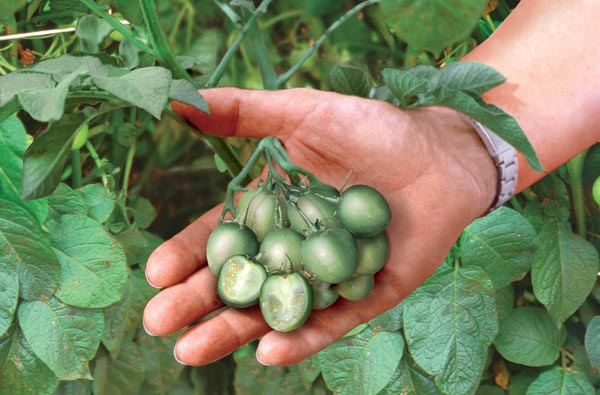
Potatoes are generally propagated vegetatively, by planting tubers. In English, these tubers used for planting are, unfortunately, referred to as seed, which they obviously aren’t, at least not in the botanical sense. Potato breeders use sexual reproduction and the resulting real seeds (extracted from the tomato-like potato fruits) to generate new varieties. The fabled potato diversity of the Andes probably originated from seeds arising from spontaneous crosses among landraces and with their wild relatives, and alert farmers that kept some of the offspring occurring in their fields. But when and where were Andean potato varieties formed? And is this type of evolution still going on?
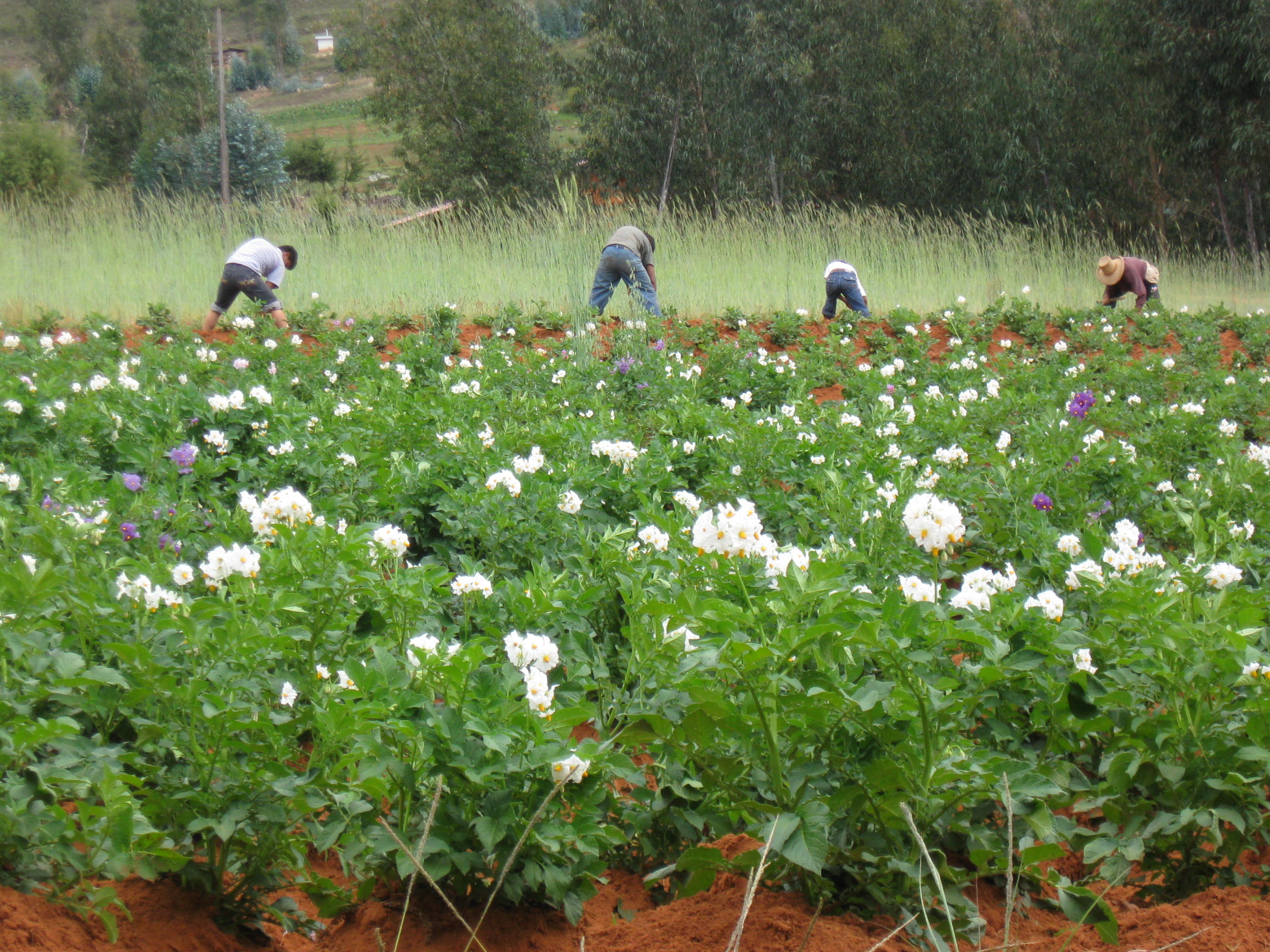
Marc Ghislain and colleagues 1 took advantage of a natural experiment in Peru to investigate whether new varieties have arisen from crosses between ‘Yungay’, and other varieties. Yungay 2 is one of the varieties of the famous Peruvian potato researcher Carlos Ochoa, produced by crossing native and exotic potatoes (from Europe, the USA, and Chiloe). Because it is genetically rather distinct from native Peruvian varieties (here is its pedigree), Ghislain and colleagues were able to use genetic markers (SSRs, in fact) to determine if a given potato variety in a farmer’s field might be an offspring of Yungay.
They looked at the DNA of 1771 leaf samples from more than 400 potato varieties growing in areas where Yungay is also grown. None of the potatoes sampled could plausibly be identified as a descendant of Yungay.
The authors’ motive was to find out whether transgenes from genetically modified potatoes might ‘pollute’ native diversity. I am more interested in the question of whether farmers are still finding, keeping and spreading new varieties from spontaneous seedlings. That would seem likely, but there appears to be no good evidence that they do so. We know that hybridization among potato cultivars, and with wild species, occurs under field conditions, but what happens to the offspring? Ghislain and his colleagues suggest that hybrids may not be adapted, and thus die off, citing research carried out in the rather unforgiving climate of Puno, and that farmers discard hybrids because they prize the quality of native varieties. But I am not convinced by that argument. Clearly, many hybrids will not make the cut, as in any breeding program, but some novelty must surely be of interest to local farmers, as it obviously has been in the past.
Is keeping new potato varieties a cultural practice that has been lost? And are most current native potato varieties therefore old, perhaps very old? Or is the process still going on, perhaps even at a similar rate as before, but the chance of detecting it is small? I wonder if there is some sort of clock that can be used to measure how old a variety is. After all, a variety is really an individual clonally propagated plant. And some potato varieties are thus of course much larger organisms than those molds that occasionally hit the headlines; each year there are about 10,000 ha of Russet Burbank in the USA alone.
Unless there is simply something wrong with Yungay’s offspring (which would make it a bad variety to use for this type of research), my guess is that there are hybrids with Yungay out there, but not many, and that they are just very hard to find. Only very few novel varieties may be good enough to spread beyond a farm to a much larger area, such that we are likely to detect them. But a transgene hybrid could have better odds than most.
Super bananas in the dock
The Gates Foundation has sunk $15 million into developing GMO ‘super bananas’ with high levels of pre-Vitamin A, writes Adam Breasley. But the project is using ‘stolen’ genes from a Micronesian banana cultivar. And what exactly is the point, when delicious, popular, nutritious ‘red bananas’ rich in caroteinoids are already grown around the tropics?
That provocative lede to an article in The Ecologist provoked a number of responses when I posted it on Facebook 3. As not everyone can post comments there, and nobody at all can post comments at The Ecologist, I’ve decided to move the whole thing here.
A couple of comments were actually questions. Anastasia Bodnar asked: Are the existing red banana cultivars suitable for growing where this new variety is intended to be grown? And Sarah Hearne added: And do the red bananas have the same farmer/consumer acceptance in East African and beyond as existing varieties? Good questions all. And Alexandra Zum Felde addressed them, and more, in her comment:
Red bananas — at least ones like those in the photo, not Fe’i bananas — can and are grown where Cavendish are grown (so basically all over the tropics), though they — like many traditional cultivars — are not as productive as Cavendish bananas. But Cavendish are not the issues here — in Uganda the staple banana is Matooke (East African Highland Banana), of which over 180 cultivars exists … and all of which are pretty beta-carotene poor … but local leafy vegetables are full of (pro)vitamins! It would be easier and more cost-effective to re-vamp the image and attractiveness of traditional foods, than to introduce one single GMO variety.
So, are red bananas, whether traditional cultivars or the ones genetically engineered in an Australian lab, the wrong answer to the right question? Discuss.