- Diversifying crop production for the SDGs: the view from AVRDC.
- Local bread, in India and Istanbul.
- Foresters get all genetic.
- Winning the battle against citrus greening in Florida.
- Yeah, so what happened in Marrakech?
- Do chickpeas really have the nutritional value of cardboard?
- An apple genebank a day…
- Drawing the International Year of Quinoa to a decorous close.
Brainfood: Pre-breeding, Wheat in Ethiopia, CAP & minor crops, IITA germplasm management, Cassava improvement, B73 maize inbred, Livestock uses, Range expansion, Sustainability standards, Soybean origins, Popping sorghum
- Evolving gene banks: improving diverse populations of crop and exotic germplasm with optimal contribution selection. Crop genebanks should learn from livestock breeding.
- Ethiopian wheat yield and yield gap estimation: A spatially explicit small area integrated data approach. You can explain 40% of the variation in wheat yield without leaving your office.
- Land Use, Yield and Quality Changes of Minor Field Crops: Is There Superseded Potential to Be Reinvented in Northern Europe? The CAP has been really bad for minor crops in Finland.
- Navigating international exchange of plant genetic resources amidst biosecurity challenges: experiences of IITA in Africa. Genebanks need to work closely with people who know about phytosanitary rules.
- Rooting for cassava: insights into photosynthesis and associated physiology as a route to improve yield potential. Canopy structure and architecture could do with improvement. No doubt IITA are working on that.
- Genetic variability within accessions of the B73 maize inbred line. Is greater than it should be.
- Using Rare Breeds in Animal-Assisted Activities: A New Model Proposed at the “Animal Farm” in Ladispoli (Rome, Italy). Worthy effort, terrible name.
- Adaptive and non-adaptive evolution of trait means and genetic trait correlations for herbivory resistance and performance in an invasive plant. When plants are released from pressure from natural enemies, they gradually lose resistance to herbivory and perform better, but independently.
- How Can High-Biodiversity Coffee Make It to the Mainstream Market? The Performativity of Voluntary Sustainability Standards (VSS) and Outcomes for Coffee Diversification. Apparently, it can’t, not without changing its flavour.
- Genetic diversity center of cultivated soybean (Glycine max) in China – New insight and evidence for the diversity center of Chinese cultivated soybean. Here. But not only.
- Heritability of Popping Characteristics in Sorghum Grain. You can breed for popping quality, but environment also has an effect.
Nibbles: Cryoconservation, Barley history, Beer in UNESCO, Future crops, Pacific crops, Ag & biodiversity, Sequencing NUS, Market education, Mauritanian camels
- Cryo congress coming.
- Ancient farmers enjoyed a beer…
- …and now we all can.
- Yeah but what’s next in the improvement pipeline?
- CePaCT: The Video.
- Why can’t we all just get along?
- Genetic maps are from Mars, nutrition is from Venus…
- Using markets to teach biodiversity.
- The end of camel herding?
Why mixtures do well
I bring you a nice photo, and even nicer quote, from Salvatore Ceccarelli’s Facebook page today. Salvatore has blogged for us in the past about his work on variety mixtures.
In 2008, at ICARDA, we dusted off the old idea of evolutionary breeding to bring biodiversity back into farming systems. We made large, widely diverse populations of barley, bread wheat and durum wheat by mixing lots of F2 lines. And I mean lots: 1600 in the case of barley, 2000 in the case of bread wheat and 700 for durum wheat. The populations went to different countries, including Jordan, Algeria, Eritrea, Iran, and lately even Italy. In Ethiopia, a specific population was made based more specifically on Ethiopian germplasm.
A few days ago Salvatore was examining this particular mixture of 217 durum wheats on a farm at Geregera, in the region of Gonder, Ethiopia.
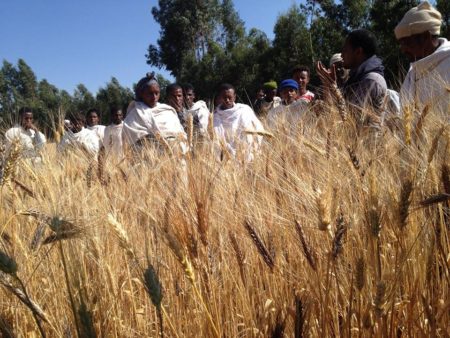
The farmer responsible for the mixture is the one at the extreme right of the photo (the guy talking, just to his left, is the student who sowed the experiment). This is how the farmer described what’s going on in his field.
In a mixture, plants are jealous of one another and try to be better than their neighbours, and the result is that the whole field is better.
And you can see what he means, although unfortunately it doesn’t seem to apply to humans.
Nibbles: Two conferences and a breeding
- Conference: Known, forgotten and lost grains, Symposia of Greek Gastronomy, Crete, next summer.
- Conference: Crop Diversification in a Changing World – Mobilizing the green gold of plant genetic resources, Eucarpia, Montpellier, next spring.
- Breeding the kale of the future, which, it seems, might be less like kale.