- Biological collections under pressure.
- And mobile phones probably wont help. Much.
- Chilean pisco? Really?
- The end of cooking?
- Sericulture on the Silk Road.
- ILRI is 40, did we say? Not sure what they do on sericulture. No doubt somebody there will tell us. They’re social networking machines over there.
- Watch out, ILRI, Silicon Valley is coming for ya.
- One of the reasons why we need livestock research: deforestation.
- I like any article with the word nexus in the title.
- The landscape approach meta-analyzed to within an inch of its life. Bottom line: it’s the women, stupid!
- The power of the people’s potatoes.
- A secret herb garden revealed. I hope they install CCTV.
- Kana’tarokhónwe. Yep, clickbait, but worth it, trust me. And then scale the thing up.
- How to do climate-smart agriculture in Latin America and the Caribbean, country by country.
- Oh no, yet another article on that Himalayan Viagra caterpillar fungus thingy.
- Boffins resurrect 700-year-old fungus from reindeer crap.
- Indian rice breeders talk about their cool new basmati.
Nibbles: Cannabis, Brachiaria, Grasslands, Oryza, Taxonomy resources, Artocarpus, Quercus, Zea, MAS, GBIF
- “Something researchers are looking at is which cultivars, or strains, of hemp are best for the various uses — fiber, oil, nutrition, etc.” Love that etc.
- Speaking about grass: Brachiaria goes home, to wild acclaim.
- Did someone say wild? Wild grass needs help!
- Rice is a grass. Oh my yes.
- How to keep up to date with taxonomic research online.
- Pacific Regional Breadfruit Initiative gets an award.
- You can also make flour from acorns.
- And maize: what’s a grit?
- Greenpeace touts MAS.
- Next thing you know they’ll be singing the praises of Big Data. Yeah, maybe not.
Lots of talking out there
In the interest of completeness, I should mention that the International Rice Congress is competing for the attention of us all with a couple of other shindigs:
- 12th Asian Conference and Expert Consultation on Maize for Food, Feed, Nutrition and Environment Security #12AMC
- 6th All Africa Conference on Animal Agriculture #AACAA
You pays your money…
Green Revolution 2.0
At 1:10 in the afternoon of 31 July 2008, ignoring the advice of his neighbors, Mr. Pal made the decision not to plow under his severely ravaged and sick-looking rice crop. His field had been submerged for 17 days from two floods.
And that is when the second Green Revolution began, according to Dr Bob Zeigler, DG of the International Rice Research Institute (IIRI). Read more about it on his blog. 1 And follow developments at the International Rice Congress, including on Twitter. As for me, I’d like to speed up that GR 3.0.
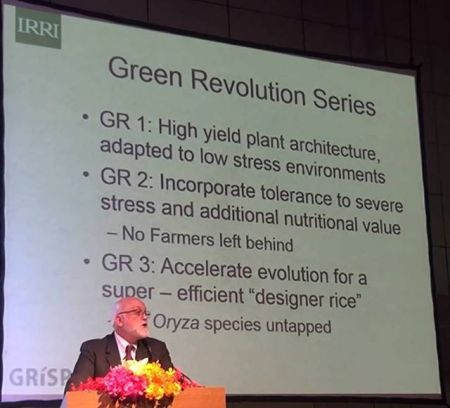
And if Dr Zeigler wants to know where those untapped Oryza species are to be found, I know where he should look.
Brainfood: Filipino rice synonyms, Jatropha breeding, Polish oats, Amazonian peppers, Wild lentils, Indian pigeonpea, Russian peas, Pulse markers, Wild pollinators, Phenotyping platforms, Almonds & peaches, Cerrado roads, Arboreta conservation
- Multiplex SSR-PCR analysis of genetic diversity and redundancy in the Philippine rice (Oryza sativa L.) germplasm collection. 427 rice accessions in the national collection with similar names resolve to about 30 unique profiles. I think. The abstract is a little hard to follow, and that’s all I have access to.
- Quantitative genetic parameters of agronomic and quality traits in a global germplasm collection reveal excellent breeding perspectives for Jatropha curcas L. 375 genotypes, 7 locations and 3 years get you quite enough data to plan a decent breeding programme.
- Studies on genetic variation within old Polish cultivars of common oat. Forward into the past.
- Morphoagronomic peppers no gender pungent Capsicum spp. Amazonia. Actually nothing to do with gender. That’s a mis-translation of “genus,” if you can believe it. Paper basically says that Amazonian peppers are really variable, which is not as interesting as it might have been.
- Global Wild Annual Lens Collection: A Potential Resource for Lentil Genetic Base Broadening and Yield Enhancement. The core collection of wild annuals (which is actually a somewhat novel concept) comes mainly from Turkey and Syria, and it’s got diversity that’s not in the cultigen.
- Pigeon pea Genetic Resources and Its Utilization in India, Current Status and Future Prospects. Indian genebank evaluates the ICRISAT core and mini-core. Then does some mutation breeding :)
- Molecular genetic diversity of the pea (Pisum sativum L.) from the Vavilov Research Institute collection detected by the AFLP analysis. Molecular data does not correspond with subspecies nor ecogeographic groupings. Back to the drawing board.
- Characterization of microsatellite markers, their transferability to orphan legumes and use in determination of genetic diversity among chickpea (Cicer arietinum L.) cultivars. Chickpea SSRs are ok for other, less studied, crops too.
- From research to action: enhancing crop yield through wild pollinators. Go wild.
- Integration of phenotyping and genetic platforms for a better understanding of wheat performance under drought. You really need managed environment facilities. Didn’t a paper in Brainfood last week say what you needed was a network of field sites? I guess you need both.
- Wild almonds gone wild: revisiting Darwin’s statement on the origin of peaches. He was not entirely wrong.
- The role of roadsides in conserving Cerrado plant diversity. 70% of species is not bad, I guess. No word on whether that includes wild peanuts, but I suspect yes.
- Do living ex situ collections capture the genetic variation of wild populations? A molecular analysis of two relict tree species, Zelkova abelica and Zelkova carpinifolia. Yes and no. But this is in botanic gardens and arboreta, what about seedbanks? The cerrado people want to know…