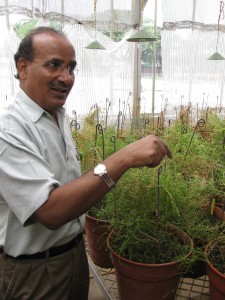
 Congratulations to Dr Hari Upadhyaya, head of the ICRISAT genebank, on being awarded the Frank N. Meyer Medal for Plant Genetic Resources by the Crop Science Society of America. If you’re going to the award breakfast, you’ll be able to hear Hari talk in person about “Crop germplasm to overcome challenges to global food and nutritional security.” If you’re not going, here’s a taste of what you’ll be missing. Well done, Hari!
Nibbles: ICRAF meet, Genome meet, Websites redux, Breadfruit video, Livestock project, Data, Kansas wheat, Chief scientists pontificate, Medieval melons, Peruvian foodiness, Whiskey
- ICRAF are having their Science Week. Follow it on Twitter. And let us know if you’re there and want to write about anything agrobiodiversity related that comes up.
- Plant Genome Evolution 2013 has been and gone, alas, but Chris Pires has storified the whole thing, pretty much. Lots of crops in there. But it’s disappeared now, of course.
- Bioversity and FAO redesign their websites. Tell them what you think.
- Diane Ragone talks breadfruit. With video goodness.
- Aussie researcher talks about landing Gates grant to improve African livestock. Hopefully some conservation in there somewhere.
- Decentralizing data: to empower communities; and to empower geeks.
- Data, you said? Here’s data on why Kansas needs wheat breeders.
- The world’s chief agriculture scientists want to share genetic resources. Good of them.
- Europe used to have more melons.
- Enough with the Peruvian superfoods meme, please.
- I may have said this before, but it’s still valid: I need a drink.
Nibbles: Coca, Rice breeding, Artisanal cheese, Win win, Microbes, Potato dyes, Beans, Agroforestry & conservation, Sweet potato marketing
- Bolivia ramps up coca production. Sniff.
- Tamil Nadu ramps up rice breeding.
- Bulgaria ramps up artisanal cheese production.
- Collaboration between organic and biotech ramped up. In other news, pigs fly.
- Ramp up use of microbes, microbiologist says. Nobody surprised.
- Americans ramp up production of purple potatoes.
- Everyone ramps up bean production. To save the planet, no less.
- Can agroforestry be used to ramp up tree conservation? Well, maybe?
- Need to ramp up sweet potato marketing.
Brainfood: PGR commons, Tomato GWAS, Mango pollen, Grapevine cryo, Synthetic wheat diversity, Wild lettuce diversity, Indian homegardens, Ghats agrobiodiversity, Indian cattle, Wild potato genecology, Composite genomics, Conservation targets
- What kind of goods are plant genetic resources for food and agriculture? Towards the identification and development of a new global commons. Exclude non-Parties to the ITPGRFA from access, and get all Parties to make up-front financial contributions are the recommendations that most grabbed my eye.
- Genome-Wide Association Studies Using Single Nucleotide Polymorphism Markers Developed by Re-Sequencing of the Genomes of Cultivated Tomato. Markers for important agronomic traits identified. Now to use the little buggers.
- Low temperature storage of mango (Mangifera indica L.) pollen. Good to know for these recalcitrant things.
- Cryopreservation of grapevine (Vitis vinifera L.) in vitro shoot tips. Another triumph for droplet-vitrification.
- Evaluation of Morphological Traits Diversity in Synthetic Hexaploid Wheat. But is it novel?
- Wild Lactuca species, their genetic diversity, resistance to diseases and pests, and exploitation in lettuce breeding. It is novel, but can be difficult to use.
- Homegardens as a distinct agro-ecological entity in Kerala: Its biodiversity, structural dynamics and environmental significance. They are becoming more and more important as refuges for biodiversity, but need policy support.
- Probable Agricultural Biodiversity Heritage Sites in India: XVII. The South-Central Region of Eastern Ghats. And not a homegarden to be seen.
- Genetic diversity and relationship of cattle populations of East India: distinguishing lesser known cattle populations and established breeds based on STR markers. Just because it’s not officially recognized as such, it doesn’t mean it’s not a breed.
- Reproductive ecology and genetic variability in natural populations of the wild potato, Solanum kurtzianum. Sexual reproduction, insect pollinator behaviour and seed dispersal by storm water channels make for more diversity within than between populations, and more besides.
- Genomics of Compositae crops: Reference transcriptome assemblies, and evidence of hybridization with wild relatives. Self-incompatibility and post-zygotic isolation makes for crops that are generally more different from their wild relatives.
- Consequences for diversity when animals are prioritized for conservation of the whole genome or of one specific allele. Basically, you can’t do both.
Nibbles: Industrial diversity, Forget feed the world, Vegetable evolution, Housekeeping
Slightly extended, slightly fewer edition
- Corn (maize) and soybeans are the bogeymen of industrialised, monocropping agriculture, striking fear into the heart of biodiversity lovers everywhere. But, surprisingly, in the US, more than half the production comes from farms that grow at least two other crops. For real specialisation, you need to look at hay and rice. Big tip of the hat to Big Picture Agriculture for that one.
- And yet, corn and soybeans power the rhetoric of “US farmers feed the world,” despite more than 40% of US corn ending up as ethanol. (See what I did there?) Anyway, Margaret Mellon at the Union of Concerned Scientists thinks its time to move beyond that unhelpful phrase. “It is time,” she says, “to separate the issues of hunger alleviation and crop production.” It is way beyond time, I say.
- And then there’s this: “More Vegetables Evolving Chocolate-Sauce-Filled Centers As Evolutionary Imperative.”
- And we’re feeling an evolutionary imperative to shift this particular parasite to a new host. We’ll be attempting to do so over the weekend. With luck, you won’t notice a think when we resume on Monday. See you then.