- “Times are hard; everybody wants more (but seems to be getting less…)…”
- “The panels will produce enough energy to power all of the bank’s seed stores.”
- “One of the Benefit-sharing Fund’s unique features is the transparent process that governs the allocation of funds. After a wide announcement of each call, all the project proposals received for funding are evaluated according to established scientific criteria by international experts in order to fund the best projects.”
- “Basically we’re going to add bullets (siRNA) to the plants’ defense arsenal. It’s science fiction right now, but if it works, then the lengthy, expensive cleanup process could be shortened to two minutes.”
- “A new website provides examples of policies, institutions and stakeholders involved in the management of zoonoses, collated in a meta-database, together with discussion of cross-cutting themes and case studies to illustrate potential approaches.”
- “…the polka-dotted pumpkins were a hit.”
- “We all know this wasn’t the meeting where world governments were going to rise from the ashes.”
- “The tradition of micro-beekeeping has completely disappeared.”
- “No one buys beans, but they do buy cilantro.”
- “Teaming up with Alex Thanthriarachchi, 62, a reformed militant Marxist, Wijertane is on a mission to promote indigenous varieties of rice and other staples as the best way for Sri Lankan farmers to deal with changing climate.”
- “As a metaphor for itself, the treaty is the seed that is there and has been planted. It now needs to be used by all countries in order to keep sustaining life.”
Nibbles: Beef, Dairy, Resilience and vulnerability, Seed systems, Irony beans, Genebanks in the news, Catch a fire, Amazon, Spanish gardens, Conservation, Work exchange
- What is the best beef in Europe?
- When was the first yoghurt of the Neolithic?
- How do you measure smallholder resilience? Or vulnerability, for that matter…
- How does this Kenyan seed story differ from this Malian one?
- How do you address iron deficiency in Rwanda?
- What’s the value of a genebank?
- There’s a downside to plant-derived smoke?
- So what’s the latest paradigm shift on that ancient-people-in-the-Amazon thing?
- How are the Spanish people coping with the crisis?
- How come those transcribed podcasting, medal winning conservationists still don’t get it?
- What are Ethiopians doing in Amazonia?
Nibbles: MCPD, Coffee pollination, WACCI & IITA get into bed, Quinoa value addition, Plant chemicals
- Rejoice, the new edition of the FAO/Bioversity Multi-Crop Passport Descriptors (MCPD) are now available on-line!
- Pollinators good for pollination shock. No, kidding apart, this is Pollinator Week and we should take note.
- Another step in building plant breeding capacity in West Africa.
- How to get quinoa cake on the menu of posh Bolivian coffee shops.
- Virtual tour of my old stomping ground at the Cambridge University Botanical Garden includes a chemical trail. Which alas does not in turn include the main chemical we used to consume there.
An opportunity to see plant breeding history
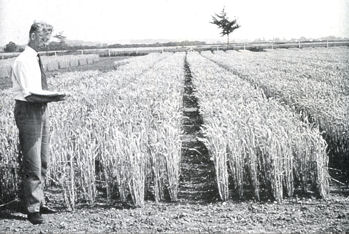
Even more interesting, frankly, is a living exhibition …
… made up of some of the 130 varieties that, over the last century have driven UK agriculture. ‘Yeoman’ wheat, introduced in 1916, was a landmark variety, showing that high-yielding, good baking-quality wheat could be bred and successfully grown in Britain. ‘Proctor’ barley led to a tripling of UK barley production. ‘Maris Piper’ potatoes were introduced in 1963 to be resistant to nematodes and are still a leading potato variety today. By the time of its privatization almost 9 in 10 of the varieties of cereal crops being grown in the UK had been developed by PBI.
That will surely be a sight to see. I wonder, though, whether the John Innes Centre could be persuaded to have some of the resultant crops analyzed for their nutrient content. Varieties bred at different times, and grown side by side under experimental conditions, are sorely needed to investigate declines in nutrition.
Brainfood: Molecular adaptation, Chicken genetic resources databases, Cacao diversity, Pistacia molecular diversity, Glycene diversity, Sheep breeding, Bt cotton, Argan oil
- Broad-scale adaptive genetic variation in alpine plants is driven by temperature and precipitation. AFLP variation linked to precipitation and temperature across 13 Alpine species.
- Current state of knowledge on indigenous chicken genetic resources of the tropics: domestication, distribution and documentation of information on the genetic resources. There are three relevant databases on chickens, and yet…
- Genetic diversity and parentage in farmer varieties of cacao (Theobroma cacao L.) from Honduras and Nicaragua as revealed by single nucleotide polymorphism (SNP) markers. 70 SNPs enough to confirm 5 morphological groups, but also pick up the odd synonym.
- Molecular diversity and phylogenetic relationships of Pistacia vera, Pistacia atlantica subsp. mutica and Pistacia khinjuk using SRAP markers. The species are pretty good.
- Biofortified, selenium enriched, fruit and cladode from three Opuntia Cactus pear cultivars grown on agricultural drainage sediment for use in nutraceutical foods. It pays to grow prickly pear on crappy soil.
- Hotspots of diversity of wild Australian soybean relatives and their conservation in situ. Looks like it’s Kimberley.
- Community-based alternative breeding plans for indigenous sheep breeds in four agro-ecological zones of Ethiopia. They’re ok, but you do have to keep good records.
- Diverse genetic basis of field-evolved resistance to Bt cotton in cotton bollworm from China. Gene jockeys need to go back to drawing board. No, wait.
- Bioactive compounds and nutritional significance of virgin argan oil–an edible oil with potential as a functional food. Jolly high in just about everything that’s good for you, more research needed, yada yada yada.