- Brussels sprout variety lost and found in Wales. Alas, it’s an F1. Start breeding now.
- Mice destroying Australian sorghum. Pied Piper unavailable for comment.
- Impact of prices in Ethiopia.
- Impact of prices in Kenya.
- Impact of prices in Latin America.
- Biofuels not to blame for food price rises. Fatuous, Jeremy comments.
- Uttar Pradesh State Biodiversity Board steps in to save rare Indian gooseberry. Is this it? Doesn’t seem rare.
- Pitaya explained. Check out the links too.
- “Picture it, an orange grape!” No thanks.
- The Economist on the CAP. Money quote: …if Europeans want to produce food in a special region or way, “let them label it, and see if the market will pay for it.â€
- Speaking of which. British wine industry in trouble. You heard me.
- Other fruits not doing well either. Via.
- Royal Ploughing Ceremony goes well in Cambodia. That’s all right then.
- On the other hand, there may be something to this traditional knowledge stuff after all.
Reindeer domestication
From our occasional contributor Michael Kubisch.
Reindeer have been domesticated by denizens of the Northern hemisphere for some time – but exactly for how long and whether domestication occurred at different sites or only once has been the matter of some debate. Estimates of how long ago domestication might have happened have ranged from as long as 20,000 years ago to as little as 3000. Part of the problems stems from the lack of archaeological records that could pinpoint a more exact time frame. The evidence for the shorter period relies mostly on ethnographic observation, such as the development of certain implements (for example saddles) that early reindeer herders developed apparently after contact with other people of the central Asian steppes.
But did domestication happen more than once? A recent paper by a group of researchers from Oslo sheds some light on this question. After analysis of a number of DNA markers they conclude that the Sami people of Northern Scandinavia domesticated reindeer independently from indigenous people in what is now Russia. Moreover the evidence points to the existence of three distinct gene pools suggesting that domestication even within Russia may have occurred more than once.
And there is another interesting observation: comparisons with gene markers from wild reindeer suggests that introgression of “wild” genes into domestic reindeer appears to have happened quite frequently through the ages, but that only some of the wild populations have made genetic contributions suggesting perhaps different propensities for domestication among animals of various wild herds.
Unfortunately there is increasing concern about the future of reindeer agriculture. The Sami herders, who live in Scandinavia, Finland and parts of Russia, are beginning to feel the effects of global climate changes. The rapid warming trend that seems to occur in the Northern hemisphere interferes not only with foraging but also with the ability to move animals across what used to be solid ice. And many Sami now fear not only the loss of their livelihood, but also the disappearance of a substantial part of the culture, which has always been intricately linked to reindeer. Â
Avocado domestication and iconography
I took advantage of the thirteen hour flight to Lima to catch up on some reading, including a recent paper reviewing the state of knowledge on avocado diversity and domestication. 1 The authors postulate that avocado exploitation began in Central Mexico with the gathering of fruits from the forest, possibly as long ago as 8000 BC. Then, when the climate changed for the worse around 4500-2000 BC, people began to tend and cultivate the tree in forest gardens. The final phase was one of intensive cultivation in homegardens and active dispersal around the region and into South America.
That’s all very interesting, but the thing that really stuck with me was the observation that the avocado tree is represented on Hanab-Pahal’s sarcophagus from Palenque. Not on the famous “astronaut” lid, however, but on its side. Ten ancestors are seen around the sides of the sarcophagus, arising from a crack in the earth, each with a fruit tree, forming a sort of homegarden around the dead king. Among them is Lady Olnal, and she has an avocado tree. Unfortunately, I couldn’t find a picture of this on the internet. But the reason it struck me is that I’d just been looking at photos of more recent, and geographically somewhat distant, but no less botanical, funerary art. Even in death, people of all ages and cultures like to be surrounded by plants, it seems.
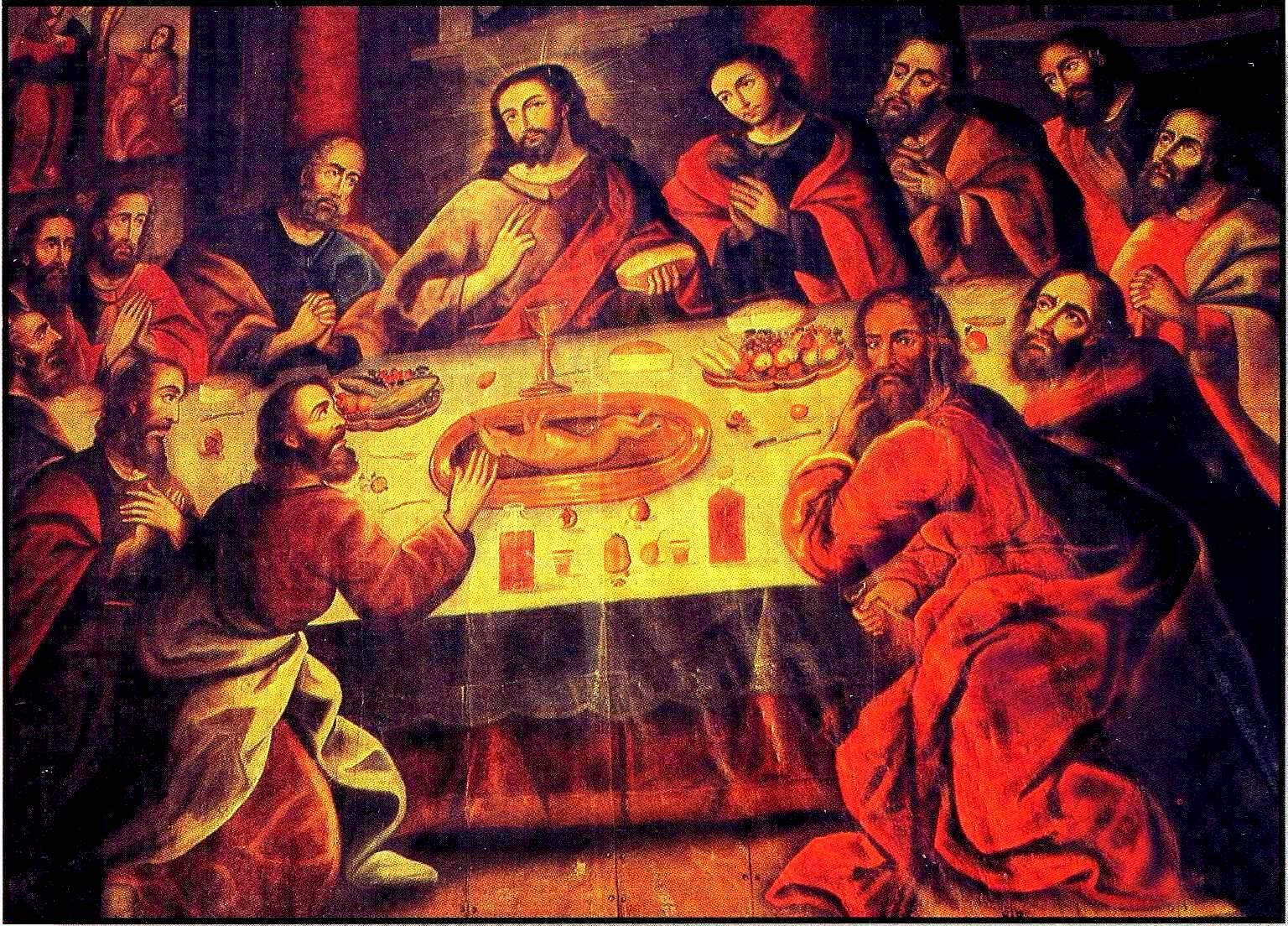
And, being in Peru, all this rumination about art and agrobiodiversity couldn’t help but remind me of Marcos Zapata’s painting of the Last Supper in Cuzco Cathedral (1753). That famously features roast cuy, but check out the thing to the left of the cuy’s head. Is it a maca? What other crops can you identify? Donwload the full-sized version on the photo and see. No avocados, alas.
Nibbles: Crabs, barley, IAASTD, wine, vegetables
- Why fisheries management is so often a failure.
- Climate change threatens beer. Luigi appalled. Via.
- IIED to answer questions raised by IAASTD. Chef comments, “Your alphabet soup is ready now.”
- Not enough Sangiovese in Brunello di Montalcino. Jeremy appalled.
- People in the burbs really into growing vegetables all of a sudden.
Nibbles: Irrigation, drought
- Latest Rice Today map: irrigation around the world. Thanks, Robert.
- Coincidentally, there’s a Science article on the genetics of how plants cope with drought, but it’s behind a paywall.