- Phylogenetic analysis in some Hordeum species (Triticeae; Poaceae) based on two single-copy nuclear genes encoding acetyl-CoA carboxylase. Divides up the Africa/Asia and American clades, but not perfectly.
- Journeys through aroma space: a novel approach towards the selection of aroma-enriched strawberry cultivars in breeding programmes. Breed a better smelling strawberry in this way, and the world will beat a path to your door.
- Strategies for engineering C4 photosynthesis. More than one way to skin a cat. But is it worth doing if you don’t eat cats?
- Uses of tree saps in northern and eastern parts of Europe. Not what it used to be.
- Resequencing rice genomes: an emerging new era of rice genomics. Maybe. But it would have been better if they had sequenced something other than Nipponbare originally.
- Toward conservational anthropology: addressing anthropocentric bias in anthropology. “Traditional practices” not always all that great.
- Seed exchange networks for agrobiodiversity conservation. A review. Farmers have to be “well connected” for conservation to work. But nobody really knows what that means.
- Landscape diversity and the resilience of agricultural returns: a portfolio analysis of land-use patterns and economic returns from lowland agriculture. Higher gross margin related positively to greater variance, negatively to diversity, in lowland UK, up to 12000 ha.
- Marker-assisted development and characterization of a set of Triticum aestivum lines carrying different introgressions from the T. timopheevii genome. Getting resistance out of wild relatives and into crops.
- Physical localization of a novel blue-grained gene derived from Thinopyrum bessarabicum. Getting blue pigments out of a wild relative and into wheat.
- Improvement of two traditional Basmati rice varieties for bacterial blight resistance and plant stature through morphological and marker-assisted selection. Getting blight resistance out of an improved variety to improve traditional ones.
- Maintaining or Abandoning African Rice: Lessons for Understanding Processes of Seed Innovation. Farmers play an important role in adopting and developing new varieties shock.
- Dynamic Conservation of Forest Genetic Resources in 33 European Countries. It happens.
- The impact of the Neolithic agricultural transition in Britain: a comparison of pollen-based land-cover and archaeological 14C date-inferred population change. Pollen and archaeology agree on dates, the rest is history.
- Higher levels of multiple ecosystem services are found in forests with more tree species. Swedish production forests, anyway. And more. And more.
European forest community in a frenzy
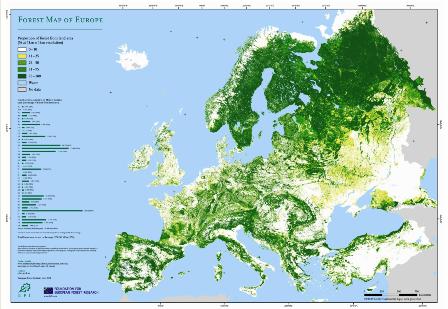 As usual, it never rains but it pours. Within a few minutes yesterday I was pointed by different sources towards the Forest Map of Europe, Tree species maps for European forests, the Condition of Forests in Europe report, a review of Dynamic Conservation of Forest Genetic Resources in 33 European Countries, and a paper on the Uses of tree saps in northern and eastern parts of Europe. Thinking that there might be something in the air, I did a quick search of my RSS feed, and found another very recent review, Translating conservation genetics into management: Pan-European minimum requirements for dynamic conservation units of forest tree genetic diversity. What’s got into the European forest conservation community? Has ash dieback got them all running scared? And is someone going to put all European forest-related maps together somewhere (eg, Eye on Earth)?
Nibbles: Mashua info, Veggies programme, Rice research, Genomes!, Indian malnutrition, Forest map, British agrobiodiversity hero, GMO “debate”, Lactose tolerance, Beer
- New Year Resolution No. 1: Take the mashua survey.
- New Year Resolution No. 2: Give the Food Programme a break, it can be not bad. As in the case of the recent episode featuring Irish Seed Savers and the only uniquely British veg.
- New Year Resolution No. 3: Learn to appreciate hour-plus talks by CG Centre DGs. And other publicity stunts…
- New Year Resolution No. 4: Give a damn about the next genome. Well, actually…
- New Year Resolution No. 5: Try to understand what people think may be going on with malnutrition in India. If anything.
- New Year Resolution No. 6: Marvel at new maps without fretting about how difficult to use they may be.
- New Year Resolution No. 7: Do not snigger at the British honours system.
- New Year Resolution No. 8: Disengage from the whole are-GMOs-good-or-bad? thing. It’s the wrong question, and nobody is listening anyhow.
- New Year Resolution No. 9: Ignore the next lactose tolerance evolution story. They’re all the same.
- New Year Resolution No. 10: Stop obsessing about beer. But not yet. No, not yet.
- Happy 2013!
Nibbles: Rice farming, Funny teas, Funny fruits, Christmas fare, Online course, Seasonal genomes, Malaysia shares, School shares
- The most beautiful rice farm in the world. No, wait.
- Jasmine tea gets protection. But does it need it? Let’s ask the South Africans what they’re doing with their tea.
- Today’s funny fruit picture. Think it’s one of these Cuban mutants?
- How many micronutrients in a Mexican Christmas dinner? And how many in a British one, featuring parsnips of course.
- People’s University has online Appreciation Programme on Sustainable Management of Biodiversity starting January 2013.
- First farmers were first carpenters.
- And today’s genome story is very seasonally appropriate. Oh no, here’s another one!
- Malaysia implements the ITPGRFA. Cool, but why is that even news?
- School sends okra seeds to Haiti. But… No, I’m not playing the Grinch on this one, it’s too sweet.
Nibbles: Manioc gastronomy, Wilting revolution, Turrialba cheese, Conservation and poverty, Beans breeding, Dye plants, Plant Cuttings, Amazon fires, Balm, African silver bullets, Heritage food, Potato politics, Native seed meet
- Cassava gets a makeover in Brazil. And another, of a different kind, in East Africa.
- Revolution turns into Terror. Where’s our Napoleon?
- Designating Costa Rican cheese.
- Conserving poverty?
- No poverty for bean breeders in the US.
- The uses of Oregon Grape. Which is of course not a grape.
- Chaffey Style.
- Coconut water is a major conservation issue for 2013. It says here.
- Fewer farmers, more fires. In the Amazon. It says here.
- Yeah, what is balsam anyway?
- So the Next Big Thing in African ag development is agricultural growth corridors. What could possibly go wrong? Will they learn from wildlife corridors? Will they be using these four apparently key technologies? Or bolstering extension? And will it all mean a decrease in bush meat consumption?
- Heritage foods book. Yummie.
- Like potatoes in Peru, I guess. And various street foods in West Africa.
- Conference on native seed use in the US. Probably even some crop wild relatives in there.