- Cannabis Domestication, Breeding History, Present-day Genetic Diversity, and Future Prospects. The weed is in trouble, man. Just one of the papers in a very special issue of Critical Reviews in Plant Sciences. And for a historical perspective…
- Genomic analyses of primitive, wild and cultivated citrus provide insights into asexual reproduction. Apomixis is down to a “miniature inverted-repeat transposable element insertion in the promoter region of CitRWP.”
- Automated cropland mapping of continental Africa using Google Earth Engine cloud computing. Croplands increased by 1 Mha/yr between 2003 and 2014.
- Genetic diversity and population structure of native maize populations in Latin America and the Caribbean. Three groups: Mexico + southern S. America, lowland Mesoamerica + Caribbean, Andes.
- Phylogeography of the wild and cultivated stimulant plant qat (Catha edulis, Celastraceae) in areas of historical cultivation. Centres of origin in Kenya and Ethiopia, with limited movement between the two, but some hybrids in N. Kenya; the Yemeni stuff came from Ethiopia.
- Process-based modelling shows how climate and demography shape language diversity. If you assume human groups split after reaching a certain population size, and rainfall limits population density, you can predict language diversity in Australia.
- Volatile Compound Profiles of Malus baccata and Malus prunifolia Wild Apple Fruit. Look at the esters.
- Genetic diversity, population structure and association analysis in coconut (Cocos nucifera L.) germplasm using SSR markers. I can’t see much new here. Please, coconut experts, tell me what I’m missing.
- Opportunities for Napier Grass (Pennisetum purpureum) Improvement Using Molecular Genetics. Could do better.
- Heterogeneity as the Basis for Rangeland Management. Gotta mix it up.
- Analysis of genetic diversity of Chinese dairy goats via microsatellite markers. The locally developed breeds are all derived from a single European breed.
- Variation in bean morphology and biochemical composition measured in different genetic groups of arabica coffee (Coffea arabica L.). You can’t use morphology to predict taste.
- Breeding for the improvement of indigenous chickens of Bangladesh: evaluation of performance of first generation of indigenous chicken. I don’t understand this much, but I liked the names of the genotypes: Naked Neck, Hilly and Non-descript Desi.
- Persistence of endophytic fungi in cultivars of Lolium perenne grown from seeds stored for 22 years. It’s a record!
Targeting germplasm in an age of climate change
Let me expand a little on yesterdays’s teaser about the Seedlot Selection Tool.
Say you have an accession of maize, for example, collected 20 years ago, for example, somewhere in the middle the NW zone of Mexico defined by Orozco-Ramírez, Perales & Hijmans (2017), for example.
Say that you’d like to know where you could grow that material 20 years from now.
Say you have a few minutes to learn how to use the USDA’s Seedlot Selection Tool.
This is what you would get, more or less, depending on the details.
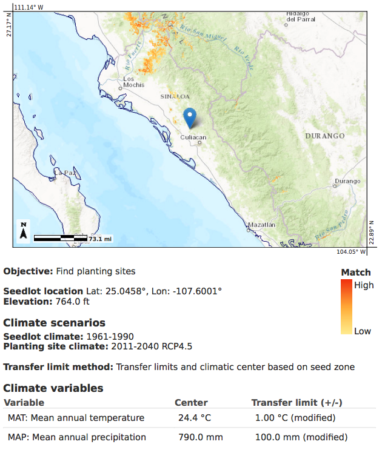
The blue dot is your collecting site, the red bits are the places where that material will be adapted in 2040. And you can run the thing the other way around too. That is, given that you want to grow something in 2040 where that blue dot is now, where would you have to have collected it in the past?
The Seedlot Selection Tool seems to be aimed primarily at forest and landscape managers, but I see no reason why it couldn’t be used in agricultural applications too, as above, subject to the same provisos.
The Seedlot Selection Tool (SST) is a web-based mapping application designed to help natural resource managers match seedlots with planting sites based on climatic information. The SST can be used to map current climates or future climates based on selected climate change scenarios. It is tailored for matching seedlots and planting sites, but can be used by anyone interested in mapping climates defined by temperature and water availability. The SST is most valuable as a planning and educational tool because of the uncertainty associated with climate interpolation models and climate change projections. The SST allows the user to control many input parameters, and can be customized for the management practices, climate change assumptions, and risk tolerance of the user.
Would love to get my hands on a global version.
Deconstructing restoration
Just to remind ourselves that conserved seeds are not just there to be used in breeding, let us “deconstruct symbolic promises of fertility and rebirth carried by domesticated seeds and look at the reality of the seeds that have never been at our service,” think as holistically as we can, and consider taking the MOOC on “Landscape Restoration for Sustainable Development: a Business Approach.” And, if we live in the western bit of North America, let us play around with the USDA’s Seedlot Selection Tool too.
Nibbles: ICARDA genebank, Mexican honeys, NWFP news, Schisandra, Swimming camels, Barley genome, Silly video, Tasty breeders, Tall maize, Praying for the prairie, Rosaceous breeding, Millet fair, Sesame entrepreneurs, Thai gardens, Apple resistance, Native Californians
- Latest on the ICARDA genebank from the author of The Profit of the Earth.
- Honey diversity in Mexico.
- Speaking of which, did we already point to the new, improved Non-wood Forest Products Newsletter?
- The schisandra berry is apparently helping save the panda. Yeah, I never heard of it either, but more power to its elbow.
- Make your day better by looking at pictures of aquatic camels.
- Oh, here we go, cue the endless stream of stories about how genomics will save beer.
- “In the last century, 94% of the world’s seed varieties have disappeared.” No, they bloody haven’t. Only linking to this for completeness.
- Breeders get into flavour. Because celebrity chefs.
- That’s one tall maize plant. No, but really tall.
- The Great Plains are in Great Trouble: “Hundreds of species call the prairie home… A cornfield, on the other hand, is a field of corn.”
- A project dedicated to the genetic improvement of US rosaceous crops. Love that word. Rosaceous.
- Eat those millets!
- Sesame opens doors in Tanzania. See what I did there?
- WorldVeg empowers women through gardening. I know how they feel. Well, kinda.
- Want a Forbidden Apple? You know you do. #resist
- “Accustomed to seeing crops planted in straight rows featuring one or a few different varieties, Muir and his European predecessors were not prepared to recognize this subtler form of horticulture. And so they viewed California Indians as lazily gathering the fat of a landscape they had hardly touched.”
Nibbles: Investing in food, Henna botany, Buckwheat promotion, Mapping India, Optimism, Genetic diversity, Forest cocktails
- Psst, you have any examples of investments for healthy food systems? What do you mean, you don’t.
- Paint it henna.
- Pleading for pseudocereals. In Switzerland?
- Mapping India’s trees. Among other things.
- To save biodiversity, look on the bright side. Easy for you to say.
- The genetic level of biodiversity makes important contribution to ecosystem services. In birds. Right.
- Taste the forest. In cocktails.