- New Zealand supports SPC regional crops and trees genebank in a big way.
- Some of those trees are wild species that contribute to food security, and more must be done to conserve them.
- Some trees are crops of course, like mangoes, and scientists are doing their bit for them in the Philippines.
- Wait, isn’t it too early for the usual BBC saving-the-apple story? Usually comes in the autumn.
- Who needs genebanks when you can inscribe landraces in a National Inventory of Intangible Cultural Heritage.
- Maybe try it with fonio next?
- Or just send seeds into space?
- Maybe including macadamia, or is space not cold enough for them?
Brainfood: Bonds, Agrobiodiversity, Subsidies, Orphan crops, Extension, Biodiversity tourism, Green farming
- Impact investing in biodiversity conservation with bonds: An analysis of financial and environmental risk. Need to show ’em the money, and that ain’t easy.
- The benefits and trade-offs of agricultural diversity for food security in low- and middle-income countries: A review of existing knowledge and evidence. Agrobiodiversity is positively connected with food security in two thirds of cases. Here comes the money…
- Repurposing agricultural support: Creating food systems incentives to address climate change. Less money for subsidies and trade barriers, more money for R&D.
- Orphan Crops: A Best Fit for Dietary Enrichment and Diversification in Highly Deteriorated Marginal Environments. More money for R&D you say? Document the evidence that orphan crops are good for you, link it to policy and communicate it to consumers.
- Extension services can promote pasture restoration: Evidence from Brazil’s low carbon agriculture plan. If only there were more money for extension too, eh?
- Linking livelihood and biodiversity conservation in protected areas: Community based tourism development perspective from developing country. People around protected areas don’t see much money from tourists, but that’s better than nothing.
- From boutique to mainstream: Upscaling wildlife-friendly farming through consumer premiums. Consumers are willing to fork over extra money for greener food.
Nibbles: Eat this tomato, Access to Seeds Index, Tongan coconuts, Grounding the groundnut, Traditional Spain, Genebanks in China and Nigeria, Tree conservation, Sorghum & millet breeding, Iraqi ag, Genebank presentations
- Jeremy gets into tomato domestication and diversity on his podcast.
- The 2021 Access to Seeds Index Insights Report is out, and includes tomatoes.
- What is the most famous place for coconut varieties?
- A new book attempts to decolonize the peanut.
- Blood and water in Spain.
- A tale of two genebanks: China and Nigeria. Maybe the African Union can help? If not, maybe China might.
- Africa needs help with tree planting too. Maybe follow Italy’s example?
- Though maybe sorghum and millet will be ok.
- Send them to Iraqi farmers?
- Presentations on seed conservation and use in genebanks.
Nibbles: Genebanks galore
- A genebank in a California botanic garden.
- A genebank at a university in Georgia.
- A genebank at a university in Wisconsin.
- Genebanks in the CGIAR
- But will all this diversity scale?
A new genebank for the ages is set for ages
Great news from the opening ceremony of the new Future Seeds genebank in Palmira, Colombia on 15 March:
The Bezos Earth Fund pledged US$17 million for Future Seeds, a new CGIAR genebank inaugurated today. The new genebank will bolster global efforts to safeguard the world’s future food supply.
This genebank is truly next-level:
Future Seeds is the most advanced facility in Latin America and is expected to become the first ever platinum-level LEED (Leadership in Energy and Environmental Design)-certified genebank building in the world. Its Data Discovery and Biotechnology Lab will use big-data technologies to mine the genebank using the latest in genetics to document the range of possibly useful traits in the current collection. Other breakthrough technologies across genebanks include drones and robotic rovers, which are helping analyze crop characteristics in the field more rapidly, and the use of artificial intelligence to enable collectors to identify potential biodiversity hotspots in nature.
Here, check it out for yourselves:
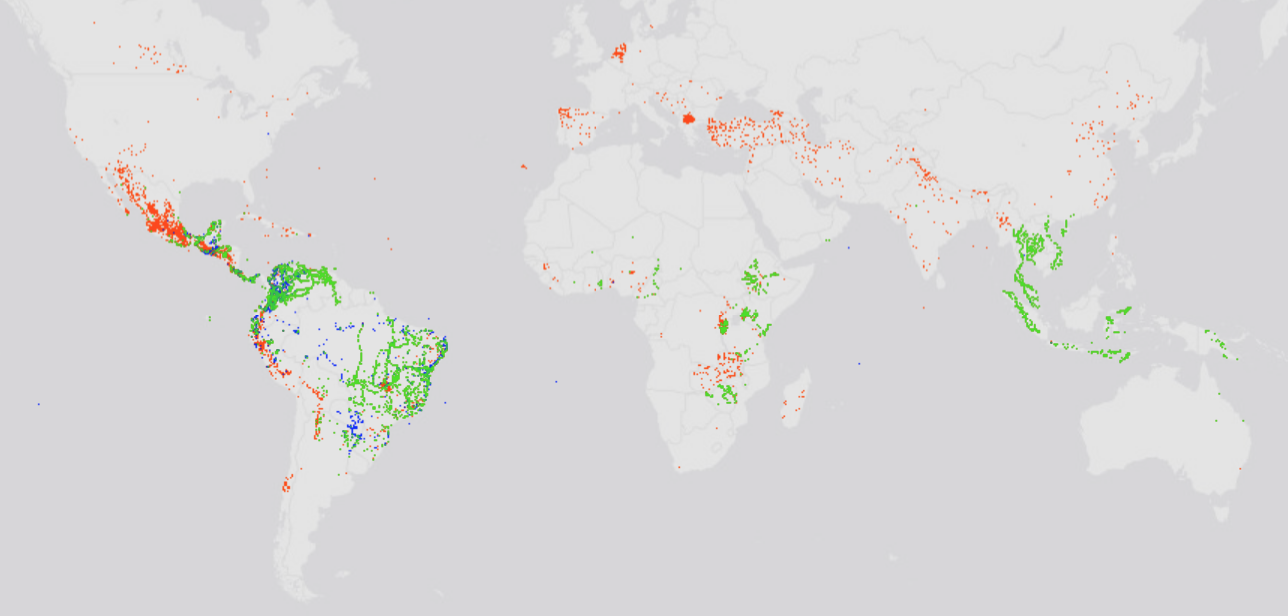
And here’s an overview of the collections from Genesys (beans in red, cassava blue, forages green).
Full disclosure: we also support the place at work.