- Mapping abiotic stresses for rice in Africa: Drought, cold, iron toxicity, salinity and sodicity. Now to mash this up with germplasm provenance information…
- Screening of rice landraces (Oryza sativa L.) for seedling stage salinity tolerance using morpho-physiological and molecular markers. …you know, so that this sort of thing could be predicted, perhaps.
- Identification of promising sources for fodder traits in the world collection of pearl millet at the ICRISAT genebank. 14 out of 326. Difficult to predict from environmental data, though, I suspect.
- Agricultural diversification as an important strategy for achieving food security in Africa. More diverse households and farming systems are more food secure, but only up to a point, and it depends on various factors. 43% of African cropland will be difficult to diversify.
- Deforestation and child diet diversity: A geospatial analysis of 15 Sub-Saharan African countries. Deforestation is bad for diet diversity. No word on overlap with the above mentioned 43%.
- Two-thirds of global cropland area impacted by climate oscillations. I bet you that includes most of the above-mentioned 43%.
- Exchanging and managing in-vitro elite germplasm to combat Cassava Brown Streak Disease (CBSD) and Cassava Mosaic Disease (CMD) in Eastern and Southern Africa. The devil is in the logistics.
- Risk of pathogens associated with plant germplasm imported into India from various countries. See what I mean?
- An exploration of the implication and feasibility of UAH (Urban Agricultural Heritages) in China. I for one really want to see the Xuanhua traditional vineyard system.
- Genetic Resources in the “Calabaza Pipiana” Squash (Cucurbita argyrosperma) in Mexico: Genetic Diversity, Genetic Differentiation and Distribution Models. Balsas-Jalisco is a potential center of domestication. Isn’t it the same for maize?
- Genetic differences in macro-element mineral concentrations among 52 historically important tomato varieties. Fairly strong and mostly independent, except for K and Mg.
- The global burden of chronic and hidden hunger: Trends and determinants. Growth not as good on hidden hunger as on chronic. Let them eat tomatoes.
Brainfood: Mesoamerican fruits, PES, Chinese vegetables, Controlled pollination, Pastoralist fodder, Taxonomy, African nightshades, Ag origins, Divortification
- Human diets drive range expansion of megafauna-dispersed fruit species. Megafauna dropped the ball (or the fruit), humans picked it up and ran with it.
- Experimental evidence on payments for forest commons conservation. Maybe we should have paid the megafauna.
- Vegetable genetic resources in China. 3 genebanks, 36,000 accessions, 120 species, about 1000 distributions per year (to research units).
- A cost-effective ground pollination system for hybridization in tall coconut palms. I have seen the future of coconut pollination.
- Determinants of pastoral and agro-pastoral households’ participation in fodder production in Makueni and Kajiado Counties, Kenya. Household heads who are female, have access to extension services, or are members of social groups are more likely to go in for fodder production.
- Taxonomy based on science is necessary for global conservation. Incredible to me that needs to be said.
- Development of next-generation sequencing (NGS)-based SSRs in African nightshades: Tools for analyzing genetic diversity for conservation and breeding. Solanum scabrum and S. villosum separate nicely, and show much diversity.
- A natural adaptive syndrome as a model for the origins of cereal agriculture. Large seed, awns and monodominance.
- Development and Examination of Sweet Potato Flour Fortified with Indigenous Underutilized Seasonal Vegetables. Ticks all the boxes, lets call it divortification.
Lost rice found, again
First there was Carolina Gold. Now there is “upland red bearded” or “Moruga Hill” rice.
Mr. Dennis had heard about hill rice…through the culinary organization Slow Food USA and the Carolina Gold Rice Foundation, the group that brought back Carolina Gold in the early 2000s. He’d also heard stories about it from elderly cooks in his community. Like everyone else, he thought the hill rice of the African diaspora was lost forever.
But then, on a rainy morning in the Trinidad hills in December 2016, he walked past coconut trees and towering okra plants to the edge of a field with ripe stalks of rice, each grain covered in a reddish husk and sprouting spiky tufts.
“Here I am looking at this rice and I said: ‘Wow. Wait a minute. This is that rice that’s missing,’” he said.
It is hard to overstate how shocked the people who study rice were to learn that the long-lost American hill rice was alive and growing in the Caribbean. Horticulturists at the Smithsonian Institution want to grow it, rice geneticists at New York University are testing it and the United States Department of Agriculture is reviewing it. If all goes well, it may become a commercial crop in America, and a menu staple as diners develop a deeper appreciation for African-American food.
And no, they couldn’t have found it in genebanks. 1 This is what Genesys knows from the region. Trinidad is shown by the yellow marker, rice accessions in red. No rice accessions in Genesys from anywhere near Trinidad, alas.
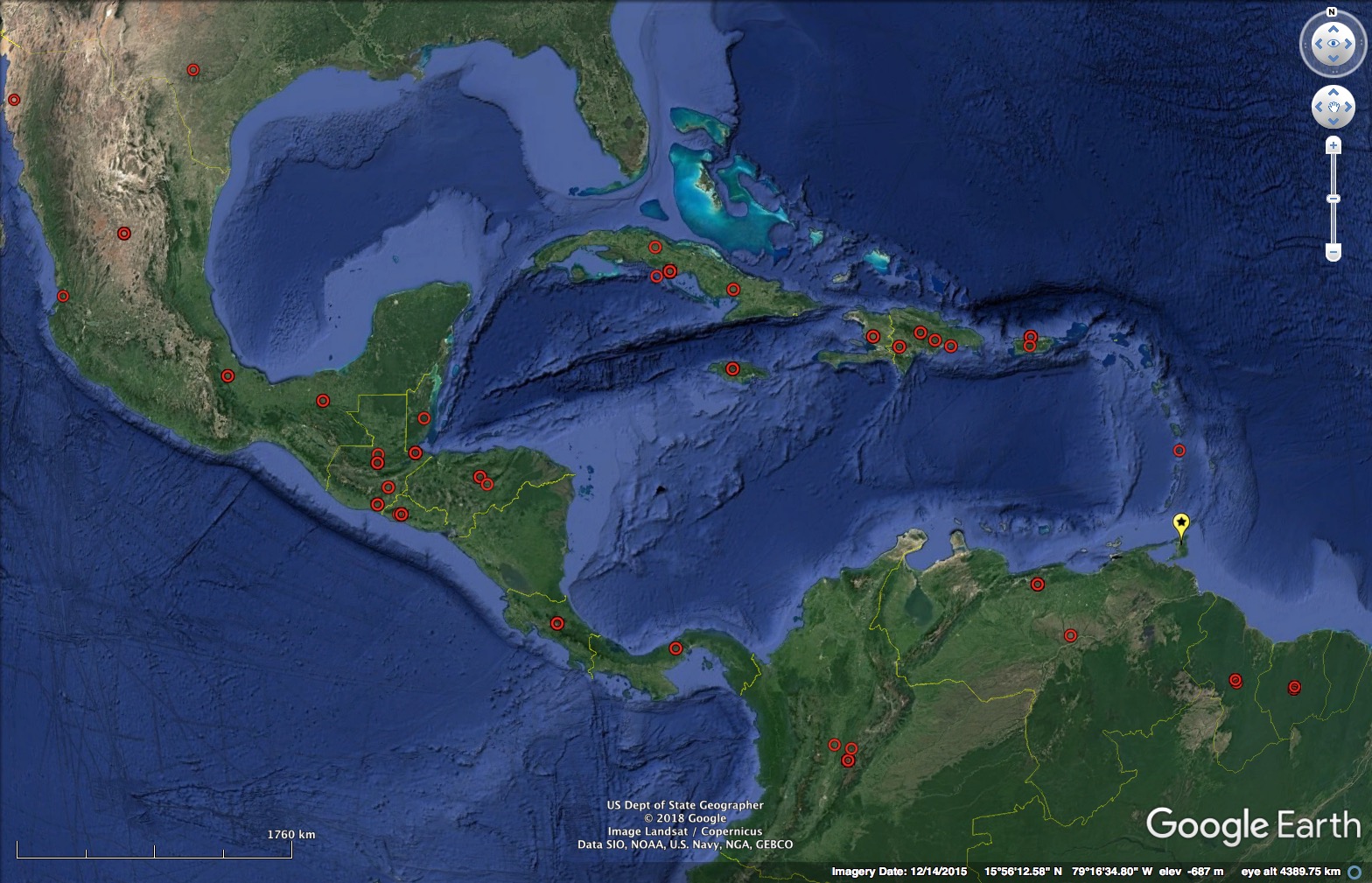
Someone should really have a systematic look at all those red dots, though.
That Pawnee corn thread
As one of those who prefers not to visit some social sites unless I need to, let’s see whether this works.
Pawnee corn latest
Attentive readers who remember our series of posts on the resurrection of Pawnee corn from almost 10 years ago may be interested in this recent Twitter thread from Prof. C.S Prakash.
Amazing story of the revival of Pawnee Eagle Corn – Grown by native Americans, thought to be extinct. One family had saved last 50 kernels taken with them when they were exiled from Nebraska to Oklahoma in the 1870s. “It tastes like almonds with cream”https://t.co/pgRSxTk8oP pic.twitter.com/B5dVDKVRbW
— Channa Prakash (@AgBioWorld) February 18, 2018
For those who would prefer to stay away from Twitter, and I know there are some, I’ll take the liberty to reproduce Prof. Prakash’s text below, embedding the links for clarity, but minus the photos, alas.
- Amazing story of the revival of Pawnee Eagle Corn. Grown by native Americans, thought to be extinct. One family had saved last 50 kernels taken with them when they were exiled from Nebraska to Oklahoma in the 1870s. “It tastes like almonds with cream”.
- A farmer who grew the Pawnee Eagle and other heirloom corn 🌽. Much beauty in the biodiversity, once extinct it is lost forever. Gene banks and such farmers heroes! Vavilov is smiling!
- Deb Echo-Hawk, Pawnee tribe’s official ‘Keeper of the seeds’. When tribes were forced from state to state by the US govt — Trail of Tears — seed keepers brought their own strains of corn seeds with them, so when they settled again, they could grow food on their new land.
- Eagle corn revived from near-extinction by an unlikely friendship and determination of Native American seed saver from Oklahoma Deb-Echo Hawk along with Ronnie O’Brien, a culinary art instructor at a community college in Nebraska.
- Pawnee tribe lived along tributaries of the Missouri River in Nebraska. In 1870, ~ 12,000 people were removed from their land, forcibly exiled to Oklahoma, only about 600 survived. Eagle corn is a tragic testimony to the brutal racism Pawnee endured.
- Roger Echo-Hawk mentioned to me that as Native Americans could not get into US universities in the 19th century, black universities such as Hampton Institute educated them. Booker T. Washington who founded @TuskegeeUniv where I work, also studied there!
- Those who wish to reach Deb Echo-Hawk to learn more about the Pawnee Eagle Corn heirloom seed and check with her when the seeds would be public available may contact her through Facebook page.
- Learn more about this amazing Pawnee Eagle Corn — Workshop on ‘NATIVE CORN’ Honoring Nebraska’s First Farmers — The First Meeting on Indigenous Crops in Nebraska, April 28, 2018 at the Central Community College-Hastings, Hastings.