- Genetic structure and internal gene flow in populations of Schinus molle (Anacardiaceae) in the Brazilian Pampa. Try to keep what forest patches remain. And link them up somehow.
- Genetic Diversity of Buckwheat Cultivars (Fagopyrum tartaricum Gaertn.) Assessed with SSR Markers Developed from Genome Survey Sequences. Two groups, overlapping in Qinghai, China.
- Increases in the longevity of desiccation-phase developing rice seeds: response to high-temperature drying depends on harvest moisture content. Genebanks may have it wrong for seeds of rice (and perhaps other tropical species) harvested while still metabolically active: these you can dry at higher temperatures than is the norm.
- Vitis International Variety Catalogue (VIVC): A cultivar database referenced by genetic profiles and morphology. Now with added microsatellites.
- Options for enhancing efficiency and effectiveness of research capacity for livestock genetics in, and for, sub-Saharan Africa. Embed in wider rural development, collaborate, and share data. Could apply to more than just livestock improvement.
- Mapping and validating predictions of bacterial biodiversity using European and national scale datasets. It’s the pH.
- Agricultural Extension Roles towards Adapting to the Effects of Taro Leaf Blight (Tlb) Disease in Nsukka Agricultural Zone, Enugu State. Basically, extensionists haven’t done a thing.
- Anthropogenic drivers of plant diversity: perspective on land use change in a dynamic cultural landscape. Abandoning farmland is not good for biodiversity.
- Agricultural landscapes and biodiversity conservation: a case study in Sicily (Italy). Ahem. Abandoning farmland is not good for biodiversity.
- Genetic diversity of Faidherbia albida (Del.) A. Chev accessions held at the World Agroforestry Centre. It’s not enough.
How do you do biofortification?
Well…
First, plant breeders screen thousands of different types of crop seed stored in global seed banks to discover varieties with naturally higher amounts of micronutrients.
Nicely, and all too rarely, said.
Nibbles: Oz vineyard apocalypse, California vineyards redux, Ethiopian genebank, Maya collapse revisionism, SunBlack tomato, Nutritious staples, Citrus endowment, Sheep pix
- In Australia, they’re ripping up vineyards.
- Whereas in California, they’re going to breed 10,000 new grape varieties and make a new wine. Go figure.
- Interview with the director of the Ethiopian national genebank, Dr Gemedo Dalle.
- Deforestation et al. not responsible for Maya collapse after all. Jared Diamond unavailable for comment.
- Black tomato a hit in Italy. Looks crap on pizza though.
- The case for biofortification.
- University of Florida sets up endowment to protect its research groves in face of citrus greening.
- Googlesheepview. Nuff said.
Sequence everything — but not only
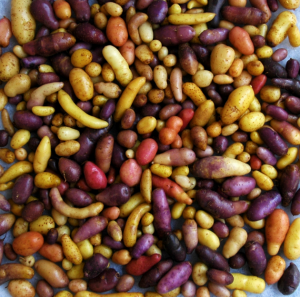 The contents of a potato genebank? Nope: “…a maximum of two alleles per locus contributed to this variation.” That’s because this tuberous cornucopia is what the authors of a recent essay in the American Journal of Botany 1 got when they selfed a diploid potato clone which was itself derived from a cross between a completely homozygous parent and one that was very nearly so.
 What does this mean for genebanks? Basically, that they can’t rely on morphological variation, in even a whole set of traits, as a proxy for overall genetic diversity. So long, old-fashioned core collections. What you really need to do is sequence everything. Music to DivSeek ears, I’m sure. But that’s not all. You also have to make sure that the resulting better diversity information gets to farmers in a way that helps them support the processes that “create and maintain useful variation for functional traits and to develop strategies to identify and select valuable phenotypes.” Or on-farm conservation, to you and me.
Nibbles: Coffee crop to cup, Pig love/hate, School lunches, Arctic life pix, Rubber sole, Ethiopian genebank
- Making a cup of “coffee.” Well, it is for Dunkin’ Donuts.
- Pigs: yum or yuch?
- FAO wants to know about how to teach healthy living in schools.
- You’d have thought it difficult to have a healthy life in the Arctic, but people manage it.
- Our rubber supply is in jeopardy. The raw material, not the product.
- Ethiopian genebank in the development news.