- A niche modelling course on YouTube.
- Diversify for better nutrition.
- Cool infographic for CGIAR’s maize work.
- Which doesn’t mention the 58 names of maize.
- Discussion on genetic diversity from the first day of the Global Landscapes Forum 2014, in Lima, Peru, during COP20. And more from same thing, scroll down.
- Scuba rice in Bangladesh.
- Supporting food traditions in Sudan and Oklahoma.
- More on that weird, unnecessary, Siberian seed vault.
Building a European Plant Germplasm System
A couple of days ago we blogged about a study by European genebankers which recommended the establishment of a “European Plant Germplasm System” (EPGS) along the lines of the US National Plant Germplasm System (NPGS). Let’s see how far the analogy can be pushed.
Some of the key features illustrated in the diagram of the “EPGS” provided in the paper, and reproduced in our post, are: active germplasm collections, a central seed storage laboratory, a system-wide information system and a plant germplasm committee. There are some interesting differences between the European and US versions of each of these. The constituent European germplasm collections, for example, would be the national collections, which tend to have a very wide range of species; whereas in the US some at least of the individual germplasm repositories are fairly focused on a crop or group of similar crops. That makes for efficiencies. Or would all the “small grains” in Europe end up in one national genebank, and all the apples in another, as in the US?
Another difference, as we discussed in the previous post, is the nature of that European plant germplasm committee. There is supposed to be only one of these in Europe, whereas in the US there is one per crop, to provide guidance and advice from germplasm users to the crop curator. That to me makes more sense.
As for information systems, Eurisco is not at the moment comparable to GRIN. The NPGS uses GRIN (GRIN-Global in the near future) to both manage workflows within the genebank and make some of the resulting data available for searching on the internet. Eurisco does only the latter at the moment (and, incidentally, like GRIN, serves its data up to Genesys). But then I expect the individual European genebanks are quite happy with their various data management systems and don’t necessarily need to share a single, standardized system. Or do they?
Perhaps the biggest difference, however, is with the central seed storage laboratory. There is at present no European Ft Collins at all to provide safety duplication of seed accessions. It would have to be built from scratch. Or perhaps one of the bigger national genebanks could suck in safety duplicates and morph into a regional genebank? But is a single central repository really necessary at all? What if, instead, you had different national genebanks taking regional responsibility for safety duplication of different crops? This would not be a new idea by any means, though I don’t think it’s ever been implemented anywhere in the world. Might it be an option in Europe?
Then there’s the stuff that’s not on the diagram. Take coordination mechanisms. The NPGS has biennial face-to-face meetings of all genebank curators, with teleconferences in the “off-years.” Plus there’s national–level coordination by the ARS Office of National Programs. The National Plant Germplasm Coordinating Committee coordinates and communicates information among federal, state and other funding entities. A related issue is administrative structure. NPGS genebanks are budgeted in a ARS Research Project, which is funded by an annual Congressional appropriation. This in turn contributes to ARS National Program 301 (Plant Genetic Resources, Genomes, and Genetic Improvement). Every five years, each National Program and its constituent Research Projects undergo external reviews. After that, each Research Project writes a new Project Plan for the next five years for review. What would European coordination and administration on crop genetic resources look like? Some is already provided by the European Cooperative Programme for Plant Genetic Resources (ECPGR), of course. Would ECPGR’s processes and structures — not to mention funding — be sufficient for a European Plant Germplasm System?
So. I guess the bottom line is that it’s easy to say that it would be nice to have a European version of the US National Plant Germplasm System. But then you start to drill down into what that would actually mean, and lots of options open up at each turn. And, at each turn, whether it makes sense to do it in Europe exactly like they do it in the US will, as they say, depend.
What does it cost to conserve crop diversity in Europe?
There’s a document on the NordGen website entitled Towards a European Plant Germplasm System — The third way 1 which advocates setting up a “European Plant Germplasm System” along the lines of the US National Plant Germplasm System. Written by Lothar Frese, Anna Palmé, Lorenz Bülow and Chris Kik — all from big European genebanks — the paper “builds on the results of the PGR Secure project funded under the EU Seventh Framework Programme.”
This is what the European system would look like:
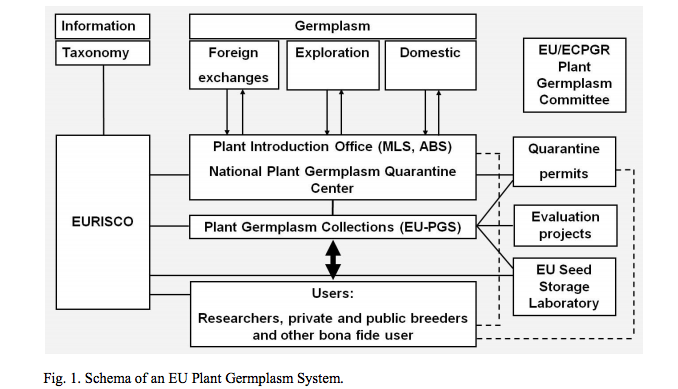
What, no Svalbard? Even the NPGS uses that. Also, there are separate germplasm committees for each crop in the US, rather than one committee to rule them all. That makes more sense if the idea is to have input from the users, as in the US; but maybe that’s not it, as in the diagram the committee is not linked to the users. So what is it for? Anyway, how much would this all cost?
As a rule of thumb, the ex situ conservation including related research costs approximately 60 € / accession and year (personal communication of Dr. U. Lohwasser of 23 May, 2014 and Dr. P. Bretting of 22 May 2014). 1,725,315 accessions are kept in European genebanks resulting in an assumed total annual costs for ex situ conservation of 103,518,900 € per year for the whole of Europe. In view of the 34 billion € spent for agri-environmental measures within the EU-28 a budget of 100 million € / year is not unreasonable. The question rather is whether the stakeholder groups and policy makers feel that having a European Plant Germplasm System is worth this amount.
Well, let’s fact-check that. The operating budget for the NPGS is $44,600,000 per year, for 569,000 accessions, which is about $78 per accession, or about €70 at today’s exchange rate. That’s probably a conservative estimate, I’m reliably informed, as the NPGS gets a lot of in-kind support from the universities with which it cooperates — but it’s the right ballpark anyway. The international genebanks of the CGIAR get around $20 million a year to maintain and make available their ca. 700,000 accessions, which seems very cheap, but includes very little of those “related research costs.”
What we don’t know — or at least I don’t — is what European countries are actually spending on their genebanks at the moment. It seems maybe the authors don’t know either, because another of the 12 recommendations they make, besides establishing the system, is to inventory the money available. Here are all the recommendations, conveniently filleted out for you. Look at number 6:
1. We suggest the establishment of a European Plant Germplasm System.
2. Establish a legal basis for conservation of plant genetic resources for food and agriculture in the EU.
3. Establishment of a technical EU infrastructure for the organisation of conservation of plant genetic resources for food and agriculture measures.
4. Establishment of an EU information infrastructure for conservation of plant genetic resources for food and agriculture.
5. Disentangle juridically and financially genebank tasks from plant breeding research and plant breeding tasks at the national level.
6. Inventory of financial means available to genebanks and estimation of financial means needed for a fully functioning European network of genetic resource collections (ex situ, in situ and on-farm).
7. Increase the visibility of plant genetic resources collections on the internet.
8. Develop a European platform for long-term crop specific pre-breeding programmes.
9. Clear uncertainties concerning Access and Benefit Sharing (ABS) rules so that breeding companies can take economic decisions on a safe legal basis.
10. Research should be strengthened to better understand the amount and geographic distribution of genetic diversity present in priority crop gene pools.
11. The European agro-NGOs and their influence should be strengthened.
12. Establishment of a European Network of Private-Public-Partnership programmes for evaluation of plant genetic resources in Europe.
My own recommendation would be to start with that inventory of financial means. It would be nice to know how close to that €100 million we in fact are — and how much of it, if any, would need to be new money.
Nibbles: Old breweries, Old grape seeds, New beer, Sheep breeds, Indian rice landraces, GM rice in China, Barley breeding, Botanical tipple, Mata Atlantica conservation, Quinoa
- There are some really old breweries out there.
- And some really old grape seeds in Sardinia.
- The beauty of hops. New and old.
- Some very photogenic old sheep breeds in the Lake District.
- Someone has discovered some old salt-tolerant rice landraces. Also medicinal and aromatic rices. Well I never.
- Meanwhile, at the other end of the rainbow, the Chinese dip a toe into gourmet GM rice.
- Brit boffins breed flood-proof barley.
- Botanical gin. Two of my favourite things, combined.
- Saving the Pau Brasil is, well, complicated. But what else was it going to be?
- Yet another roundup of the pros and cons of quinoa.
New version of banana genebank information system goes live
Great to see a new version of the Musa Germplasm Information System (MGIS) released. The URL is unchanged. The key improvements are listed as follows (slightly edited):
1. All information on a single accession can be viewed in one page
2. Taxonomic content of each collection is summarized graphically.
3. Easier data filtering and export functions.
4. Users can share comments on any accession.
5. Accessions can be requested online via the Musa Online Requesting system (MORS) with a modified interface.
I particularly like the ability to comment, though you do have to register for that. The data cover 2,281 accessions from six genebanks around the world, 2 including 1,456 in the International Transit Centre (ITC) managed by Bioversity International in Belgium:
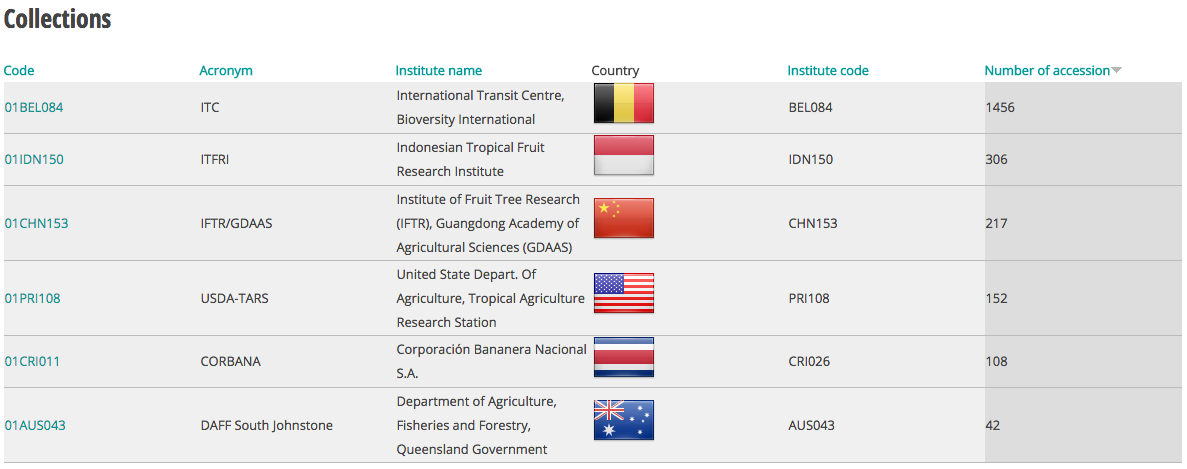
The ITC data are also in Genesys, which shows 1,529 accessions rather than 1,456. I assume MGIS is the more up to date, but I’m unclear why there should be a difference. 3
You can search among the 2,281 accessions on name or number; or by filtering by any combination of genebank, species, subspecies, genome group (AAB, say), subgroup (Cavendish, say), country of origin, ploidy, whether there’s a photo, whether it’s been included in a molecular study, and availability. Searching is pretty fast.
Each accession gets a nice page summarizing all the pertinent information.
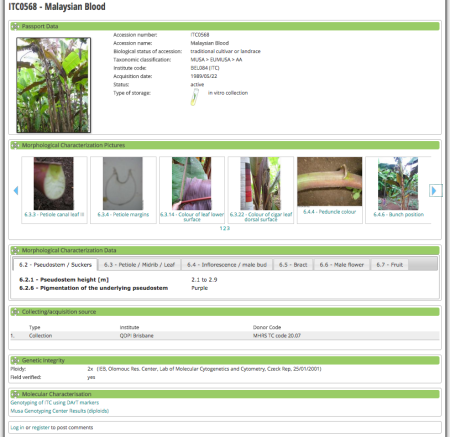
That information can include morphological characterization data, and illustrations, as you can see above, but I could not find a way of searching the database based on a particular descriptor or combination of descriptors. You get a map when collecting locality is known, but you can’t map multiple accessions, as far as I could see. You’d have to do that in Genesys, I guess.
If you want to download data, you have to cut and paste accession numbers into a form on another page, and then you get a CSV or XLS. It didn’t look to me like you could export either morphological characterization data or molecular data. I have to say I was disappointed by the whole export thing.
So, some good things, some not so good things in this new version of MGIS. I’ll be keeping an eye on it for further developments. And continue playing with it, of course. Maybe I missed something.