- Selection of the most informative morphoagronomic descriptors for cassava germplasm. From 51 to 32. Hardly seems worth it. And dropping descriptors can be dangerous.
- Advances in core collection of plant germplasm resources. In Chinese, alas, but it sounds intriguing.
- Trends in breeding oat for nutritional grain quality – An overview. You want high β-glucan, and you can get it by breeding for high yield, luckily. A. atlantica has high β-glucan.
- Indigenous Fruit Trees of Tropical Africa: Status, Opportunity for Development and Biodiversity Management. Need for “exploiting the under-tapped treasuries of IFT.” Still? People have been saying that for years. They’ve even designated agroforestry systems as globally important and everything.
- Promoting Santalum yasi Seeman (Sandalwood or yasi) in agroforestry systems to reverse agrodeforestation in Fiji. An attempt to introduce a high value species into a threatened agroforestry system. Not just fruit, then.
- Genetic diversity and population structure of wild/weedy eggplant (Solanum insanum, Solanaceae) in southern India: Implications for conservation. Quite a lot of geneflow.
- The potential for crop to wild hybridization in eggplant (Solanum melongena; Solanaceae) in southern India. Transgenes from the crop could spread to the wild relative.
- Variation in Antioxidant Activity and Flavonoid Aglycones in Eggplant (Solanum melongena L.) Germplasm. So, the leaves are good for you. But I suspect they taste like crap.
- The Qingyuan Mushroom Culture System as Agricultural Heritage. Would pay money to see that.
- Selecting High Amylose Rice Germplasm Combined with NIR Spectroscopy at the RDA Genebank Conserved. From 9481 to 14 with high amylose and decent agronomy. But why bother?
- Field response of chickpea (Cicer arietinum L.) to high temperature. There are some heat tolerant lines in the ICRISAT genebank.
- Genetic diversity in East African finger millet (Eleusine coracana (L.) Gaertn) landraces based on SSR markers and some qualitative traits. The diversity is high, mainly within countries, and missing from the ICRISAT minicore. Naughty.
- Analyses based on the 16S rRNA and secA genes identify a new phytoplasma subgroup associated with a lethal yellowing-type disease of coconut in Côte d’Ivoire. The international genebank is threatened.
- New Insights into Capsicum spp Relatedness and the Diversification Process of Capsicum annuum in Spain. Limited genetic diversity has differentiated in Spain into pungent, elongated peppers in the South and Center, and sweet, blocky and triangular types in the North.
- Knowing native potatoes: finding local experts through innovative methods in the Peruvian Andes. Community Biodiversity Register methodology applied to potato landraces. Don’t see anything much new here, but good to have it nicely documented.
Nibbles: Biltong, Coco de mer, PGRFA course, Poplar genebank, IRRI genebank, African agriculture, Hybrid chickens, American food
- Professor wants to copyright the name biltong, should be forced to eat nothing else until he takes it back.
- Getting to the bottom of coco de mer.
- PGRFA course at Wageningen. Expensive, but worth it, and you can apply for a NFP/MENA Fellowship, check on the course overview PDF.
- The IRRI genebank manager has seen the future of genebanks: “…we need to work on building the system to estimate breeding value from genotype, and then we will be able to feed more detailed knowledge to the breeders.” He probably means DivSeek. Now IRRI really need to get a different stock image of him and his genebank.
- The UK now has a National Black Poplar Clone Bank. Not quite as big as the above.
- A different take on Bill’s Big Bet. And more along the same lines.
- Hybrid Kuroiler chickens a big hit in Uganda. Bill may be onto something after all.
- “As American as apple pie” is just the beginning. I want to see Kuroilers at KFC.
Nibbles: Conservation course history, Language and DNA, Entomophagy blog, IPBES help, Phenomics methods database, Sustainable Nestlé, Got other milk?, NCYC
- University of Birmingham conservation course alumnus/a? This one’s for you.
- Phonemes follow human genomes. Kinda. No word on crop and livestock genomes. Yet.
- A whole blog on eating insects.
- Interesting: “Each IPBES assessment must include reference citations to indigenous knowledge, and every review panel must include experts in this.”
- Curated list of methods in Plant Phenotyping and Phenomics.
- Nestlé’s sustainable agriculture guy visits CIAT, plants coconut, talks supply chains.
- Camelcino, anyone?
- UK yeast genebank reaches totally arbitrary milestone.
Nibbles: Food security course, Food foodprint infographic, Ganja genomics, Hop hope, French collections, Forest control, Australian poppies, Paraguayan resistance, Cacao improvement, Hot pepper, Endogenous viruses, Biofortification
- Our Hungry Planet: Agriculture, People and Food Security. Free online course from University of Reading.
- What if people in country X ate the same diet as people in country Y?
- The Man wants to fingerprint your stash.
- Or maybe fragrantly hopped beer is your poison?
- A new one on me: Conservatoire des Collections Végétales Spécialisées (CCVS).
- All politics is local. All control of forestry enterprises ought to be.
- Victoria takes to the poppy. Afghanistan unavailable for comment.
- The small farmers of Paraguay holding back the flood of soy. Or trying to.
- The promise — and curse — of CCN 51. And some context on the whole peak chocolate thing.
- Wait, some people think Bhut Jolokia is a cool name?
- The grapevine has gone viral. Millions of years ago.
- Global Panel of Wise Agricultural People says to biofortify your crops.
CGIAR to listen — again
There are “cross-cutting topics of global importance — women and youth; climate change; and capacity development — [that] will systematically strengthen and build coherence in research across all domains and Intermediate Development Outcomes (IDOs).” Should not conservation and sustainable use of agricultural biodiversity be one of these?
We posed that trenchant, though perhaps predictable, question last November, as CGIAR asked all and sundry for input on their new Strategy and Results Framework (SRF). Well, all and sundry have been heard, and the new version of the SRF is out. The answer to our question is, alas, no. The cross-cutting themes — now gender and youth, climate change, policies and institutions, and capacity development — still do not include agrobiodiversity.
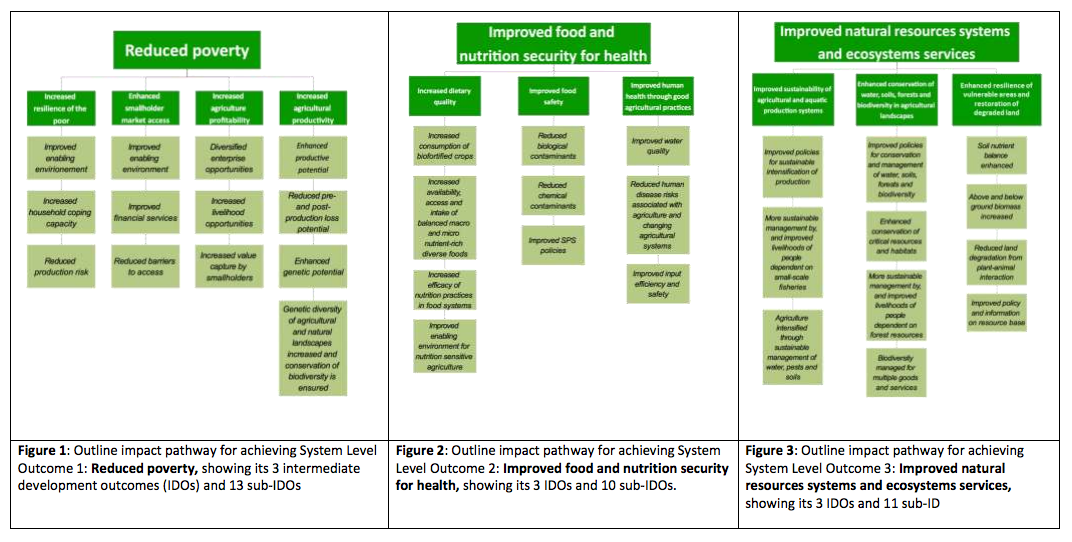
But leaving it at that would be unfair. Remember that in the old SRF, as we pointed out last time, “use of genetic diversity … only contribute[s] to the reduced poverty outcome, and then only via increased agricultural productivity.” Here’s the chart to jog your memory, and sorry again for the poor quality. The sub-IDO in question is the one that breaks the symmetry of the left-hand column, click on the image to see it a bit better:
Here’s the new schema, thankfully now more legible:
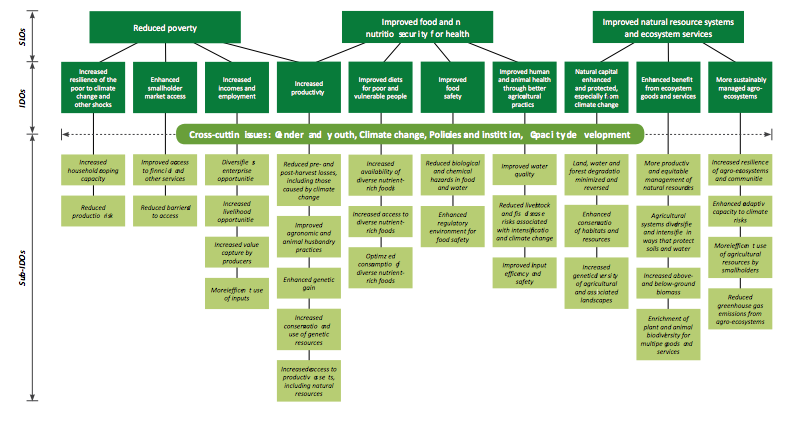
Equally thankfully, conservation of genetic resources now contributes to the System Level Outcome of improved food and nutrition security for health, in addition to that of reduced poverty. See that little extra line going right and up from the IDO of increased productivity? That’s what a small victory, of sorts, looks like. And there are additional sub-IDOs that we can also get behind:
- Increased genetic diversity of agricultural and associated landscapes.
- Agricultural systems diversified and intensified in ways that protect soil and water.
- Optimized consumption of diverse nutrient-rich foods.
So I guess we can say that people saying things very much like those we say here have been heard, at least a little bit. Let the second round of consultations begin! The Consortium Board and then the Funders Council sign off on the SRF in March and April, respectively.