- The industrial sliced loaf as racist fantasy.
- Bill Gates talks dirty. About cassava, settle down.
- Where the wild things are is where the languages are, but why? And where are they endangered?
- This new Indian wild banana is probably a bit endangered.
- The past may be a foreign country, but they got Street View there too.
- Blockbuster rice in India. (But how energy-efficient is it?)
- And potentially blockbuster livestock breeds in Kenya.
- China goes GMO. Which of these?
- Maybe they should read this vision for organic farming? You know, just for completeness?
- Have a food adventure! Just perhaps not in China.
- FAO and National Geographic have a food security adventure together. For more stuff like this, no doubt…
- Eat more plants, and ditch the junk food. Sounds easy, doesn’t it? Ok, for the more complicated, nerdy approach, there’s always fancy indicators.
- Ethiopia’s community seed banks.
- I bet there are some in Zimbabwe…
- African Development Bank makes a bet on agroforestry. Maybe health is why? There’s more that one reason…
- Gotta be strategic with your legume collecting.
- Want conservation science to translate into impact? Don’t publish behind a paywall.
- CIMMYT earns its keep.
- Build a better apple, and you won’t be able to keep the journalists away.
More genebank manager photos
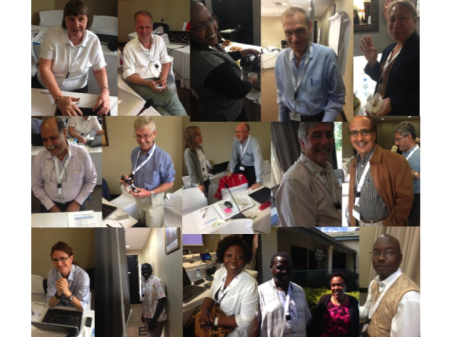
True to my word in yesterday’s post, here’s a picture of John Wasswa Mulumba, head of the Ugandan national genebank. He’s bottom right corner. I missed one or two of the other genebank managers who came to the meeting in Arusha a couple of days ago. If you’re one of them, or were there and have a picture of them, send it to me and I’ll add it. The first reader to get all their names and affiliations right gets a prize.
More than just a talking shop
I suspect that our brief post a couple of weeks back encouraging everybody to follow the fun that assorted genebank managers were having in Arusha may have been a little too short of context to engage all but the most diehard of readers. So here’s the deal.
All the genebank managers of the CGIAR centres get together every year as part of the CGIAR Research Programme (CRP) on Genebanks. It’s not really a research programme, but why it’s called that is too long and boring a story for now — or perhaps ever. Suffice it to say that it’s the mechanism whereby reliable, long-term funding for the day-to-day running costs of these important genebanks is assured, and managed. You know, things like making sure the fridges stay on and the staff are paid.
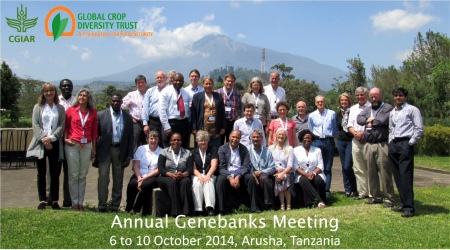
And these collections really are important. Together they represent about 10% of global holdings of crop diversity, if you go by total numbers of accessions, but probably closer to a quarter or a third if you try (and it’s not easy) to account for duplicates among genebanks. They are global in coverage, both as regards the diversity of the crops they hold and the service they provide. They underpin the crop improvement work of the international agricultural research centres themselves, and of public sector breeding programmes in developing countries from Afghanistan to Zimbabwe. For all this they are recognized in Article 15 of the International Treaty on Plant Genetic Resources for Food and Agriculture. Here’s the people who have the responsibility to keep all this ticking over, day in and day out. That’s Mt Meru in the background.
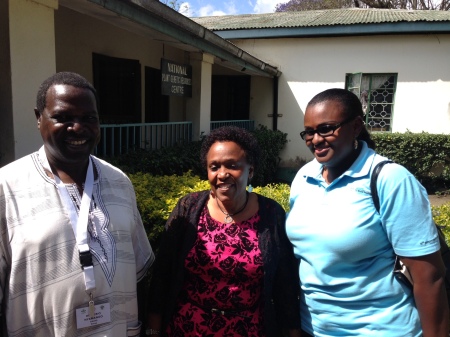
So every year the women and men who look after the international collections managed by the CGIAR centres (and the Secretariat of the Pacific Community) on behalf of the world under Article 15 of the ITPGRFA meet together to discuss how they’re getting on, and what their plans are for the following year. That may sound a bit old-fashioned, but there’s only so much you can do by email. Anyway, the meeting is also an opportunity to debate particular technical issues, and link up with other genebanks, on this occasion from eastern Africa. The managers of the national genebanks of Tanzania, Uganda and Kenya joined the fun this year, and so did a representative of the SADC Plant Genetic Resources Centre (the regional genebank for southern Africa) and the head of the genebank at the World Vegetable Centre (AVRDC), which although based in Taiwan has a regional office, and indeed a regional genebank, in Arusha. During the field day we visited both that and the Tanzanian national genebank. The lady in the middle of this photo is Margaret Mollel, who runs the latter. The guy on her right is Desterio Nyamongo, who’s the head of the Kenyan genebank. The other lady works at AVRDC. Somewhere among my photos there must be ones of John Wasswa Mulumba, who’s the manager of the Ugandan genebank and Lerotholi Qhobela from SPGRC. I’ll see if I can dig them up for you.
It’s not easy summarizing what happened during the course of five very full days, but you can maybe get something of an idea from this social media dump. 1 There’ll be a formal report in due course, of course, which I’ll link to for all you genebank nerds out there. I’ll just tell you here the four things that really stuck in my mind.
First, this idea of sequencing the whole collection is, perhaps inevitably, really taking off. There’s Seeds of Discovery at CIMMYT for maize and wheat. And that 3000-rice-genomes thing at IRRI that we’ve already blogged about here. And cassava, chickpea and other crops are getting in on the act too now. Which makes the time especially ripe for DivSeek. If collections are going to be sequenced left, right and centre, it will be important that genebank B does it in a way that’s comparable to how genebank A did it.
Second, genebanks are embracing quality management systems. I don’t mean that everybody’s trying to get ISO certification, or the like, although some are. No, what I mean is that the international genebanks realize that they need to say clearly what they do, do what they say, and get someone to verify that, including through regular external reviews. And, crucially, that they must have a plan to continuously monitor their performance and improve it towards common agreed targets.
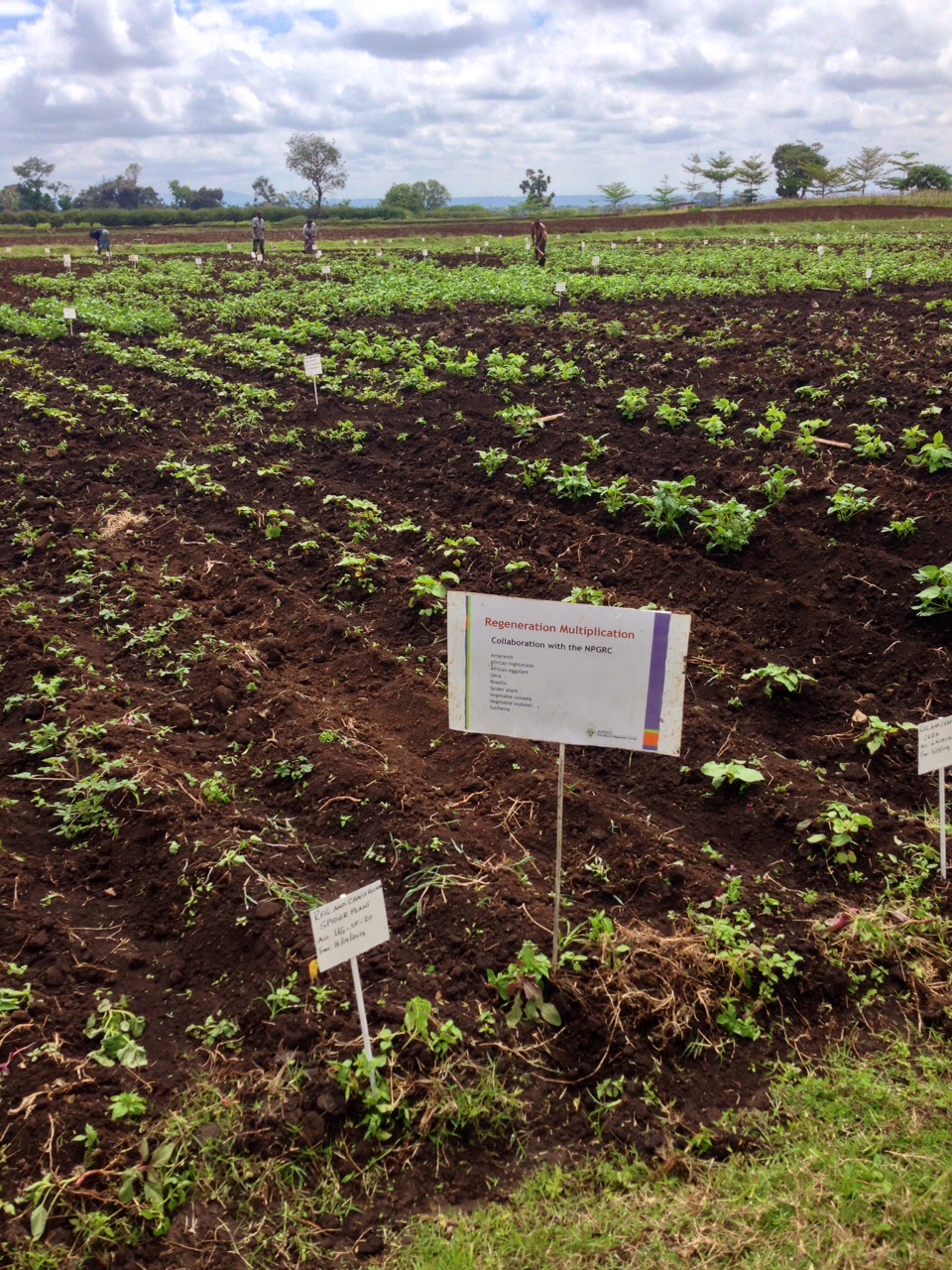 Thirdly, everybody agrees that genebanks have to work together, not just IRRI with AfricaRice, say, on conserving rice diversity in Africa, or on research on optimal rice seed storage conditions; but also those two with all national genebanks all over the world with rice collections. That 3000 rice genomes project also involved China, for example. But genebanks don’t have to share a crop to learn from one another. Everybody has a little management trick, or a bit of software, or a staff member, that could potentially really help someone else. Meetings such as these become market places for innovation, and everybody wins. A lot of great ideas came up at the meeting. By way of example, the regeneration and multiplication work illustrated here on the right is a collaboration between AVRDC and the Tanzanian genebank.
Finally, it was unbelievable to me that, despite everything, ICARDA staff in Aleppo are still somehow managing to keep the genebank going. That, perhaps, is the most remarkable of the achievements of the amazing, yet largely unsung, group of people who run genebanks, international and otherwise — not just in Aleppo but also in Lima, Cali, Texcoco, Leuven, Cotonou, Ibadan, Nairobi, Addis Ababa, Hyderabad, Los Banos, Suva, Shanhua, Arusha, Entebbe, Muguga… — and some of whose representatives met in the shadow of Mt Meru earlier this month. We owe them all so much, and I don’t think they hear that enough.
Comparing the niches of wild, feral and cultivated tetraploid cottons, Conclusion
We’re trying something new for us this week. Dr Geo Coppens co-authored an interesting paper 2 recently which brings together a number of our concerns: domestication, diversity, crop wild relatives, spatial analysis… He’s written quite a long piece about his research, which we’ll publish here in three instalments. This is the third and final instalment. Here’s the previous one.
Understanding the causes of the large difference between the distributions of TWC and that of cultivated and feral cottons is crucial for future breeding efforts. On one hand, the strong genetic divergence between wild and feral G. hirsutum that we have found in a sister SSR marker study may be partly related to differential selection and adaptation, and/or to the difficulty for domesticated forms to get established in a hostile environment. On the other hand, there is little doubt that much of the difference lies in the distinct ecological interpretation to be given to their respective models. Indeed, we may consider that the distribution of cultivated cottons approaches that of the fundamental niche of the species (i.e. where abiotic factors are favourable), which is obviously wider than the realized niche (further constrained by biotic factors, including competition).
Indeed, biotic factors are much less important under cultivation. For feral plants, we may refer to another niche concept: source-sink relations between cultivated and feral populations may explain how the latter may be found in unsuitable habitats (Pulliam, 2000). Logically, escapes from cultivation simply persist in the vicinity of cultivated cottons, in recently abandoned fields or along roadsides, benefitting from the open agricultural landscape. Why do feral populations observed further from cotton fields and dooryards, in more developed secondary vegetation (our ‘wild/feral’ category), present a very similar climatic envelope, and not an intermediate one? In fact, once interspecific competition has been avoided or reduced at the seedling stage, ancient escapes may persist for long, even in relatively high secondary vegetation. This is consistent with germplasm collectors’ reports (e.g. Ulloa et al., 2006) that feral populations are morphologically similar to local races of cultivated cotton, and that they are getting rarer as the cultivation of perennial cotton declines in Mexico.
The cotton example shows the relevance of ecological niche concepts even in the seemingly straightforward study of crop plant distribution, and particularly in the context of domestication studies, where it is crucial to distinguish between wild and feral forms. Comparing cultivation areas of domesticated forms with the original distribution of their wild relatives does not allow direct inferences on crop potential for climatic adaptation. Getting back to the tetraploid cotton example, niche conservatism after more than 1 million years of species diversification (the age of the AADD allotetraploid Gossypium genome) should make us more cautious in evaluating the result of 10,000 years of breeding on crop climatic adaptation. While there is no doubt that domestication and cultivation have resulted in widening of crops’ climatic envelopes, we need to understand much better the respective shares of genome and environment in the process. In the face of global climate change, we will need the tools of both genetic improvement and agroecology.
References
Brubaker CL, Wendel JF (1994) Reevaluating the origin of domesticated cotton (Gossypium hirsutum, Malvaceae) using nuclear restriction fragment length polymorphism (RFLP). Am J Bot 81: 1309–1326. doi: 10.2307/2445407
Coppens d’Eeckenbrugge G, Lacape J-M (2014) Distribution and Differentiation of Wild, Feral, and Cultivated Populations of Perennial Upland Cotton (Gossypium hirsutum L.) in Mesoamerica and the Caribbean. PLoS ONE 9(9): e107458. doi:10.1371/journal.pone.0107458
Fryxell PA (1979) The Natural History of the Cotton Tribe (Malvaceae, Tribe Gossypieae): Texas A&M University Press, College Station, TX. 245 p.
Hutchinson JB (1954) New evidence on the origin of the old world cottons. Heredity 8: 225–241. doi: 10.1038/hdy.1954.20
Hutchinson JB, Silow RA, Stephens SG (1947) The evolution of Gossypium and the differenciation of the cultivated cottons: Emprire Cotton Growing Corporation. 160 p.
Miller AJ, Knouft JH (2006) GIS-based characterization of the geographic distributions of wild and cultivated populations of the Mesoamerican fruit tree Spondias purpurea (Anacardiaceae). Am J Bot 93: 1757–1767. doi: 10.3732/ajb.93.12.1757
Pulliam HR (2000) On the relationship between niche and distribution. Ecology Letters 3: 349–361. doi: 10.1046/j.1461-0248.2000.00143.x
Russell J, van Zonneveld M, Dawson IK, Booth A, Waugh R, et al. (2014) Genetic Diversity and Ecological Niche Modelling of Wild Barley: Refugia, Large-Scale Post-LGM Range Expansion and Limited Mid-Future Climate Threats? PLoS ONE 9(2): e86021. doi:10.1371/journal.pone.0086021
Sauer JD (1967) Geographic reconnaissance of seashore vegetation along the Mexican Gulf coast; Mc Intire WG, editor. Baton Rouge. 59 p.
Stephens SG (1965) The effects of domestication on certain seed and fiber properties of perennial forms of cotton, Gossypium hirsutum L. The American Naturalist 94: 365–372. doi: 10.1086/282377
Thomas E, van Zonneveld M, Loo J, Hodgkin T, Galluzzi G, et al. (2012) Present Spatial Diversity Patterns of Theobroma cacao L. in the Neotropics Reflect Genetic Differentiation in Pleistocene Refugia Followed by Human-Influenced Dispersal. PLoS ONE 7(10): e47676. doi:10.1371/journal.pone.0047676
Ulloa M, Stewart JM, Garcia EA, Godoy S, Gaytan A, et al. (2006) Cotton genetic resources in the Western states of Mexico: in situ conservation status and germplasm collection for ex situ preservation. Genet Resour Crop Evol 53: 653–668. doi: 10.1007/s10722-004-2988-0
Wendel JF, Brubaker CL, Seelenan T (2010) The origin and evolution of Gossypium. In: Stewart JM, Oosterhuis DM, Heitholt JJ, Mauney JR, editors. Physiology of cotton. Dordrecht: Spinger, Netherlands. pp. 1–18.
Brainfood: Shea diversity, Weedy rice, Old barley, Grassland diversity, Afrikaner cattle, Sudanese baobab, FGR review, Small farmers, Ecological pest management, Andean ag changes, European soil biodiversity, Durum adaptation, Agrobodiversity indicators
- Genetic diversity in shea tree (Vitellaria paradoxa subspecies nilotica) ethno-varieties in Uganda assessed with microsatellite markers. Three geographic populations revealed by SSRs, not much related to the folk classification.
- Malaysian weedy rice shows its true stripes: wild Oryza and elite rice cultivars shape agricultural weed evolution in Southeast Asia. The weed is caught in the middle and swings both ways.
- Farmers without borders—genetic structuring in century old barley (Hordeum vulgare). Nordic barley structured latitudinally, with lots more variation within landrace accessions than now, according to historical specimens.
- The Agrodiversity Experiment: three years of data from a multisite study in intensively managed grasslands. Does increasing plant diversity in intensively managed grassland communities increase their resource use efficiency? No idea, but here’s the data from a huge multi-site experiment. Go crazy.
- Genetic diversity in selected stud and commercial herds of the Afrikaner cattle breed. It’s doing just fine, genetically, despite recent declines in numbers.
- The African baobab (Adansonia digitata, Malvaceae): Genetic resources in neglected populations of the Nuba Mountains, Sudan. Maybe a little more variation in homesteads compared to the wild. Maybe.
- Seeing the trees as well as the forest: The importance of managing forest genetic resources. The first State of the World’s Forest Genetic Resources and the first Global Plan of Action for the Conservation, Sustainable Use and Development of Forest Genetic Resources summarized: exchange, test in common gardens, and be clever with genetics, in breeding, management and restoration.
- Are small family farms a societal luxury good in wealthy countries? Rich countries don’t mind inefficient farms because they look nice.
- DIVECOSYS: Bringing together researchers to design ecologically-based pest management for small-scale farming systems in West Africa. Where do I sign up?
- Ecosystem governance in a highland village in Peru: Facing the challenges of globalization and climate change. Big Dairy doing for Andean crops.
- Intensive agriculture reduces soil biodiversity across Europe. What they said.
- The climate of the zone of origin of Mediterranean durum wheat (Triticum durum Desf.) landraces affects their agronomic performance. 4 main climatic zones, accounting for up to 30% of variation in important evaluation traits. FIGS, anyone?
- Indicators for the on-farm assessment of crop cultivar and livestock breed diversity: a survey-based participatory approach. And only 5 of them too!