- A new genebank for CIAT?
- DuPont Pioneer sponsors a plant breeding symposium at Wageningen University. You can attend by webinar but you have to register. But I fear this is going out way too late. Sorry! Nevermind, you’re still in time for this.
- 360 tomato genomes give an all-round view of its evolution.
- EUFORGEN turns 20. Don’t know EUFORGEN? Watch this video. Or go to this side event.
- Self-reproducing hybrid cowpea and sorghum? Gates Foundation is on it. Ah, but it’s not all sweetness and light in Seattle.
- It’s also a bit late, so don’t expect a prize, but you can still take the GCP World Food Day quiz just for fun.
- But for real fun, watch their cassava video.
- Oh my! Judge for yourself whether it was worth listening to.
Svalbard gets more seeds
Brainfood: Biogeoinformatics, FGR review, Lesser pulses, Slovak orchards, Wheat evaluation network, Iranian olives, Beans & FIGS, Blasted rice, Tibetan pigs, Alpine grass, Development as freedom
- Biogeoinformatics of livestock genomic resources. Don’t forget the “geo” bit. Goes for plants as well!
- Utilization and transfer of forest genetic resources: A global review. They’ve been going on for 200 years, but we’ll need provenance trials and conventional breeding more than ever in the future. Phytosanitary risks involved in tree germplasm movement are now better managed, but the big problem in the future will be Nagoya. Molecular assisted breeding? Meh.
- Genomics and molecular breeding in lesser explored pulse crops: Current trends and future opportunities. We’re mostly still awaiting our jetpacks.
- Orchards as traces of traditional agricultural landscape in Slovakia. About half are left, but they won’t save themselves.
- A wheat phenotyping network to incorporate physiological traits for climate change in South Asia. Local checks significantly earlier than the best CIMMYT can offer. Evaluate the whole genebank?
- Genetic structure of Iranian olive cultivars and their relationship with Mediterranean’s cultivars revealed by SSR markers. The N Iran cultivars are different from everything else.
- Leaf traits associated with drought adaptation in faba bean (Vicia faba L.). Chalk up another success for FIGS.
- Large scale germplasm screening for identification of novel rice blast resistance sources. 289 out of 4246 accessions showed resistance against all five rice blast isolates. The 4246 chosen on basis of “annotated rice blast resistance information” from the IRRI genebank. No word on whether FIGS was considered.
- Genetic Variation of EPAS1 Gene in Tibetan Pigs and Three Low-Altitude Pig Breeds in China. One haplotype seems to be particularly associated with high altitude adaptation. Unclear if that is a really important objective of pig breeding around the world.
- Morpho-physiological variation of Poa alpina L. genetic resources from the Rhaetian Alps, Italy, grown in two altitude-contrasting sites. There was more variation within than among populations, and it’s ok to do seed production for high altitude sites at low altitudes. No word on whether same could be said for alpine pigs.
- Protection of Traditional Knowledge and Origin Products in Developing Countries: Matching Human Rights and IP Protection with Business Development Opportunities. It’s all in the value chain.
Brainfood: Polyculture services, Apple resistance, Clover seed storage, Oil palm diversity, Alternative foods in Italy, Oregano chemicals, Pig diversity, IPR and indigenous people
- Do polycultures promote win-wins or trade-offs in agricultural ecosystem services? A meta-analysis. Yes, at least if the services in question are per-plant yield and biocontrol.
- Susceptibility of apple genotypes from European genetic resources to fire blight (Erwinia amylovora). 3 of 40 were resistant.
- Effect of sulphuric acid scarification on seed accessions of cluster clover (Trifolium glomeratum) stored in a genebank. Potentially disastrous.
- Genetic diversity of the world’s largest oil palm (Elaeis guineensis Jacq.) field genebank accessions using microsatellite markers. 3 groups: extreme W Africa, rest of Africa, Madagascar. Choose parents based on genetic distance, though, not just genetic group.
- Introducing territorial and historical contexts and critical thresholds in the analysis of conservation of agro-biodiversity by Alternative Food Networks, in Tuscany, Italy. Alternative Food Networks can contribute to conservation, but they need context.
- Chemical diversity among different accessions of Origanum vulgare L. ssp. vulgare collected from Central Himalayan region of Uttarakhand, India. 2 chemotypes, the one with higher thymol mainly from higher altitudes.
- Merging Molecular Data for Evaluating Cross Country Genetic Diversity of Pigs. Microsatellite datasets from USA, China and Brazil successfully combined and analyzed together. Should be more of this kind of thing.
- How Are Indigenous and Local Communities’ Rights Over Their Traditional Knowledge and Genetic Resources Protected in Current Free Trade Negotiations? Highlighting the Draft Trans-Pacific Partnership Agreement (TTPA). Indigenous people are generally not given stronger rights over their intellectual property in international instruments compared to non-indigenous people. Rights over IP are in general stronger than over genetic resources.
Follow the genebank managers’ fun
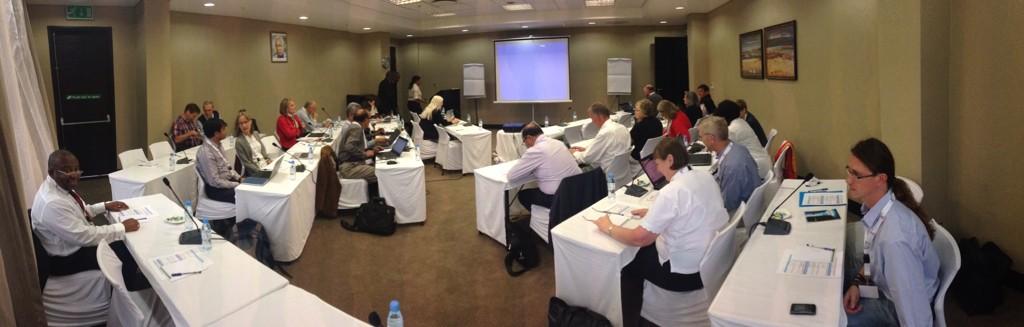
What’s the collective noun for a roomful of genebank managers? An accession? No, that can’t be right.
Whatever it is, you can follow along with the fun at the Twitter hashtag #agm2014.