Food policy ignores genebanks, so what else is new?

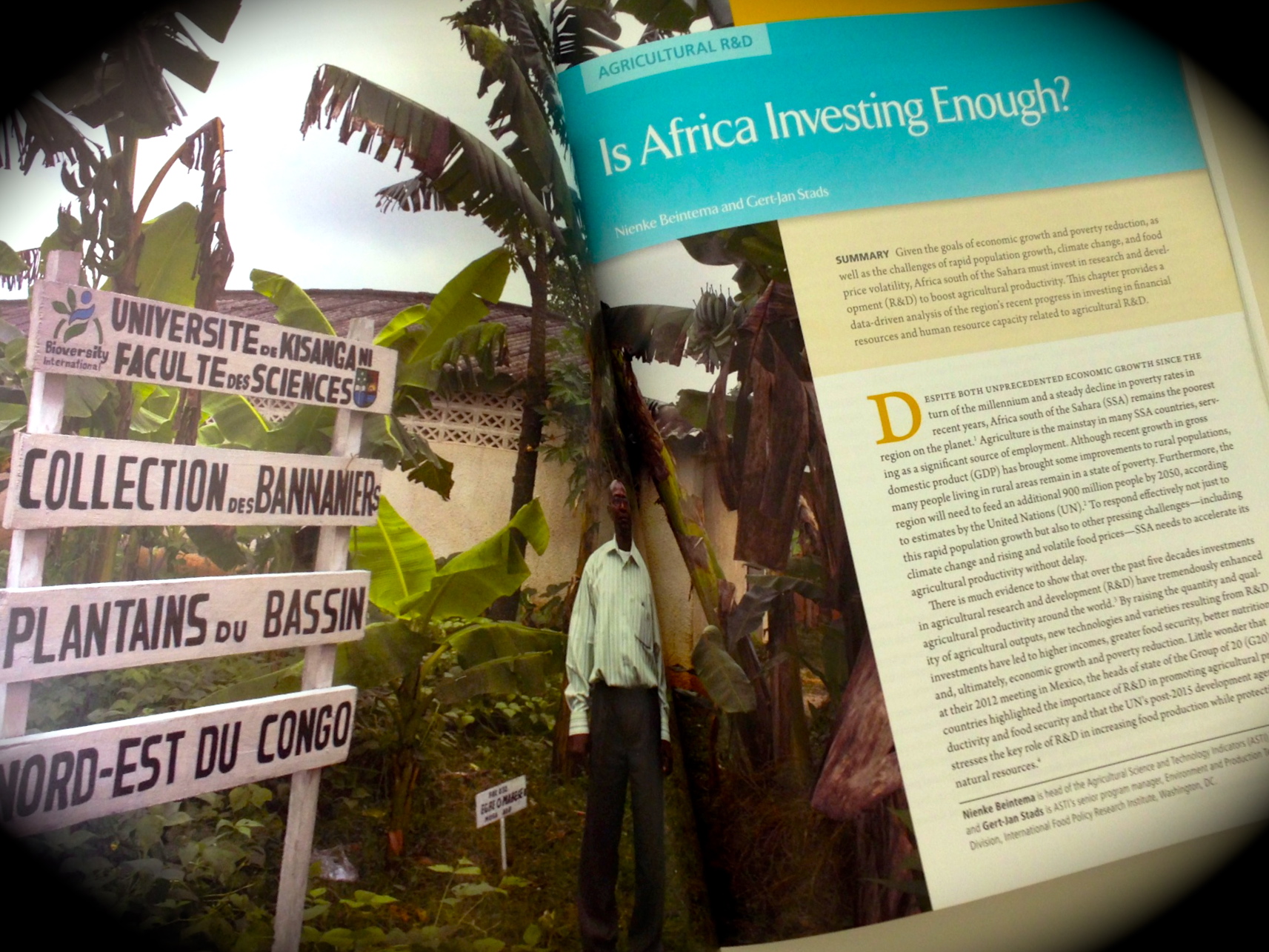
photo (15)IFPRI’s latest Global Food Policy Report is out. I know because I was at the launch a couple of days ago in Berlin. Leafing through the hard copy while listening to IFPRI’s DG summarize the main findings, I was heartened to see the photo reproduced here, at the start of the section entitled “Is Africa investing enough?”. It’s a banana genebank! In a publication on food policy? Will wonders never cease?

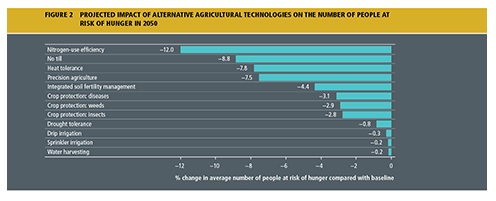
Unfortunately, they did. There’s nothing at all in the report about genebanks, apart from that photo. That’s despite the fact that another section, the one entitled “The promise of innovative farming practices,” did a great job of highlighting the importance of interventions that ultmately depend on the genetic diversity found in genebanks. IFPRI researchers used a geographically explicit modelling approach to predict the effect of 11 different agricultural technologies on yield, global harvested area and number of people at risk of hunger in 2050. They did this for three major staples: maize, rice and wheat.

It turned out that of the three breeding-based technologies included among the 11 — that is, new varieties that are more heat tolerant, N-efficient or drought-tolerant — the first two were consistently the ones resulting in the greatest impact. No-till agriculture was also up there. But really, if you were going to do just one thing to alleviate hunger, breeding for N-efficiency would probably be it, according to this analysis.
Screen Shot 2014-06-14 at 11.28.23 PM

So why not mention the source of the raw materials for doing that? Especially as IFPRI’s fellow CGIAR centres manage global germplasm collections of these crops which have been formally recognized as fundamentally important to food security (check out Article 15 of the International Treaty for Food and Agriculture). It’s amazing how no opportunity is ever wasted of taking genebanks for granted.

Brainfood: Open sesame, Turkish buffalo, Crops & diets, Tuberous-rooted chervil, Pine breeding, Pigeonpea diversity, Sorghum adoption, Slumdog trees, Regenerating wild sunflower

Nibbles: Colombian chocolate, Urban ag, Subaks, GM debate, Taxonomy online, Genebank tools online, BBC on Kew, Australian seed bank, Cedar of Lebanon, Pizza philosophy, Feijoada

Oldie but goldie story of sweet potatoes traveling back to NZ

The Māori kumara would have been lost were it not for the efforts of a Yen, who collected 617 kumara varieties from all over the world during the 1950s and 1960s. In 1963, when the collection became too big for the DSIR to maintain, Dr Yen arranged for its safekeeping in three gene banks in Japan. Interest in the collection was revived in 1988 at an ethnobotanical conference organised by the DSIR. Members of Pu Hao Rangi, a Manukau-based Māori Resource Centre, journeyed to Japan and brought back 9 New Zealand kumara varieties, 4 of which were identified as pre-European varieties. These are now cultivated by several Māori groups.

I came across this feel-good story of genebank use today in connection with something else I was doing, and I was sure I’d at least pointed to it before on the blog. Too heart-warming not to have done so. Alas, I can find no evidence to that effect, so here goes. There’s a bit more about what happened in a Bioversity proceedings volume from 2001:

Dr. Douglas E. Yen of the New Zealand National Research Institute for Crops collected about 600 sweetpotato landraces from the Pan-Pacific area (Yen 1974), including some New Zealand landraces. When Dr. Yen retired from the institute, the New Zealand government decided not to maintain his collection. The U.S. and Japanese governments, who were afraid that this precious collection might be lost, took over its management in 1969. Now 362 accessions of the Yen collection are preserved in our genebank at the National Institute of Crops Science (NICS).

The collection put together by Dr Yen was of great historical significance, as he based his pioneering monograph on the ethnobotany of the crop on it. It would be nice to know if it’s still around, and where. Unfortunately, there are a number of institutes in Japan conserving sweet potatoes, and I can’t figure out which one is the National Institute of Crops Science. Anyway, here’s what happened next:

The Maori Chiefs Conference decided to send a delegation to visit Japan and bring back their landraces. On 18 November 1988, four Maori chiefs visited our institute for a special ceremony turning over their sweetpotato landraces back to them. Among our Yen collection, we returned nine accessions (Y-500, Y-501, Y-502, Y-503, Y-504, Y-507, Y-508, Y-512, and Y-513) to the Maori chiefs. Since then, the Maoris are preserving these landraces as a precious gift from their ancestors.

Now, I would have said that the National Institute of Crops Science is what is now known as the National Institute of Agrobiological Sciences (NIAS), but entering those accession numbers in their database returns sorghums, so maybe not. But I’m looking into it, fear not.