- Agricultural Heritage Systems: A Bridge between Urban and Rural Development. “…agricultural heritage systems can take full advantage of abundant funds…” Really?
- Multi cob-bearing popcorn (Puakzo) maize: a unique landrace of Mizoram, North East, India. Would be nice to know how unique globally.
- Enabled or disabled: Is the environment right for using biodiversity to improve nutrition? Maybe, in some places.
- Orbitide Composition of Flax Core Collection (FCC). In other news, Canada has a flax core collection.
- Farmer Perspectives on OCA (Oxalis tuberosa; Oxalidaceae) Diversity Conservation: Values and Threats. It’s the cultural value, stupid. And weevils.
- The expansion of modern agriculture and global biodiversity decline: an integrated assessment. Fancy maths shows that if you assume that unabated agricultural expansion is bad in a particular way, you can come up with a model which spares land at a modest cost to per capita consumption, given decent investment in research.
- Nuclear genetic variation of Rosa odorata var. gigantea (Rosaceae): population structure and conservation implications. Wild relative of domesticated rose shows lots of diversity and two distinct populations either side of a fault zone in China.
- Worldwide Evaluation of Quinoa: Preliminary Results from Post International Year of Quinoa FAO Projects in 9 Countries. 19 sites, 21 genotypes, a few winners. But the real story is how difficult it was to get hold of the material in the first place.
- Shaping Seed Regulation in Nepal: The Role of Networks, Community and Informality. The formal needs to recognize the informal. And vice versa.
- Crop domestication in the upper Madeira River basin. Nice, brief review of evidence of domestication for a number of crops along one branch of the Amazon.
- Analysing genebank collections using “R”: Making trait information widely available to users. NordGen takes genebank data analysis to the masses. And about time too.
Brainfood: Yam protection, Gleditsia distribution, Seed systems, Conservation narratives, Roselle diversity, Hassawi extinction, Apple GWAS, Dog domestication
- Disease risk perception and diversity of management strategies by farmers: The case of anthracnose caused by Colletotrichum gloeosporioides on water yams (Dioscorea alata) in Guadeloupe. Farmers gauge the disease pretty much the way scientists do, and use a diversity of mitigation measures, including diversity.
- Ghosts of Cultivation Past – Native American Dispersal Legacy Persists in Tree Distribution. “In the southern Appalachian region, honey locust distributions are more a reflection of Native American cultural practices.”
- Good year, bad year: changing strategies, changing networks? A two-year study on seed acquisition in northern Cameroon. In bad years, women call on extended networks.
- Conservation narratives in Peru: envisioning biodiversity in sustainable development. In terms of the relationship between conservation and development, there are biodiversity protectionists, traditionalists, localists, pragmatists, and capitalists.
- Diversity analysis based on agro-morphological traits and microsatellite based markers in global germplasm collections of roselle (Hibiscus sabdariffa L.). Nicely complementary datasets show that fibre type more diverse than calyx type.
- Extinction probabilities of Hassawi cattle from Saudi Arabia using Population Viability Analysis. Fancy maths gives it 20 years.
- Genome to Phenome Mapping in Apple Using Historical Data. Going back to old phenotype data in GRIN allowed identification of SNPs for color, fruit firmness, and harvest time.
- Genomic and archaeological evidence suggest a dual origin of domestic dogs. Independent domestications from different wolf populations in East Asia and in Western Europe, with the latter partially displacing the former.
As American as apples
Gayle Volk and Adam Henk of USDA recently published a fascinating article on “Historic American Apple Cultivars: Identification and Availability.” Gayle kindly agreed to summarize it for us. Thanks, Gayle. Oh, and by the way, if you like old pictures of old apples (and other fruits), there’s a mesmerizing Twitter feed for you.
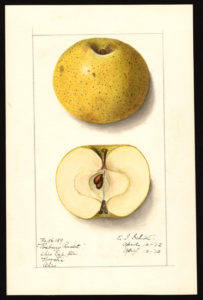
In this work, historic books, publications, and nursery catalogs were used to identify the cultivars that were propagated and grown in the United States prior to 1908. Synonyms, introduction dates, and source country for 891 historic apple cultivars were recorded in total. We then classified them based on their availability over time and popularity in nursery catalogs. We considered the highest priority cultivars for conservation to be those that were actively propagated and sold through multiple nurseries, as well as those that were grown and documented in more than one of the three time periods recorded (pre-1830, 1830-1869, and 1870-1907).
We found that, overall, 90% of the 150 highest priority cultivars are currently available as a result of conservation efforts in genebanks, private collections, and nurseries. Overall, it’s quite remarkable (and likely due in part to the longevity of apple trees) that these trees remain available, since the USDA National Plant Germplasm System Clonal Repository, where apple cultivars are conserved, wasn’t established until the 1980s. Cultivars that are not currently protected within genebanks but considered high priority were identified and suggested for inclusion in genebanks in the future. There were 51 high priority cultivars identified as possible additions to genebank conservation efforts, many of which may be available from the National Fruit Collection in Brogdale, England, and the Temperate Orchard Conservancy in Oregon.
This information will be useful for the many landholders who have historic apple trees on their properties. Identification efforts may make use of lists of historic cultivars to help determine identities based on either DNA fingerprinting or phenotypic traits.
Brainfood: Rice & drought, Diet & biodiversity, Iranian fermentation
- Genetic and root phenotype diversity in Sri Lankan rice landraces may be related to drought resistance. Fancy genotyping and phenotyping picks out landrace whose name in Sinhalese means “drought rice.”
- The relationship between agricultural biodiversity, dietary diversity, household food security, and stunting of children in rural Kenya. Increasing dietary diversity could increase household food security.
- Biodiversity and origin of the microbial populations isolated from Masske, a traditional Iranian dairy product made from fermented Ewe’s milk. Streptococcus thermophilus doesn’t sound like a safe thing to be drinking, but I still want to try it.
- Well, what can I tell ya, that’s all that caught my eye last week. Send me your favourite paper that I missed, and I’ll summarize it in a sentence by next Monday.
Potatoes at the Chelsea Flower Show, again
Nice to see agricultural biodiversity on display at the Chelsea Flower Show, in the form of potatoes, of all things. Scroll down past the very boring flowers to the very exciting tuber display. A similar — maybe the same? — display actually won a prize last year, which I can’t think how we missed.