- Don’t understand the Global Strategy for Plant Conservation? Fear not, help is at hand.
- Don’t understand livestock genetics? Fear not, help is at hand.
- Don’t understand how ICTs could assist agricultural development? Fear not, help is at hand.
- Don’t understand how climate change affects vegetable genetic resources. Fear not, do this postdoc at Wageningen and you will.
Brainfood: OSP adoption, Milk quality, Passport data quality, Historical collections, Sweet potato domestication, African veggies, Baobab diversity and domestication, Cassava diversity, Strawberry breeding, Barley GWA, Pest symbionts, Maize diversity and climate change
- A large-scale intervention to introduce orange sweet potato in rural Mozambique increases vitamin A intakes among children and women. Just 1 year of training worked just as well as a higher intensity intervention (3 years) in increasing OSP and vitamin A intake by younger children, older children and women, and decreasing prevalence of inadequate vitamin A intakes. OSP represented about half of all sweet potatoes consumed so I guess there was not complete replacement of local varieties.
- Composition of milk from minor dairy animals and buffalo breeds: a biodiversity perspective. There are significant interbreed and inter-species differences. Dromedary milk is closest to cow milk, mare and donkey milk maybe the healthiest, but moose milk is the one I’d like to try.
- Quality indicators for passport data in ex situ genebanks. That would be the genebanks in Eurisco. Verdict: not bad, but could do better. Most variation in quality is among institutes.
- Exploring the population genetics of genebank and historical landrace varieties. Old samples of dead seeds of 4 crops in Swedish museum jars more genetically variable than genebank accessions, but it’s not the genebank’s fault. And at least their seeds are still alive. Also no genetic correspondence between geographically matched museum and genebank samples.
- Combining chloroplast and nuclear microsatellites to investigate origin and dispersal of New World sweet potato landraces. Two areas of domestication, probably from a single wild progenitor species: lowland NW South America and lowland Central America/Caribbean. Genetic differences between these 2 genepools not accompanied by morphological differences, but then again nobody’s looked properly, and the current descriptors are useless anyway.
- The significance of African vegetables in ensuring food security for South Africa’s rural poor. Their huge potential is being thwarted by evil extensionists. Ok, but don’t we need to move beyond that?
- Comparative study on baobab fruit morphological variation between western and south-eastern Africa: opportunities for domestication. Hang on a minute, aren’t there a million factsheets about all this?
- Marriage exchanges, seed exchanges, and the dynamics of manioc diversity. Kinship structures determine cassava diversity patterns in Gabon. Matrilineal societies have more diversity.
- Interspecific hybridization of diploids and octoploids in strawberry. You get pentaploid and tetraploid plants.
- Genome wide association analyses for drought tolerance related traits in barley (Hordeum vulgare L.). Ok, deep breath. Over 200 accessions, both wild and cultivated, from 30 countries, so quite variable, but also structured. There were some QTLs that differed between dry and wet sites, but they didn’t explain much phenotypic variation, and they couldn’t be related to previous work. So GWA not much use, probably because of population structure. But couldn’t that have been predicted? And isn’t it possible to do something about structure in the analysis?
- Population genetics of beneficial heritable symbionts. Of insects, that is. Mostly proteobacteria. So my question is, could somehow attacking the symbionts form the basis of a pest management strategy?
- Projecting the effects of climate change on the distribution of maize races and their wild relatives in Mexico. Many races and wild relatives are predicted to shift in geographic distribution. Unless of course agronomy intervenes. Teocinte taxa should be collected.
Conservation status of European crop wild relatives assessed
The latest IUCN assessment of the conservation status of European biodiversity is out, and is making the news. The bit on plants is co-authored by Melanie Bilz, Shelagh P. Kell, Nigel Maxted and Richard V. Lansdown and, unsurprisingly perhaps given their track record, includes, I believe for the first time, extensive discussion of crop wild relatives as a distinct class. 1 The authors, which coordinated input from dozens of experts, conclude that out of a total of 591 CWR species:
Within the EU 27, at least 10.5% of the CWR species assessed are threatened, of which at least 3.5% are Critically Endangered, 3.3% Endangered and 3.8% Vulnerable – in addition, 4.0% of the species are considered as Near Threatened. One species, Allium jubatum, is Regionally Extinct within Europe and the EU; it is native to Asiatic Turkey and Bulgaria, but has not been found in Bulgaria since its original collection in 1844.
It does not even seem to be available from botanic gardens, according to Botanic Gardens Conservation International’s database. I don’t know what has caused its disappearance in Bulgaria, but currently the main threats to CWRs seem to be intensified livestock farming, tourist development and invasives:
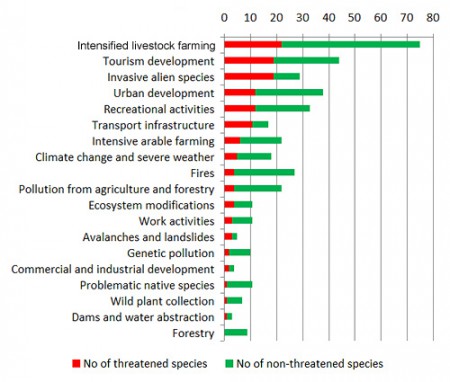
And there are maps 2 of both the distribution of overall CWR species richness and of the most threatened species:
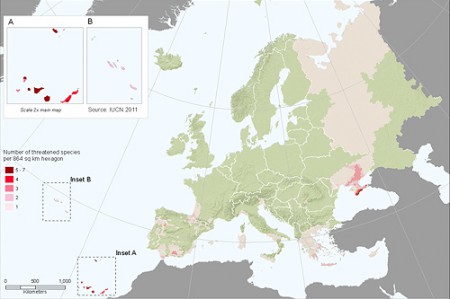
An extremely useful review is provided of previous work assessing the extent to which CWRs are conserved in genebanks, botanical gardens and protected areas in Europe. But here perhaps I would like to quibble with the authors. Although their listing of existing conservation efforts seems to me thorough and comprehensive, there is no attempt made to synthesize the results of all the different initiatives and come up with a list, however preliminary, of high priority plants for immediate conservation intervention. Surely it would not have been particularly difficult to cross-reference their list of threatened species with listings of accessions in Eurisco and the BGCI database, for example. Maybe this was beyond the scope of this particular exercise and is the focus of parallel work. Perhaps Nigel or Shelagh will respond here.
This is a very important contribution to raising the profile of CWRs within the biodiversity conservation community. Let us hope that it will translate into increased support for their conservation, both ex situ and in situ, along the lines so usefully set out by the authors in their recommendations.
Rounding up wild Guatemalan cacao accessions
…are there really no wild Guatemalan cacao accessions conserved in genebanks around the world?
I asked the question, so I better have a go at answering it, I suppose.
WIEWS shows no wild cacao from Guatemala, and actually not all that much cacao in Guatemala of any kind. GRIN returns 10 Theobroma accessions from Guatemala, but none of them are described as wild. The International Cocoa Germplasm Database (ICGD) returns 6 accessions from 4 localities. Here they are shown as crosses.
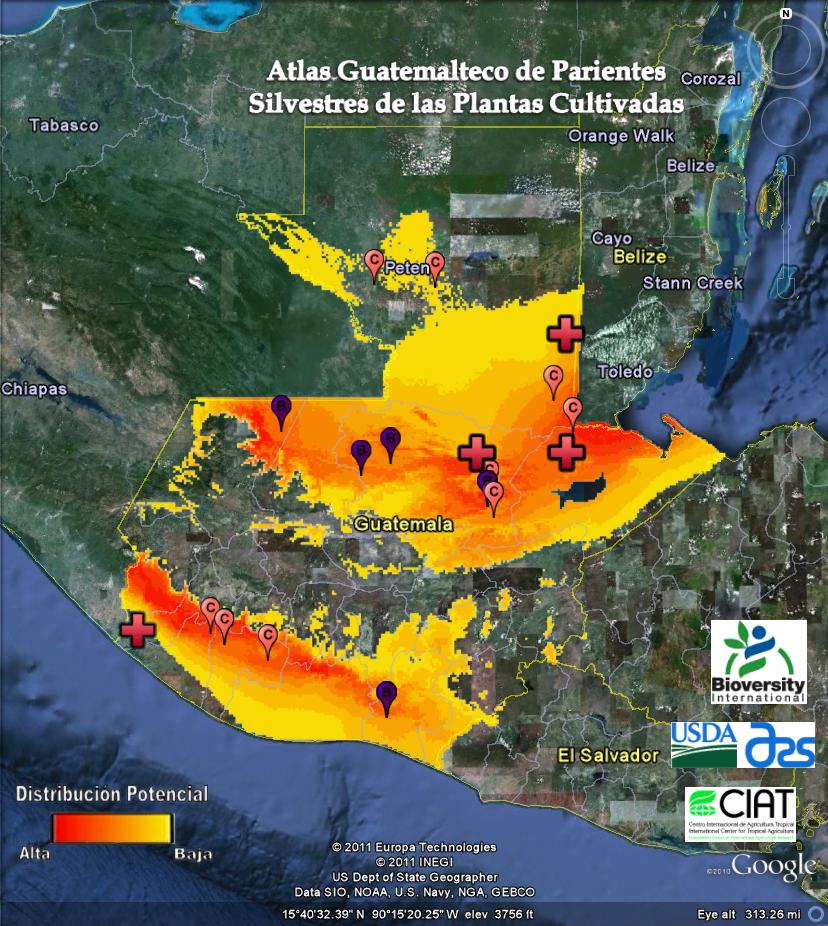
I got them into Google Earth via DIVA-GIS. The other icons show the distribution of herbarium specimens of wild T. cacao (C) and T. bicolor (B) and the predicted range of the former, according to the Guatemalan CWR atlas I blogged about yesterday. But you can’t tell from the data in ICGD whether the accessions represented by crosses are wild or not. Don’t worry though, there’s a reference given for all the accessions, so all is not lost: Rivera De Leon, S. (1986). Informe general sobre el proyecto de recoleccion de cacao Criollo en Guatemala. Unpublished report AGPG:IBPGR (FAO Rome)/86/156. Estacion de Fomento Los Brillantes, Guatemala.
It is an IBPGR report, so it should be available in the Bioversity’s Collecting Missions Files Repository. Which it is, although finding it was non-trivial. I’m not sure if that last link is going to last long, so look for collecting mission CN234. The problem is, I can see no way of attaching the description of the material given in the report to one or another of the accessions in ICGD. So although it does look from the report as though some of the material collected in 1986 may have been wild, I can’t tell you which if any of those crosses in the map above could legitimately be added to the Atlas of Guatemalan Crop Wild Relatives.
So the answer to the question I started out with is: I don’t know. I suppose it’ll take an expert in the crop to sort it out. You come up against this again and again in Genebank Database Hell. You can get so far, but to get any further you need human intervention.
Mapping crop wild relatives in Guatemala
Good news for lovers of Mesoamerican crop wild relatives. Ten years in the making, the Atlas of Guatemalan Crop Wild Relatives (Atlas Guatemalteco de Parientes Silvestres de las Plantas Cultivadas) is finally out. 3
The Atlas provides detailed information on 105 species or subspecies of wild Guatemalan plants that are related to crops, including their description, distribution, diversity and conservation status. The species are organized into genepools corresponding to the 29 crops that were chosen for this study because of their economic, cultural and biological importance. Through an interactive Google Earth® interface, users of the Atlas can consult individual maps for each of the 105 plants included in the study, showing their known distribution based on the locations where scientific specimens were collected and projections of their potential range based on climate. Additional maps display areas of high species richness and diversity to assist conservation efforts. The maps draw upon a database of 2,600 records of scientific specimens conserved in numerous national and international institutions, primarily herbaria and seed banks.
I’ve been playing around with it and it is pretty easy to use. Once you open the database in Google Earth 4 you can map the actual and potential distributions of individual species within each of the genepools, and also of the genepool as a whole. This, for example, is what you get for Phaseolus.
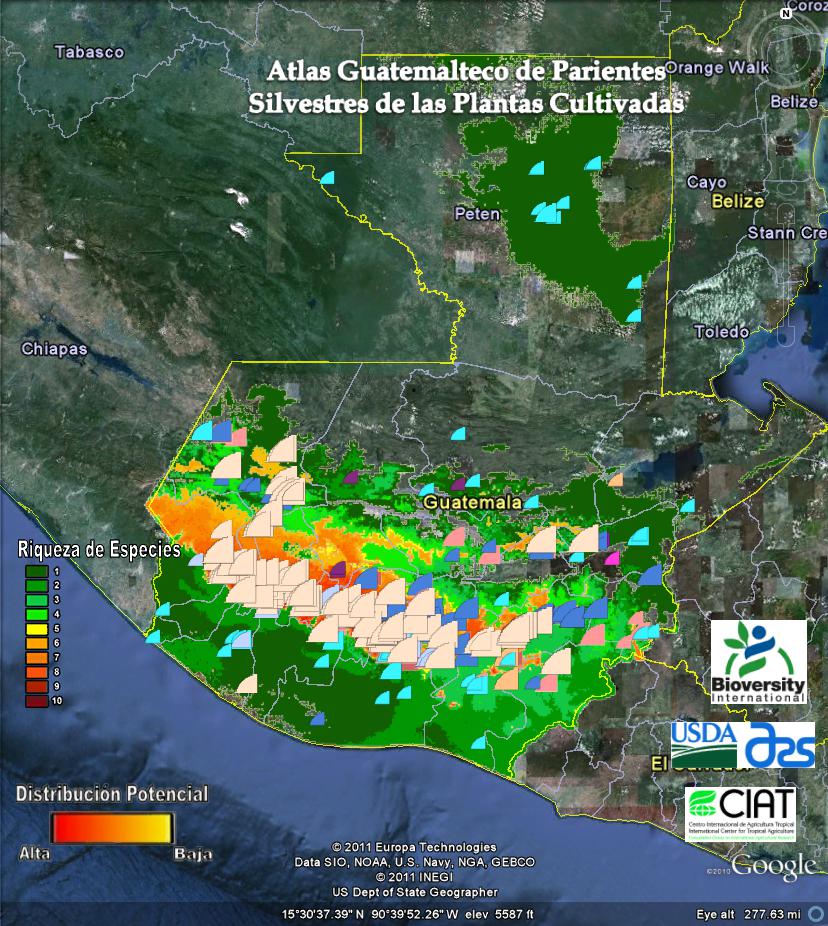
The green-to-red colouring shows the geographic distribution of species richness within the genus. One could quibble on aesthetic grounds about the choice of icon in this case, but that can always be changed by fiddling with the properties of the appropriate layer in Google Earth. More important is that the potential distributions and richness maps are clipped to the borders of Guatemala. I can understand the logic for that, an unwillingness to extrapolate, but I would perhaps have taken the risk, if only to stimulate neighbouring countries to embark on similar efforts.
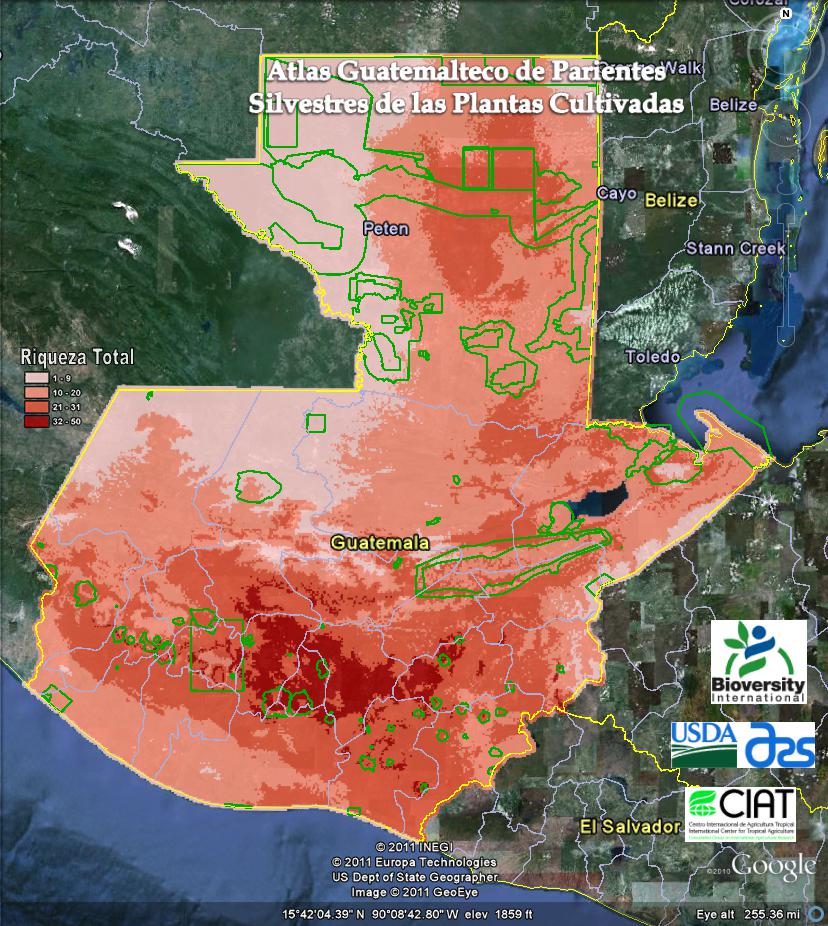
The Atlas also allows you to look at the distribution of specimens and species richness in the dataset as a whole, and helpfully provides a layer on the protected areas of Guatemala. So this is all the specimens that the authors looked at, mapped together with the extents of national parks, archaeological sites and the like.
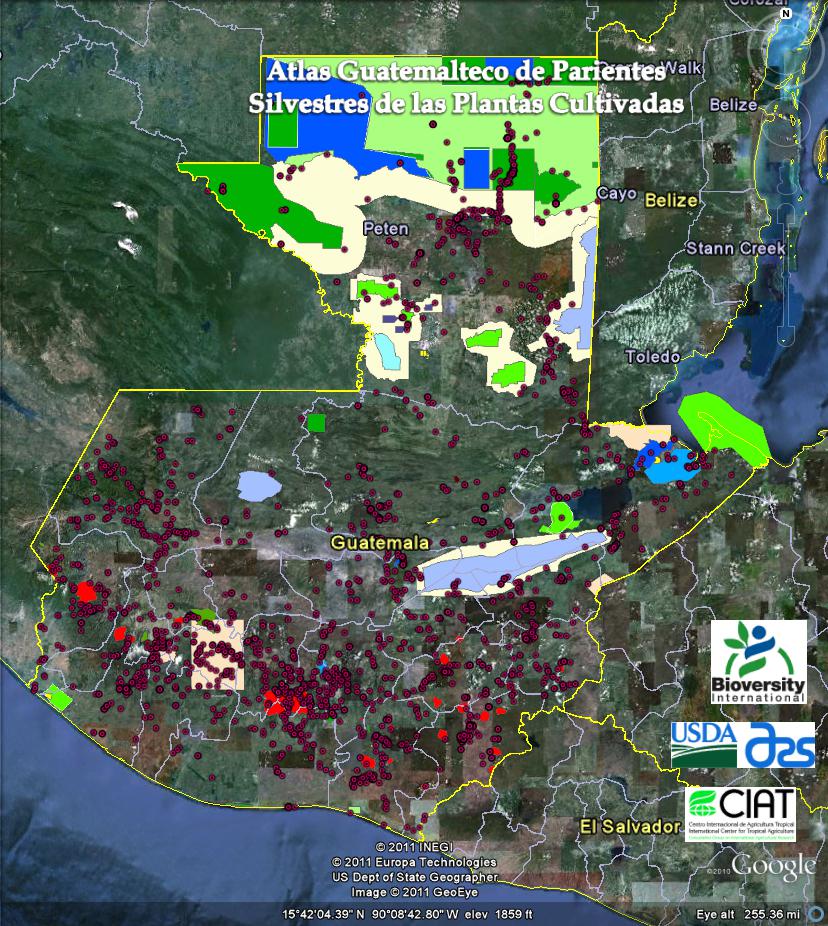
Just a little more fiddling with the properties of the layers allows you to see to what extent areas high in richness of crop wild relative species can be found within the confines of protected areas. The answer? Not much.
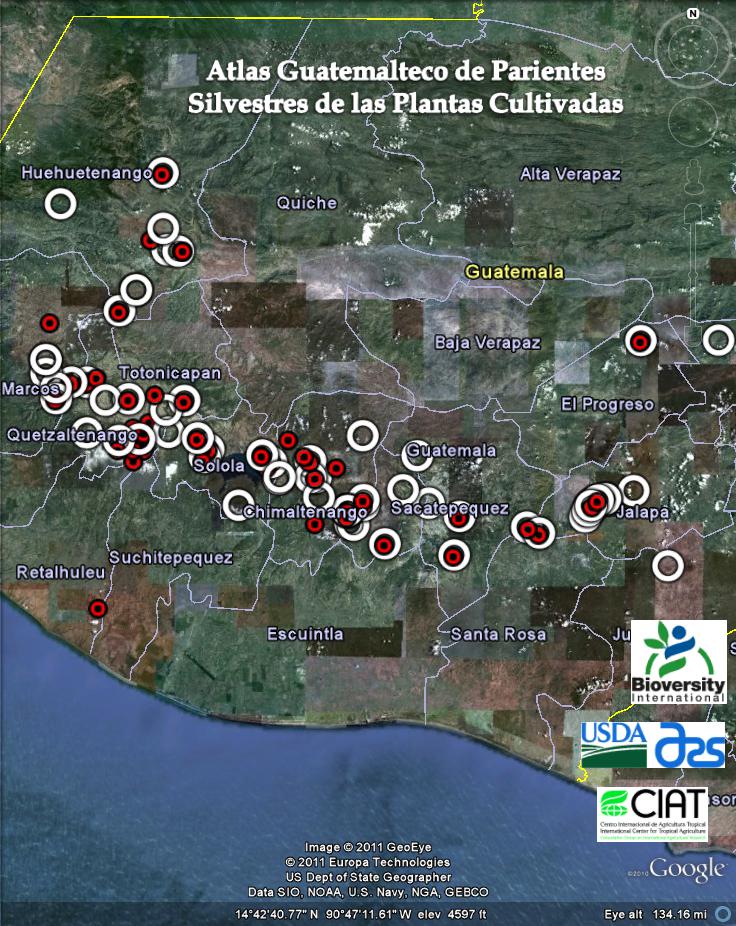
I don’t know enough about the flora of the region to be sure whether all the relevant species have been included, but the coverage looks pretty comprehensive to me. Clicking on the specimen icons gives you useful basic metadata. In some cases, the specimens are distinguished as to whether they are from herbaria and/or genebanks. So in this case the red dots are germplasm and the rings herbarium specimens of Phaseolus coccineus, which allows a rudimentary form of gap analysis, I suppose.
Perhaps more effort could have been expended in this direction. For example, are there really no wild Guatemalan cacao accessions conserved in genebanks around the world? And could not a little widget have been concocted to very roughly delimit gappy-looking areas? But that is to quibble, and no doubt both data and functionality could be added in the future. An English translation certainly will be. This will prove a marvellous conservation resource. Congratulations to the authors. 5 Now, guys, what about Paraguay?