- SeedUSoon: A New Software Program to Improve Seed Stock Management and Plant Line Exchanges between Research Laboratories. Great name.
- Building a Global System for the conservation and use of all plant diversity. Botanical gardens learning from crop genebanks?
- Understanding potato with the help of genomics. Crop genebank learning from genomics.
- What are the socioeconomic implications of the value chain of biodiversity products? A case study in Northeastern Brazil. Two Amazonian fruits, very different markets.
- Weak Genetic Structure in Northern African Dromedary Camels Reflects Their Unique Evolutionary History. Severe bottlenecks and long-distance movement makes for quite a genetic mess.
- Genetic variation for tuber mineral concentrations in accessions of the Commonwealth Potato Collection. Is considerable, and might be useful in breeding. I’m shocked.
- The Domestic Livestock Resources of Turkey: Social Aspects, Genetic Resources and Conservation of Companion Animal Cats (Felis Catus). The nondescript cats are not in danger.
- Feasting, Social Complexity, and the Emergence of the Early Neolithic of Upper Mesopotamia: A View from Göbekli Tepe. Agriculture as a result of religious feasting. No word on the role of cats.
- Economic Development and Forest Cover: Evidence from Satellite Data. More money = more deforestation.
A moving botanic garden story
My new post over at work looks at some of the differences, and similarities, between the worlds of botanical gardens and genebanks.
The photo of the Royal Botanic Garden Edinburgh which accompanies a tweet about the piece, though, is a bit out of date:
Read latest Science blog by @AgroBiodiverse: "A Turn in Dr Sibbald’s Garden" https://t.co/ktNuyXLDpV pic.twitter.com/CpUca61E1t
— The Crop Trust (@CropTrust) January 30, 2017
It turns out that the hedge archway now leads to the Botanic Cottage, which had to be moved there stone by stone from the previous location of the garden in order to save it.
Now home to the @BotanicCottage! @AgroBioDiverse @SteveBlackm0re @CropTrust pic.twitter.com/BllfQRrd9C
— Royal Botanic Garden Edinburgh (@TheBotanics) January 31, 2017
It now even has a Twitter account.
Migrant coconuts
A couple of days ago, Jay Bost asked about the origin of coconuts in the Americas:
Anyone ever explore possibility of dispersal of coconut to Americas by Polynesians? Given movement of sweet potato and chickens, any chance they brought coconut?
The answer, it turns out, is out there. I take the liberty here of highlighting what might otherwise remain somewhat buried in a comment on a comment:
Gunn et al. (2011) suggest that the species, “a native of the Old World tropic…was spread to eastern Polynesia and subsequently introduced to the Pacific coasts of Latin America, most likely by pre-Columbian Austronesian seafarers from the Philippines”. Figure 2. is a great schematic showing coconut dispersal routes by humans
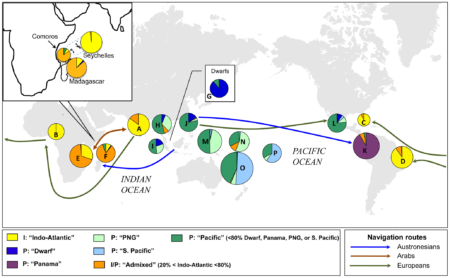
Just sayin’
https://twitter.com/may_gun/status/824704129142370304
Coconut history 102
Yesterday’ post by Hugh Harries on the recent article in AramcoWord entitled Cracking Coconut’s History, by Ramin Ganeshram, elicited this response from another coconut expert, Luc Baudouin, on the coconut google group.
I enjoyed reading the [article], especially the picture from Dioscorides’s Tractatus De Herbis, a 15th Century manuscript. Congratulations to the author. While I share several of Hugh’s comments, I beg to differ as regards the presence of coconut on the Pacific coast of America. Several travellers mention its presence and provide multiple evidence. I will mention only two diagnostic traits.
The first one is simply that coconut has huge fruits, unparalleled among palms (except for Lodoicea maldivica, known as… the sea coconut). That the coconut fruit is as big as a human head was mentioned in virtually all accounts of coconut before AD 1500 and can thus be considered as part of the definition of coconut at that time. It is thus unreasonable to suppose that palms such as Attalea, Bactris or Elaeis were misidentified as coconut. In fact, palms of these and other genera were described as distinct ‘kinds’ by Oviedo, and their nuts were described as comparable to a coconut, but “the size of a walnut”, or “of a Seville olive” etc.
The second one is seed dissemination by oceanic currents, which is unique to coconut among palms. It was observed in the mouth of the Santa Maria river, southern from the old Spanish town of Nata. This used to be a bay which was converted into a salt works. The original population still exists in Aguadulce.
When and where was coconut first brought to America clearly remains an open question. BC 150 in the Bahia de Caraquez? AD 800 in the Gulf of Guayaquil? Or some other unidentified landing? We really don’t know but it was clearly before the Spaniards arrived. One may hesitate to admit it because of the extremely long distance from the Philippines to the American coasts, but it’s a fact. Hugh mentioned the presence of coconuts of the San Ramon type in Guam and this could contribute to ease the problem. It would be a two-leg journey.
In this context, the question of survival should be taken in the opposite way. While the Panama Tall can be described as an ‘incipient domesticate’, it did thrive at a small number of locations on the Pacific coasts of America. This shows that it did not lose its ability to propagate itself without human help (but in the absence of competitors that are more adapted to long distance dissemination).
I am talking of the Pacific coast of Panama. As regards Mexico and the Caribbean, I agree with Hugh.