- Emma Cooper blogs her ethnobotanical MSc dissertation on British homegardeners and their cool crops.
- If she’d done her work in Sweden, she’d have written about Ragnar Pettersson and his “treasure of Ardre.”
- The downside of backyard farming: homeless hens.
- International e-Conference on Germplasm Data Interoperability: Genebank Database Hell gets an e-conference. What could possibly go wrong.
- Apparently there’s a new way to search for agricultural bibliografic (sic) data.
- CIMMYT gets its maize out there.
- ICRISAT is not one to hide its light under a bushel either.
- Aussies to survey their yeasts and bacteria to improve winemaking.
- The problems of India: “It takes a particular brand of incompetence and neglect for decades of stellar growth to have no apparent impact on India’s sky-high levels of under-nutrition.” I bet Dreze and Sen didn’t include a food bubble. Hey, but that can be exported.
- Oh and happy World Soil Day! Thanks to it, and Jim Croft, I now know Australia has a sort of soil genebank.
Nibbles: EU rules, Squash, Potato, Agroforestry textbook, Wine for health, Ag history, Breeding stories, Food security reports, Talking to policymakers
- Plants for Europe is (are?) incensed about new EU regulations. Should it/they be?
- Squash is a Native American word, natch. I bet they’re incensed.
- Speaking of Native American crops, here’s a big writeup on the potato, including great pix, and nice shoutout for the CIP genebank.
- If you live in the tropics and want to learn about agroforestry, you could just go out and talk to the first smallholder you meet. Or you could read a textbook.
- A roundtable on whether genetics can help us figure out whether wine is good for you. When they do the large scale clinical trial, as they surely must, I’ll be first in line.
- The breakthroughs of agriculture. Sadly, working out the seed viability equation does not feature. Nor does vegetarianism.
- Breeding does, though. And here’s an example why, featuring soybeans.
- And another from rice: IRRI bags another silver bullet gene.
- And we’ll soon have those in cotton too.
- Which is all fully recognized in the latest WRI report on how to feed the world.
- Though not in this other mega-report on Brazil, at least not quite so explicitly.
- “We need more research” is the wrong answer. Even when it’s breeding?
Food globalization under Mowbray’s Cupola
 One of the highlights of my recent trip to India was dinner with Prof. Swaminathan and some of his colleagues at the Madras Club. That’s me under the club’s famed 18th century cupola. The Madras Club is reputed to be the birthplace of mulligatawny soup, so I was planning a post showing how this quintessentially Indian concoction illustrates global interdependence in food products, complete with map of the worldwide origin of the ingredients. A map like this.
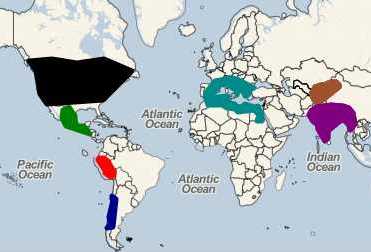
But it was Italian night, and I had minestrone.
Outsourcing rice germplasm collecting
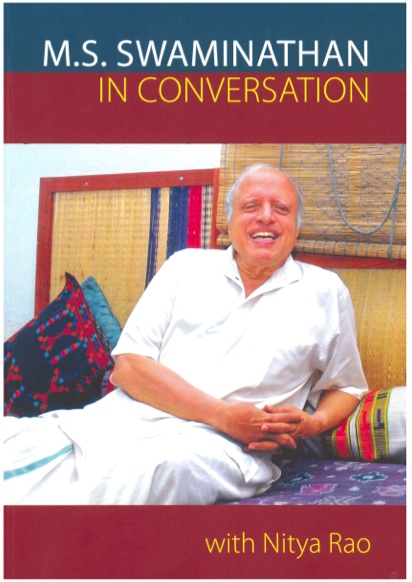 One of the highlights of my recent trip to India was receiving a copy of the booklet “M.S. Swaminathan in Conversation with Nitya Rao” from the great man himself. Sure, you can of course download the thing in PDF. But my copy is signed :)
Anyway, there’s lots of interesting stuff in there about Prof. Swaminathan’s life and career, a career that included a number of very high level positions in agricultural research and development in India (which earned him the title of “Father of the Green Revolution in India,” among other things), but also a very successful stint as director general of IRRI. Given Prof. Swaminathan’s lifelong interest in genetic resources conservation, it came as no surprise to see the IRRI genebank mentioned a number of times.
What was surprising, at least to me, were the somewhat unconventional methods that were sometimes used to make sure that endangered diversity did in fact reach the genebank. Here’s a snippet, you can find more on page 53.
Burma, now Myanmar, has a lot of germplasm, similar to what we have in our North East. However, this was not collected because these were very disturbed areas. When I went to Myanmar from IRRI, I told General Yu Gong that he should give some protection to our collectors. ‘Why Swaminathan, why do you want to send your people? You train my soldiers on how to collect and what to collect, and they will do this for you’. We made a very good programme, I was there for the first two days. T. T. Chang ran the programme, explaining to the generals and the soldiers how to collect what we call ‘passport data’ about the plant. They collected about 9,000 varieties. I must give credit to General Yu Gong for opening my eyes to this potential.
I have in the past mused about decentralized approaches to collecting for ex situ conservation (see, for example, slide 19 in these training materials on germplasm collecting methods and strategies), but I have to admit that using the military never even occurred to me.
Nibbles: ICRISAT award, SIRGEALC awards, Food etymology, Black carrot, Bolivian potatoes, NASA weirdness, Mexican maize, Rice 2.0, Vaccinium
- Dr Upadhyaya Goes to Tampa.
- SIRGEALC participants get prizes too. Maybe one of them can tell us about it.
- First uses of various food words.
- Punjab Black Beauty set to take the carrot world by storm.
- Bolivia conserves its potato relatives. When will it ratify the ITPGRFA and share the love?
- NASA going to grow plants on the Moon. What could possibly go wrong.
- Free trade apparently threatens maize and Mexican culture. I personally think both can take it. They’ve been going for a while.
- You know, I just have no idea what this silly piece about rice in Africa is trying to tell me. Maybe you can figure it out and let me know.
- Celebrating the cranberry.