- If you’re going to grown switchgrass as a biofuel, grow it in variety mixtures.
- The two wild parents of the cultivated peanut get sequenced.
- As also does common bean from its Mesoamerican genepool. Happy International Year of Pulses.
- New wild Aussie tomato gets a cool name. No word on when it will be sequenced. Or how long it will last.
- Speaking of climate change in Australia, wine might be in trouble.
- And more from Down Under: new book on indigenous Australian foods. Some of which may have been cultivated.
- Lots of herbarium specimens have the wrong name. Well I never.
- CIMMYT and ICARDA collaborate on wheat diversity.
- Roman wine rising again from the ashes of Pompeii.
- Exhibition on Colombia’s food plants.
- Portuguese green broth is no doubt very nice, but definitely needs a new name.
- The ancient urban gardens of Istanbul live on.
- Kenya gets on top of using biodiversity for climate change adaptation. Or on top of developing a strategy for doing so, anyway.
- Ola Westengen has a strategy, but you have to speak Norwegian to hear about it.
- Hybrid wheat is 5 years away. How long have they been saying that?
- The latest Rice Today has an article on genebank tourism by Mike Jackson (p. 39), who should know.
- Iowa State University is offering $900 to eat 3 orange bananas.
- Sahaju: saving agricultural biodiversity in India the organic way. Cheaper than $900 too.
- Want to multiply up coconuts really fast? They know how to do it in the Philippines.
Vulnerability of crop wild relatives kinda sorta mapped
There’s a nice paper in Nature on how sensitive vegetation around the world is expected to be to climate change. Here’s the money map.
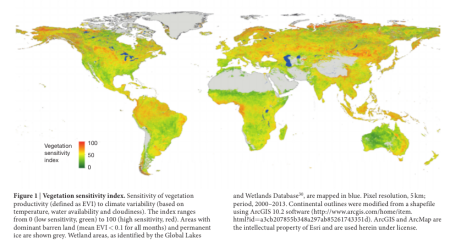
Cries to be mashed up with crop wild relative distributions and gap analysis.
Brainfood: Species shifts, Rewilding caution, Managing grassland, Natural control, Expansion, Rutin, Citrullus core, Open source seeds, Nagoya consequences, Tree diversity
- Altitudinal shifts of the native and introduced flora of California in the context of 20th-century warming. Introduced species are better at spreading upward than the native flora.
- Rewilding is the new Pandora’s box in conservation. Step away from the shiny new box.
- Threatened herbivorous insects maintained by long-term traditional management practices in semi-natural grasslands. Because they can’t compete with generalists better adapted to the new-fangled conditions.
- Agricultural landscape simplification reduces natural pest control: A quantitative synthesis. Aphid control 46% lower in simple landscapes with lots of cultivated land, compared to more diverse landscapes.
- Addressing future trade-offs between biodiversity and cropland expansion to improve food security. Expansion could really help with food security, also in importing countries, but is likely to occur in biodiversity hotspots, which means the devil will be in the spatial detail.
- Quantitative analysis of rutin content using silkworm genetic resources. Wait, silkworm powder?
- Genetic Diversity, Population Structure, and Formation of a Core Collection of 1197 Citrullus Accessions. Microsatellites detect differences between American and E. Asian ecotypes and select diverse subset of 130 accessions from Chinese collection.
- Open Source Foodways: Agricultural Commons and Participatory Art. Seeds as art.
- Implications of the Nagoya Protocol for Genome Resource Banks Composed of Biomaterials from Rare and Endangered Species. There are many, some of them unforeseen.
- Functional Resilience against Climate-Driven Extinctions – Comparing the Functional Diversity of European and North American Tree Floras. Loss of species diversity may be decoupled from loss of functional diversity.
Promoting local varieties through fancy cooking
So, did everyone catch the common strand in a lot of Friday’s Nibbles? I’ll give you a couple more minutes to figure it out, so go and have another look…
Yep, it’s the use of local crops and varieties in gourmet cuisine. And by implication the role of high-end chefs and restaurants 1 in conserving them, for example maize landraces in Oaxaca, everything from potatoes to huacatay in Peru, heirloom rice in the Philippines, and, for added piquancy, wild pepper in Madagascar.
Interesting that a number of CGIAR centres are involved in this kind of work. Although CIP is not mentioned by name in the Peru article, they do have form. And the International Year of Pulses presents an opportunity that some at least are grabbing with both hands. Here’s hoping it’s all part of an ingenious system-wide strategy which will do something about pearl millet next. No, wait…
Squashing that old old squash seeds story
As the story goes, some six years ago, during an archeological dig on the Menomonie Reservation, a clay ball was unearthed. It was clear that there was something inside of this clay ball and, when opened, what was found were squash seeds, carbon dated to 800 years old. Some of these seeds were planted and they grew and bore fruit.
You may remember that from an article we Nibbled last summer. Well, sadly, it ain’t so.
It’s a great story, said Kenton Lobe, an environmental studies professor at Canadian Mennonite University in Winnipeg, Manitoba. And though Lobe can attest to the size of the squash as grown for the last three years by his students at the university’s farm, the rest of the story is untrue, he said.
But the real story is still pretty cool.