- Biogeoinformatics of livestock genomic resources. Don’t forget the “geo” bit. Goes for plants as well!
- Utilization and transfer of forest genetic resources: A global review. They’ve been going on for 200 years, but we’ll need provenance trials and conventional breeding more than ever in the future. Phytosanitary risks involved in tree germplasm movement are now better managed, but the big problem in the future will be Nagoya. Molecular assisted breeding? Meh.
- Genomics and molecular breeding in lesser explored pulse crops: Current trends and future opportunities. We’re mostly still awaiting our jetpacks.
- Orchards as traces of traditional agricultural landscape in Slovakia. About half are left, but they won’t save themselves.
- A wheat phenotyping network to incorporate physiological traits for climate change in South Asia. Local checks significantly earlier than the best CIMMYT can offer. Evaluate the whole genebank?
- Genetic structure of Iranian olive cultivars and their relationship with Mediterranean’s cultivars revealed by SSR markers. The N Iran cultivars are different from everything else.
- Leaf traits associated with drought adaptation in faba bean (Vicia faba L.). Chalk up another success for FIGS.
- Large scale germplasm screening for identification of novel rice blast resistance sources. 289 out of 4246 accessions showed resistance against all five rice blast isolates. The 4246 chosen on basis of “annotated rice blast resistance information” from the IRRI genebank. No word on whether FIGS was considered.
- Genetic Variation of EPAS1 Gene in Tibetan Pigs and Three Low-Altitude Pig Breeds in China. One haplotype seems to be particularly associated with high altitude adaptation. Unclear if that is a really important objective of pig breeding around the world.
- Morpho-physiological variation of Poa alpina L. genetic resources from the Rhaetian Alps, Italy, grown in two altitude-contrasting sites. There was more variation within than among populations, and it’s ok to do seed production for high altitude sites at low altitudes. No word on whether same could be said for alpine pigs.
- Protection of Traditional Knowledge and Origin Products in Developing Countries: Matching Human Rights and IP Protection with Business Development Opportunities. It’s all in the value chain.
Brainfood: Polyculture services, Apple resistance, Clover seed storage, Oil palm diversity, Alternative foods in Italy, Oregano chemicals, Pig diversity, IPR and indigenous people
- Do polycultures promote win-wins or trade-offs in agricultural ecosystem services? A meta-analysis. Yes, at least if the services in question are per-plant yield and biocontrol.
- Susceptibility of apple genotypes from European genetic resources to fire blight (Erwinia amylovora). 3 of 40 were resistant.
- Effect of sulphuric acid scarification on seed accessions of cluster clover (Trifolium glomeratum) stored in a genebank. Potentially disastrous.
- Genetic diversity of the world’s largest oil palm (Elaeis guineensis Jacq.) field genebank accessions using microsatellite markers. 3 groups: extreme W Africa, rest of Africa, Madagascar. Choose parents based on genetic distance, though, not just genetic group.
- Introducing territorial and historical contexts and critical thresholds in the analysis of conservation of agro-biodiversity by Alternative Food Networks, in Tuscany, Italy. Alternative Food Networks can contribute to conservation, but they need context.
- Chemical diversity among different accessions of Origanum vulgare L. ssp. vulgare collected from Central Himalayan region of Uttarakhand, India. 2 chemotypes, the one with higher thymol mainly from higher altitudes.
- Merging Molecular Data for Evaluating Cross Country Genetic Diversity of Pigs. Microsatellite datasets from USA, China and Brazil successfully combined and analyzed together. Should be more of this kind of thing.
- How Are Indigenous and Local Communities’ Rights Over Their Traditional Knowledge and Genetic Resources Protected in Current Free Trade Negotiations? Highlighting the Draft Trans-Pacific Partnership Agreement (TTPA). Indigenous people are generally not given stronger rights over their intellectual property in international instruments compared to non-indigenous people. Rights over IP are in general stronger than over genetic resources.
Nibbles: ILRI@40, CIAT cleanup, Breadfruit factsheets, Spice book, Senegalese e-goats, Natural history collections, Seed supplies, Bean breeding, Institution building, Eat This Podcast, Phenotyping, Indian eggplant, GMO Terminator
- ILRI celebrates 40 years with a major conference.
- Keeping the CIAT germplasm collection nice and clean.
- New variety information sheets from the Breadfruit Institute.
- Review of Gary Nabhan’s new book, Cumin, Camels, and Caravans: A Spice Odyssey.
- Buying goats online.
- What would you do with one billion historical biodiversity data points?
- The tools of the seed-saver‘s trade.
- How to stress your beans, and why.
- A place for conservation organizations to hang out and share. You have to register, but this looks interesting.
- Jeremy has a second Twitter home.
- All 115 plant image analysis software solutions…
- Hyderabad’s brinjal obsession.
- A GMO terminator technology?
Brainfood: Ethiopian landuse history, Linum diversity, Chinese melons, Organic cauliflower, Mexican mission citrus, Saline mungbeans, Saving the elm, Future Fusarium, Wheat biofortification, PPB and public value
- Dynamics and driving forces of agricultural landscapes in Southern Ethiopia – a case study of the Chencha and Arbaminch areas. It’s the population pressure, stupid. No word on what expansion of agriculture and decrease in holding size is doing to agricultural biodiversity. Or wild relatives, for that matter.
- The potential of pale flax as a source of useful genetic variation for cultivated flax revealed through molecular diversity and association analyses. Levels of diversity similar in wild and cultivated, but strong differentiation between the two.
- Microsatellite analysis of genetic relationships between wild and cultivated melons in Northwest and Central China. For the true wild melons, go to the NW. Others may be escapes and introgressions.
- Evaluation of cauliflower genebank accessions under organic and conventional cultivation in Southern Germany. Genotype performance differs depending on cultivation method. But if you want to breed specifically for organic conditions, here’s what to use.
- Mission and Modern Citrus Species Diversity of Baja California Peninsula Oases. Lots of unique types in the mission oases and surrounding ranches. For how long? Well, here’s the baseline. I’d like to know about the agritourism potential.
- Evaluation of mungbean genotypes for salt tolerance at early seedling growth stage. From the Indian core collection. Some good stuff found.
- Implementing the dynamic conservation of elm genetic resources in Europe: case studies and perspectives. Genebanks are not enough. But then again, nobody ever said they were.
- Future distributions of Fusarium oxysporum f. spp. in European, Middle Eastern and North African agricultural regions under climate change. Some countries are in big trouble.
- Use of wheat genetic resources to develop biofortified wheat with enhanced grain zinc and iron concentrations and desirable processing quality. CIMMYT has used a range of wild species to increase the Zn and Fe content of high-yielding, high-quality bread wheat lines.
- Expressing the public value of plant genetic resources by organising novel relationships: The contribution of selected participatory plant breeding and market-based arrangements. PPB can help smallholders manage the indirect and option value of agrobiodiversity, but it needs new types of property rights and networked governance. Whatever that is, it can take a variety of forms. All this from China, of all places.
On sorghums and cultures
Our friend Dr Ola Westengen just sent us this post on a paper that he’s just had published. Keep it up, Ola, and thanks.
In a new study published in PNAS this week we stand on the shoulders of Jack R. Harlan et al. and take a molecular approach to test some interesting hypotheses on the factors shaping diversity in sorghum. In the book Origins of African Plant Domestication, from 1976, Harlan and Stemler summarized findings from their Crop Evolution Laboratory at Illinois University and proposed that the five basic “races” of sorghum identified were associated with language distribution in Africa: “Guinea is a sorghum of the Niger-Congo family, kafir a Bantu sorghum. Durra follows the Afro-Asian family fairly closely, and caudatum seems to be associated with the Chari-Nile family of languages” (p. 476). This kind of crop-language co-distribution would be in support of the contested farming-language co-dispersal hypothesis (by Diamond and Bellwood). Genetic studies have hitherto not directly explored the molecular support for this sorghum-language co-distribution hypothesis — maybe because such studies have found “little correspondence between races and marker-based groups” (Billot et al.).
We let go of the race concept and based on molecular markers we modelled the population structure in a panel of 200 ICRISAT accessions with a broad geographic origin. We identified a pattern that is in strong support of the notion that sorghum diversity and ethnolinguistic groups are associated in Africa. We identified three major sorghum populations: a Central population co-distributed with the Nilo-Saharan language family; a Southern population co-distributed with the Bantu languages; and a Northern population distributed across northern Niger-Congo and Afro-Asiatic language family areas.
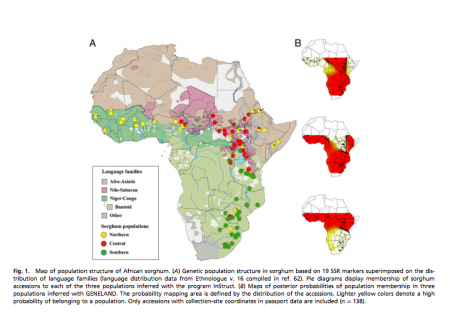
A case study of the seed system of the Pari people, a group descending from the proposed first Nilo-Saharan sorghum cultivators, living in today’s South Sudan, provides a window into the social and cultural factors involved in generating and maintaining the pattern seen at the continental scale. We show that the age-grade system, a cultural institution important for the expansive success of this group in the past, governs the traditional sorghum seed system in a way that maintains the Pari sorghum landraces as a metapopulation. Thus, we can make Harlan and Stemler’s words as ours: “It has been our observation that the races of sorghum are intimately associated with the cultivators who grow them.”
So Harlan et al. are our main references, but how did we start thinking along these ethnolinguistic lines in the first place? Well, like many others in the community we regularly read this excellent blog.