- And we’re back: Desertification threatening Mongolia. Will Biden talk about that on his 6-hour visit today? No, I don’t think so either. Fortunately some people are trying to do something.
- Life not great for pastoralists in Kenya either. But some people are looking to camel milk to see them through. Alas, the latest effort to boost food security research in E. Africa doesn’t have much for livestock-keepers.
- Kew tries to reform UK native grassland seed business. Hope they are taking latest figures on species migration speeds into account.
- Specialty Crops for Pacific Islands book out. Alas, it includes coffee.
- But don’t worry, adapting to climate change is easy.
Brainfood: Genetic isolation and climate change, Not a Sicilian grape variety, Sicilian oregano, Good wine and climate, Italian landraces, Amazonian isolation, Judging livestock, Endosymbionts and CCD, Herbal barcodes, Finnish barley, Wild pigeonpea, Protected areas, Tree hybrids
- The impact of distance and a shifting temperature gradient on genetic connectivity across a heterogeneous landscape. Climate change bringing formerly genetically isolated populations together, possibly increasing adaptive potential.
- Intra-varietal genetic diversity of the grapevine (Vitis vinifera L.) cultivar ‘Nero d’Avola’ as revealed by microsatellite markers. 15 distinct genetic group among 118 plants from 30 Sicilian vineyards seems quite a lot.
- Emerging cultivation of oregano in Sicily: Sensory evaluation of plants and chemical composition of essential oils. More from Sicily. Wild is best.
- Effect of vineyard-scale climate variability on Pinot noir phenolic composition. Its complicated. But at least Pinot noir is not like Nero d’Avola. Or is it? Oh, crap.
- Landraces in Inland areas of the Basilicata region, Italy: monitoring and perspectives for on farm conservation. “Farmer-maintainers” of landraces tend to be old and isolated. Interesting stratified sampling strategy. Basilicata? They grow horseradish there, don’t they? They do indeed.
- Critical distances: Comparing measures of spatial accessibility in the riverine landscapes of Peruvian Amazonia. GIS-calculated time-based accessibility influences rural livelihoods and land use pressure. And agrobiodiversity? Apply to Basilicata next?
- A morphological assessment system for ‘show quality’ bovine livestock based on image analysis. Image of side of animal fed through neural network almost as good as experts in determining how beautiful the animal is. well there’s a triumph for science.
- Endosymbionts and honey bee colony losses? Something else to add to the list of possible causes of colony collapse disorder.
- Commercial teas highlight plant DNA barcode identification successes and obstacles. About a third of products revealed signatures of stuff that was not listed in the ingredients, but that could be due to a number of reasons.
- What would happen to barley production in Finland if global warming exceeded 4°C? A model-based assessment. Nothing good, surprisingly. Better get some new varieties, I guess.
- Cajanus platycarpus (Benth.) Maesen as the donor of new pigeonpea cytoplasmic male sterile (CMS) system. Gotta love those CWRs.
- Australia’s Stock Route Network: 1. A review of its values and implications for future management. Established for movement of livestock before trucks and trains, but has lots of endangered species and communities. Great value on many fronts, in fact. Needs proper governance though.
- Should forest restoration with natural hybrids be allowed? Yep.
Mapping sacred sites
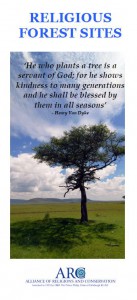 A short piece in The Times of India 1 pointed me to a longer version of basically the same press release on an interesting project to map the sacred forests of the world. This is a collaboration between the Oxford Biodiversity Institute and the Alliance for Religion and Conservation (ARC), the latter of which is new to me. Worth keeping an eye on. Unfortunately none of the players involved seem to have heard of RSS.
Nibbles: Frogs, Sacred forests, Heirloom onions, Lobster, Przewalski’s horses, Marco Polo sheep
- Eating frog legs is bad. France surrenders.
- Oxford boffins to map world’s sacred forests.
- Lafort onion: from the Wellesbourne genebank to Irish Seed Savers to urban kitchen garden.
- Lobster 101.
- A wild relative in trouble any way you slice it.
- And one that gets around. Didn’t we blog about this before? Yep.
Nibbles: AnGR, Sustainable diets, MDG, Plantwise, Maize in Africa, Lead farmers, Micro-livestock (again), Cows and climate change
- Money for AnGR conservation up for grabs.
- 8th International Food Data Conference: Biodiversity and Sustainable Diets is taking place September 14-17, 2011 at NBI Conference Centre, Norwich, UK.
- So how are we doing with that MDG1?
- More on CABI’s Plantwise. I just hope most of it will be free. They have a blog, natch.
- CIMMYT drought-tolerant maize varieties featured in blog post. I’ll alert the media. No, wait. Seems like only 60% of farmers in Kenya are willing to pay for these varieties anyway.
- No extension workers? No problem.
- A tasty dish of Ugandan grasshoppers. Always a good subject for a subtly xenophobic CNN phtoto feature.
- Cows not so bad after all?