So it seems that common names are important in conservation of both wild and crop biodiversity. As long as someone sorts out the synonymy, sure, why not.
Drought in the land of the Diné
Carol Snyder Halberstadt, president and cofounder of Black Mesa Weavers for Life and Land, Inc., has sent this in via DAD-Net in response to our nibble of an NPR story on the Churro, and indeed an earlier post of ours. We look forward to more news from Carol on the Diné and their Churro sheep.
I’ll have to write you more in reply to the questions on your post — but I can add that several sources refer to the word “Navajo” (which is not the name for themselves — that’s Diné “The People”), is a Tewa word meaning “people of the cultivated fields.” The Diné were and are not only great shepherds and weavers, but also diversified and skilled farmers — planting corn, beans, melons, and squash, herbs and other plants — right to the present day. It’s a healthy and wise diet, supplemented by wild plants, pinyon nuts, and other bounty of the land — when the droughts permit.
About 8 years ago I had the privilege of visiting flourishing fruit orchards with peach trees in a well-populated Diné area on the farthest western edge of the Black Mesa region in Arizona, where a well-watered stream still flowed, springs still bubbled, and there were still wetlands and marshes.
It was a visit to a rare place like the entire Black Mesa region once was, before its aquifers and springs and wetlands and marshes were drawn down by Peabody Coal Company (beginning in 1968) and its 272-mile coal slurry pipeline drained the N-aquifer (pristine, pure glacial water, and the source of water for most of the region — Diné, Hopi, Anglo alike). And the drought of at least 20-years’ duration continues as well, as the effects of climate change and global warming intensify. Most of the washes and arroyos are dry; the wetlands and marshes are gone.
In 2005, the Mohave Generating Plant in Laughlin, Nevada, to which the slurry coal pipeline flowed was finally turned off (but the N-aquifer has still not recharged), and the battle against new coal mines and new uranium mines continues.
It’s worldwide… but wisdom perhaps may one day prevail.
When all the trees have been cut down,
when all the animals have been hunted,
when all the waters are polluted,
when all the air is unsafe to breathe,
only then will you discover you cannot eat money.~ Cree Prophecy
Hozhoogo nanina’a doo — may you walk in beauty, balance, sustenance, and health.
Nibbles: Madagascar’s environment, Zambian beer, Agroecology, Shade coffee, AnGR, Entomotherapy
- BBC photos of natural resources management in Madagascar.
- Zambian brewer uses local sorghum.
- Olivier De Schutter says ecological agriculture can feed the world.
- The future of coffee according to Conservation International.
- BBC says African livestock an “untapped genetic resource.” So it must be true.
- Take two cockroaches and call me in the morning.
Nibbles: Rhoades, Trigonella, Plant nutrition, Annals of Botany roundup, Vitamin A, Insect Week, yeast, Biocultural diversity online
- Remembering Robert Rhoades.
- Fenugreek 101.
- Plant nutrition experts on why plant nutrition is important for development.
- Nigel Chaffey rounds up botanical news. Best of its kind.
- Lois Englberger and others comment on that provocative vitamin A paper.
- Hey, did you know it was Insect Week?
- Olivia Judson on yeast.
- Welcome to Terralingua’s Portal on Biocultural Diversity Conservation!
Sheep at Floatingsheep and among the Navajo
Floatingsheep.org is a great website “dedicated to mapping and analyzing user generated Google Map placemarks.” Always fun, it occasionally even tackles agrobiodiversity issues. I’m still waiting for the guys to look at the distribution of the crops of the world, but for now I’ll have to settle for livestock. Here’s a quick look. There are closeups of different regions on the original post.
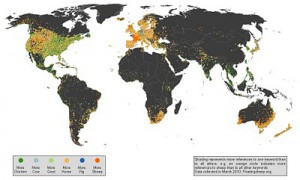
Those sheep hotspots in Arizona and New Mexico are no doubt due to the revival of the Navajo’s churro, the subject of an NPR story yesterday. And of one of our longer posts some months back. Yep, nothing much gets past us.