- Telegraph op-ed on agricultural biodiversity. Yeah, you read that right.
- No, avocado does not come from the Aztec’s word for testicles. It’s the other way around.
- Why honey is a keeper.
- Mapping the hell out of pigs.
- Photo database to help tell bananas apart.
- Deconstructing the Tragedy of the Commons.
- The C footprint of your diet.
- “We can spare 50 percent and share the rest.”
- Cave man caviar.
- Whiskey with that?
- Potato wild relatives and food security.
- Cassava and food security. No word on its wild relatives.
- Wales finds a new apple.
- Maybe someone will take a cool picture of it.
- Potatoes were always for the masses. Ok, but not sure anyone ever thought otherwise, though.
- Grapes, on the other hand…
- The cuisines of Africa get their shot.
- Some of those will go well with craft beer.
- Agricultural heritage list gets saffron and argan. Bet they go together well.
- Maybe wild kiang tea will get there too someday.
- Or the Aboriginal Australians. Not really agriculturalists, but still.
- Is this alpaca exploitation? Maybe you can take the promotion of agricultural biodiversity too far.
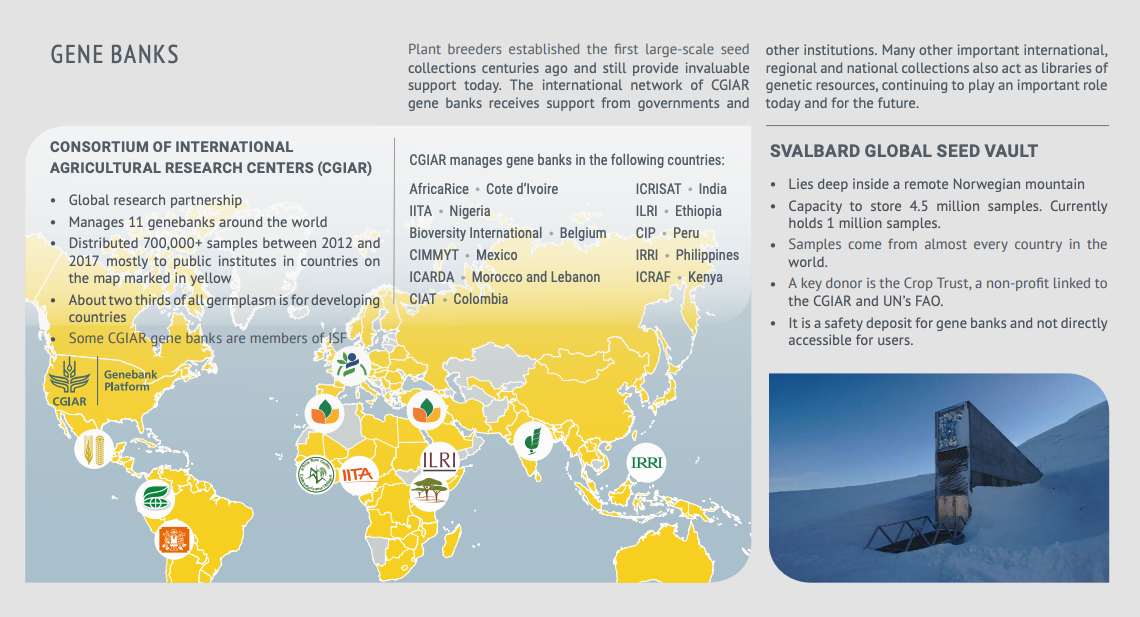
- Will the Svalbard Global Seed Vault qualify one day? Ten years on, still going strong. And return to top.
Brainfood: Stressful crops, Quinoa, Ganja genome, Medicinal vetch, CWR in PAs, CWR in Zambian farms, African viral chickens, Naked barley, Farmer trials, Cotton genomes, Tuscan toms, Land sharing, Nigerian goats, Walnut diversity, Bean breeders, Sweet rice
- Developing naturally stress-resistant crops for a sustainable agriculture. Can’t help thinking there will be a trade-off.
- Quinoa Abiotic Stress Responses: A Review. Case in point?
- A physical and genetic map of Cannabis sativa identifies extensive rearrangement at the 2 THC/CBD acid synthase locus. At last, the prospect of better weed.
- In vitro anthelmintic effect of Vicia pannonica var. purpurascens on trichostrongylosis in sheep. From Turkish folk medicine to the big time?
- Should plant breeders be denied of genetic resources from protected areas? Not if you put it that way. Maybe they should be valued? There’s a way to do that…
- Estimating in situ conservation costs of Zambian crop wild relatives under alternative conservation goals. Put it out to tender.
- The genetic diversity of local african chickens: A potential for selection of chickens resistant to viral infections. No word on their monetary value, though.
- Agro-morphological diversity of Nepalese naked barley landraces. Lots of diversity, little used as yet by breeders.
- Generating Farm-Validated Variety Recommendations for Climate Adaptation. One word: tricot.
- Reference genome sequences of two cultivated allotetraploid cottons, Gossypium hirsutum and Gossypium barbadense. 13 QTLs for better fibre quality.
- Ancient Tomato (Solanum lycopersicum L.) Varieties of Tuscany Have High Contents of Bioactive Compounds. Better than commercial varieties, apparently.
- Biodiversity and yield under different land-use types in orchard/vineyard landscapes: A meta-analysis. Land sharing works.
- Small Ruminants as a Source of Financial Security Among Women in Rural Southwest Nigeria. Better with education, extension and cooperation.
- Analysis of genetic diversity and structure in a worldwide walnut (Juglans regia L.) germplasm using SSR markers. W Europe/N America vs E Europe/Asia.
- David Bond and Jean Picard: Two pivotal breeders of faba bean in the 20th century. Bond and Picard?
- Status and factors influencing on-farm conservation of Kam Sweet Rice (Oryza sativa L.) genetic resources in southeast Guizhou Province, China. In the end of women and the old.
New journal alert
From friend-of-the-blog Colin Khoury, who is involved in the venture:
https://twitter.com/ColinKhoury/status/1070748429251371009
Fabulous articles by Sandy Knapp, Barbara Schaal, Peter Crane and Paul Smith in the inaugural issue, among others. Going to be great.
Brainfood: Medicago sequencing, Barley GBS, Cowpea GBS, Yeast origins, Czech WTP, Seed storage, Functional phenomics, BXW control, Adoption, Dietary diversity, Modern wheat drawbacks, Maize & CC, Lekker lettuce, Wild Ipomoea sequenced, Asia crop history, Sustainable intensification
- Whole-genome landscape of Medicago truncatula symbiotic genes. There’s always something else.
- Genebank genomics highlights the diversity of a global barley collection. IPK’s, that is, and that’s 22,000 strong. Let the GWAS begin. Including for whisky-related traits, of course.
- A polyploid admixed origin of beer yeasts derived from European and Asian wine populations. And beer-related.
- Genetic diversity and population structure of a mini-core subset from the world cowpea (Vigna unguiculata (L.) Walp.) germplasm collection. There are three broadly geographic clusters, and the mini-core is representative of overall diversity, in Africa at least.
- Identification of candidate domestication‐related genes with a systematic survey of loss‐of‐function mutations. Fancy methods lead to doubling of possible domestication genes in soybean to 110.
- Social Valuation of Genebank Activities: Assessing Public Demand for Genetic Resource Conservation in the Czech Republic. Willingness to pay is $9 per sample. But this is unpacked in a guest post by Nik.
- Gene bank scheduling of seed regeneration: Interim report on a long term storage study. Maybe someone can tell me what’s new here?
- Functional phenomics: An emerging field integrating high-throughput phenotyping, physiology, and bioinformatics. Again, what exactly is new here, apart from the word pheme?
- Xanthomonas Wilt of Banana (BXW) in Central Africa: Opportunities, challenges, and pathways for citizen science and ICT-based control and prevention strategies. Technology is not enough.
- Beyond individuals: Toward a “distributed” approach to farmer decision‐making behavior. And even if it were enough, adoption is a whole ‘nother thing…
- Dietary Diversity: Implications for Obesity Prevention in Adult Populations: A Science Advisory From the American Heart Association. As currently defined, dietary diversity does not necessarily mean healthy eating.
- Modern Wheat Varieties as a Driver of the Degradation of Spanish Rainfed Mediterranean Agroecosystems throughout the 20th Century. Under traditional organic management, older varieties have similar yields to modern varieties, plus more biomass both above and below ground, making for better soils.
- Peculiarly pleasant weather for US maize. Adaptation to warmer climates accounts for 28% of yield increases since 1981. It won’t last, see below.
- Increase in crop losses to insect pests in a warming climate. Losses to insects will increase by 10 to 25% per degree Celsius of warming for wheat, rice, and maize.
- Metabolite variation in the lettuce gene pool: towards healthier crop varieties and food. Tasty lettuce is possible.
- Genome sequences of two diploid wild relatives of cultivated sweetpotato reveal targets for genetic improvement. Carotenoid biosynthesis alleles identified.
- Climate change stimulated agricultural innovation and exchange across Asia. Climate models suggest that about 3,500 years ago Central Asia and Tibet cooled, and 2,000 years ago China followed suit, in both cases leading to shifts in crops.
- Intensification for redesigned and sustainable agricultural systems. Depends on building social capital first.
Nibbles: Jackson on Vavilov, ICRAF genebank, #Imaginenopotatoes, Eye in the sky, Food system, Brazilian fruit singer, Fruit pix, Livestock data
- Mike Jackson reminisces about 50 years in plant genetic resources.
- Cracking story about taking a crack at cracking the problem of tree seeds.
- CIP asks you to imagine a world without potatoes.
- Satellites on the lookout for pests.
- The food system is broken. Or maybe it’s working just fine, to the wrong end.
- Singing about açaí.
- Pomology, illustrated.
- Livestock data, deconstructed.