- Boffins sequence plant in field for real-time identification.
- Boffins decide machines do identification better.
- Boffins trace apple domestication to Silk Road.
- Famous Silk Road traveller on sago.
- Thinking up fun ways of cooking another pretty tasteless staple.
- Did someone mention super-foodszzzzzzz.
- Mongabay: Africa needs creative conservation funding approaches.
- Emily Garthwaite: Hold my latte.
When do people search for coconut?
Or any other food, for that matter, at least in the US. Well, now there’s The Rhythm of Food for all the answers, in nice visualizations to boot.
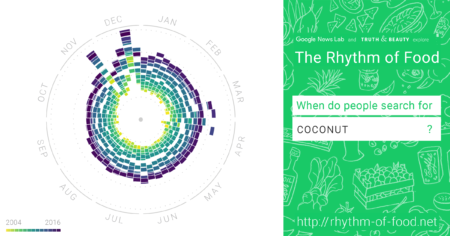
And if anyone knows why Americans do more searching for coconut during the winter holidays, and then again in spring, do tell us.
Brainfood: Temperate maize, Pre-Neolithic Revolution, Social media, European maize
- Genomic estimation of complex traits reveals ancient maize adaptation to temperate North America. “The diversity needed for high altitudes was there, but getting it in the right combination took 2,000 years,” says ancient maize DNA.
- The deep human prehistory of global tropical forests and its relevance for modern conservation. There were “garden cities” in the tropical forests of equatorial Africa, South Asia, and Southeast Asia starting 45,000 years ago.
- An Introduction to Social Media for Scientists. Choose wisely.
- Is there an optimum level of diversity in utilization of genetic resources? It depends.
Nibbles: Weird genebank, Wheat history, NJ blueberries, Xoloitzcuintle, Cemetery prairie, Tenure, Sunflower at USDA, Potato breeding book, Cullinary diversity, Genomics & breeding, Migration report
- There’s a genebank for algae and protozoans.
- How Turkey Red Wheat from Ukraine built Kansas.
- Taming the wild blueberry.
- History of the ugliest dog breed in the world.
- The prairie lives on among the dead.
- Speaking of which: land tenure and conservation.
- Conserving and breeding sunflowers in the US.
- Making potato breeding great again.
- M.S. Swaminathan recommends millets.
- Computing our way to food security.
- Food insecurity and migration.
Brainfood: Mycorrhizal diversity, Olive diversity, Teak diversity, Core software diversity, Cost-benefit, Frosty rye, CGIAR future, Portuguese beans, Improvement networks, Food sovereignty
- Historical biome distribution and recent human disturbance shape the diversity of arbuscular mycorrhizal fungi. Proximity to tropical grasslands during the last glacial maximum makes for a large potential species pool, remoteness from human disturbance for the presence of a high percentage of that pool.
- The First Molecular Identification of an Olive Collection Applying Standard Simple Sequence Repeats and Novel Expressed Sequence Tag Markers. 59 genotypes among 370 trees.
- Worldwide translocation of teak—origin of landraces and present genetic base. The dryer part of the natural range has not really been used in plantations.
- GenoCore: A simple and fast algorithm for core subset selection from large genotype datasets. Better than MSTRAT, Core Hunter, and random sampling.
- Global economic trade-offs between wild nature and tropical agriculture. We can go ahead and cut down the Atlantic Forest. Wait, what?
- Exploring new alleles for frost tolerance in winter rye. Basically one allele, actually.
- Reforming the research policy and impact culture in the CGIAR: Integrating science and systemic capacity development. Let CGIAR be CGIAR.
- Improving global integration of crop research. Taking this to the next level. Which sounded a lot like the International Treaty’s Global Information System on PGRFA. Also, see above.
- Establishing the Bases for Introducing the Unexplored Portuguese Common Bean Germplasm into the Breeding World. 37 accessions had 100% of the diversity of 175 accessions, which were mainly hybrids between the two main genepools. I don’t think I’ve ever seen that before.
- Plant diversity increases with the strength of negative density dependence at the global scale. Janzen-Connell were right, it’s natural enemies that explain the tropical-temperate diversity pattern. With video goodness.
- Local food sovereignty for global food security? Highlighting interplay challenges. “…scaling up of food sovereignty will not necessarily lead to wider sustainability and food security outcomes.”