- Developing radically-new meanings through the collaboration with radical circles: Slow Food as a platform for envisioning innovative meanings. Companies should collaborate with radicals. Presumably in order to turn them. #resist
- Unraveling agronomic and genetic aspects of runner bean (Phaseolus coccineus L.). At least we know what we don’t know.
- Total leaf crude protein, amino acid composition and elemental content in the USDA-ARS bamboo germplasm collections. If you want to use bamboo as feed, you need to choose among the 100-odd species very carefully.
- The Gene Collection of Autochthonous Wine Grape Varieties at the Institute as a Contribution to the Sustainable Development of Wine Growing and Viticulture in Istria. 3591 seems a hell of a lot, but wow.
- Phage Biodiversity in Artisanal Cheese Wheys Reflects the Complexity of the Fermentation Process. Modern methods kill a lot of phages.
- Setting conservation priorities for Argentina’s pseudocereal crop wild relatives. Go north, young CWR researcher!
- Flowering phenology shifts in response to biodiversity loss. Experimentally decreasing diversity in a California grassland advanced phenology.
- Activity, diversity and function of arbuscular mycorrhizae vary with changes in agricultural management intensity. No-till helps VAM, helps soils.
- Oases in Southern Tunisia: The End or the Renewal of a Clever Human Invention? I’m not hopeful.
- Physiological responses to drought stress in wild relatives of wheat: implications for wheat improvement. 4 species show promise.
- PepperHub, a Pepper Informatics Hub for the chilli pepper research community. Hot off the presses.
- Molecular diversity and phylogenetic analysis of domestic and wild Bactrian camel populations based on the mitochondrial ATP8 and ATP6 genes. The wild species is not the ancestor, and the domesticated species is a geographic mess.
- GenMon-CH: a Web-GIS application for the monitoring of Farm Animal Genetic Resources (FAnGR) in Switzerland. Upload data on your herd or flock, end up with a map of where the breed is most endangered.
- Stealing into the wild: conservation science, plant breeding and the makings of new seed enclosures. Ouch!
- GlobalTreeSearch – the first complete global database of tree species and country distributions. 60,065, about 10% crop wild relatives.
Nibbles: Viking dope, Garden survey, Ancient olive press, Proposal writing, Nice figures, Old garden books, Chestnuts, Cannibalism, Saving coffee, Vanilla history, Seed book, Spanish brassica
- Vikings got high.
- “How can you and your garden help us find out more about the global biodiversity associated with the plants in gardens?” Here’s how.
- The oldest olive press in Anatolia.
- “The Mistake: Writing a proposal that showcased knowledge rather than addressing the audience’s needs.” Indeed.
- The Solution: cool downloads from Gapminder.
- The only surviving illustrated Old English herbal. And, from several centuries later, a medieval book on how gardens will save you.
- AramcoWorld on my favourite nut.
- Cannibalism is a choice.
- One kick-ass botanist.
- Saving Ethiopia’s coffee forests. Nah, let’s just map the genome.
- Vanilla has dark side.
- The Profit of the Earth: cool new book on seeds, dark side and all.
- Remember my little trip to the Spanish genebank? What they’re doing on brassica.
Seeing the wood and the trees
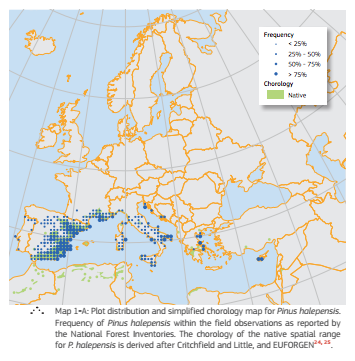 The day after the Global Tree Assessment is published by BGCI, which revealed there are about 60,000 tree species in the world, is also a good time to link again to the wonderful European Atlas of Forest Tree Species. Now all we need is the same thing for Brazil, which has about 9,000 of those 60,000. BTW, a very quick check suggests that about 1% of trees are crop wild relatives, globally. More on this later.
Plants of the World Online is online
Great to see the launch of Kew’s Plants of the World Online portal.
In 2015, the Royal Botanic Gardens, Kew launched its first Science Strategy establishing its vision to document and understand global plant and fungal diversity and their uses, bringing authoritative expertise to bear on the critical challenges facing humanity today. The Science Strategy also committed Kew to delivering nine strategic outputs with the overarching aim to disseminate Kew’s scientific knowledge of plants and fungi to maximize its impact in science, education, conservation policy and management. The Plants of the World Online portal (POWO), is one of the nine strategic outputs and its aim is to enable users to access information on all the world’s known seed-bearing plants by 2020…
…Ultimately, POWO will become a single point of access for authoritative plant species information, a multi-dimensional catalogue of plant life, including information on identification, distribution, traits, conservation, molecular phylogenies and uses. The codebase is open source and Kew hopes to support existing partner networks to set up their own portals, creating a distributed network of botanical data hubs. POWO aims to become a resource that has global coverage which can empower and inform citizens, policy makers, conservationists and farmers everywhere, about the importance of plants and fungi to life. In addition, a key function of POWO is to ensure that Kew’s floristic data can be harvested and ingested by the World Flora Online (WFO) portal enabling Kew to support the Global Strategy for Plant Conservation (GSPC) Target 1 2020.
And speaking of harvesting and ingesting, it even has crops! As it develops, I do hope it will include links to genebank and botanical garden collections.
Oh, and since I’m on Kew, don’t forget this year’s State of the World’s Plants Symposium is coming up. Last year there was a section on crop wild relatives. Nothing so agricultural on this occasion, but lots of interesting topics nevertheless.
Nibbles: Mango genebank, Japanese elite fruit, Mother Hass, African cattle diversity, New wild ginger, Seed saving, False ivory, ABS, Deforestation, Blight causes, Desert ag, Conserving potatoes, Imperial botany
- Goa to set up a mango genebank. Where do I donate?
- The murky world of really expensive Japanese fruit.
- What is this one avocado tree worth?
- The importance of indigenous African cattle breeds.
- You can never have too many wild ginger species.
- Saving seeds in South Carolina.
- Seeds save elephants.
- IFPRI meeting discusses the increasing complexity of germplasm access and benefit sharing.
- Food giants look to their greenify their value chains. Will they finally decide to secure their genetic base too?
- Irish potato famine: don’t blame the near-fungus.
- Chinese oasis is engineering wonder: and the crops?
- Pachamama and the ever-so-humble potato.
- Review of book on the imperial origins of botany.