Documenting improved variety adoption

In my defence, I have visited the ASTI website before. Just not in a while, unfortunately. And I therefore missed a lot of developments. So thank you, Jeremy, for sending me there again earlier today. But let’s step back a bit. What is ASTI, anyway?

Agricultural Science and Technology Indicators (ASTI) provides trusted open-source data on agricultural research systems across the developing world. Led by the International Food Policy Research Institute (IFPRI), ASTI works with a large network of national collaborators to collect, compile, and disseminate information on financial, human, and institutional resources at both country and regional levels across government, higher education, nonprofit, and (where possible) private for-profit agricultural research agencies.

Very laudable. There’s a lot of useful stuff on the website, organized by country and region, but also covering the CGIAR centres. And the last is what I would like to focus on for a minute here. ASTI is hosting two projects tracking the adoption of improved varieties in South Asia and Africa. The raw data is downloadable, but there are useful summary graphics, though I would have liked them to be more easily sharable (the following examples are screenshots).

So, if we take as an example pigeonpeas in Madhya Pradesh, we get this overview:
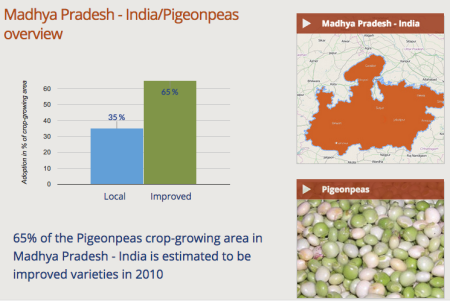
overview

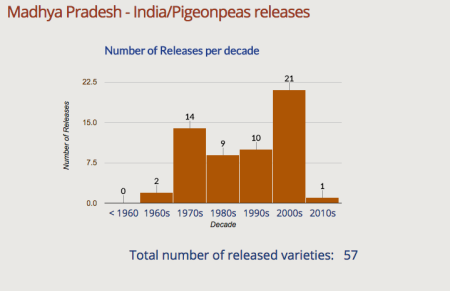
And a time line of releases:

total number of varieties

And, perhaps most interestingly, the level of adoption of the main varieties:
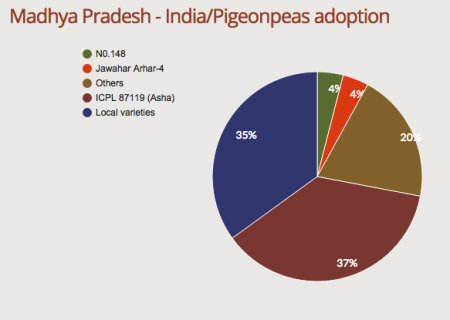
adoption by variety

And if you’re interested in that 37% share, and I know you are, you can find out all about the variety in question, ICPL 87119 (otherwise known as Asha) from ICRISAT.

Nibbles: Plant names, Tomato trifecta, Amaranth, Corn wars, Wild lettuce, Dying, Indian ag, Chocographic, Root symbionts, Rehabilitation, Mesquite, Extreme weather, Saviour plants, Pawpaw, Japanese rice, Coffee museum, Caribbean early ag, Amazonian livelihoods, Vislak on corn

Brainfood: Brassica rethink, Camel colours, Parsing the ITPGRFA, Static buffalo, Traits not taxa, Expert tyranny, Chinese pollinators, Heritage landscapes, Mining text, Diversity & nutrition

Nibbles: Kinky crops, Hot pepper, Cary Fowler, Gin history, Open data, Quaker food, QPM in Ethiopia, Botany app, Old seeds, New tomato

  • Why aren’t there more crops among the orchids?
  • This pepper is not so much a crop as a weapon of mass destruction.
  • Now here’s a crop. New tomato has taste, storability, looks. But I think it’s dating.
  • Maize with cool amino acids reaches Ethiopia. Must have walked there.
  • Really old squash seeds.
  • Cary Fowler on the Weather Channel. You heard me.
  • Quakers have an opinion on the right to food and climate change. Well, why shouldn’t they? They also have a UN office, but that’s another story. No word on whether they made the Weather Channel.
  • Ok, so apparently the answer is data. Says a data company. And open data at that. Quakers nonplussed.
  • Botanizing in N or S America? There’s an app for that.
  • The rise and rise of gin. And I certainly need one.

Brainfood: Apple diversity, Wheat diversity, Wild lettuce diversity, Picking cores, Saudi rice diversity, Indian minor millets, Species distribution modelling, Pollinator diversity