- Crowdfunding the Zero Tree Extinctions project.
- Seed fairs for climate change adaptation in Zimbabwe.
- Make mine a baobab smoothie.
- Another great review of Simran Sethi’s new book Bread, Wine, Chocolate: The Slow Loss of Foods We Love.
- Blessed are the cheesemakers.
- Big Food taking fright?
- Breeding the organic breeders of the future.
Nibbles: Ancient faba, Ampelography double, S. African cattle, CIMMYT in Ethiopia, Seed pix, Heirloom pix, Trifolium genome
- Faba beans came before cereals in Galilee.
- Wine is not quite so old in Georgia, but still pretty old. But will they be able to genotype it?
- South Africa is a cattle melting pot.
- Getting improved wheat out there in Ethiopia.
- These seeds are definitely ready for their close-ups.
- Speaking of close-ups: Amy Goldman has a new book out.
- First forage clover genome. More and more difficult to think of firsts.
A newsletter to conjure with
Well, I thought we had our finger on the agricultural biodiversity pulse, but this is a new one on us:
Agrobiodiversity@knowledged is a joint Hivos and Oxfam Novib Knowledge Programme initiated in 2011. This three-year Knowledge Programme aims to break through the barriers that limit the scaling up, institutional embedding and horizontal extension of practices that build on agricultural biodiversity for improved livelihoods and resilient food systems. At the heart of the programme is a global knowledge and experience community of organizations working on agricultural biodiversity with millions of farmers worldwide, where evidence and insights are generated, shared and tested. The knowledge programme aims to synthesize knowledge from a local to a global scale, conduct research on approaches and analytical frameworks that provide new perspectives on agricultural biodiversity and its role in resilient socio-ecological food systems, and improve horizontal and vertical knowledge flows towards positive change and transformation.
There’s a useful-looking newsletter too, though I’m blowed if I can work out how to subscribe to it.
Nibbles: CC & crop diversity, Agrobiodiversity newsletter, Foley blog, Heirloom pepper, ITPGRFA PPT, Gobble gobble, Ancient DNA, Sunflower relatives, Leafy greens
- FAO has guidelines for making sure climate adaptation plans include crop diversity.
- A new agricultural biodiversity newsletter for your reading pleasure.
- And a new blog of global sustainability issues from Jonathan Foley.
- The Beaver Dam pepper back from the brink.
- Nice set of slides summarizing the Plant Treaty.
- The traditional Thanksgiving save-heirloom-turkeys story.
- Farming changed people.
- Crop elders?
- Women speak out about traditional African veggies.
NBPGR’s genebank dashboard takes a bow
Good to hear 1 that the National Bureau of Plant Genetic Resources in India has a new online “dashboard” summarizing data from its genebank, one of the largest in the world. 2
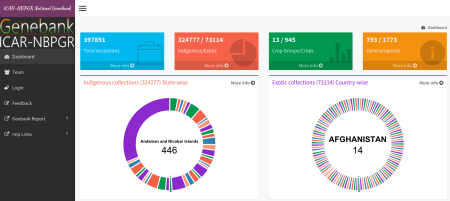
There is a separate PGR Portal for searching the collection, though apparently only on basic characterization data so far. Except for wheat, that is, where you can search for a long list of phenotypic characters.
Clearly lots of work going on lately at NBPGR on getting their data out there. But when will we see them on Genesys?