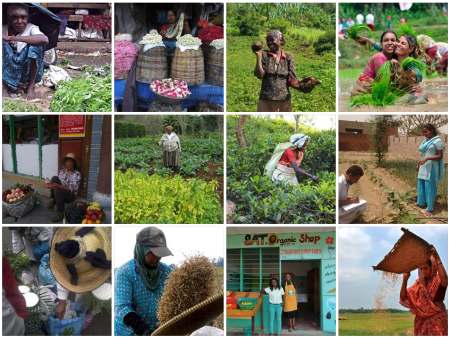
- A domestication assessment of the big five plant families. Half of cultivated plants are legumes, a third grasses.
- The vulnerability of US apple (Malus) genetic resources. Moderate.
- Microorganisms associated with amylolytic starters and traditional fermented alcoholic beverages of north western Himalayas in India. Veritable microbial communities.
- Spatial incongruence among hotspots and complementary areas of tree diversity in southern Africa. It’s not just about the hotspots.
- Integrating Agricultural and Ecological Goals into the Management of Species-Rich Grasslands: Learning from the Flowering Meadows Competition in France. Gotta document the synergies.
- Genetic–geographic correlation revealed across a broad European ecotypic sample of perennial ryegrass (Lolium perenne) using array-based SNP genotyping. Strong structure both with latitude and longitude. Wonder if the Flowering Meadows competition took that into account.
- Interactions of knowledge systems in shiitake mushroom production: a case study on the Noto Peninsula, Japan. Tradition is not always a totally good thing.
- Development of Core Sets of Dolichos Bean (Lablab purpureus L. Sweet) Germplasm. Heuristic is better. But is it PowerCore?
- Genetic Diversity of Local and Introduced Sweet Potato [Ipomoea batatas (L.) Lam.] Collections for Agro-morphology and Physicochemical Attributes in Ethiopia. The improved varieties are not all that great. But there were only two of them. And the local landraces were not necessarily the best.
- Study of genetic variability in Vitis vinifera L. germplasm by high-throughput Vitis18kSNP array: the case of Georgian genetic resources. Some differentiation between wild and cultivated, but significant overlap.
De-balkanizing crop genomics
Genomics has a data problem, according to Nature. Not perhaps as big as YouTube’s, but…
Nevertheless, Desai says, genomics will have to address the fundamental question of how much data it should generate. “The world has a limited capacity for data collection and analysis, and it should be used well. Because of the accessibility of sequencing, the explosive growth of the community has occurred in a largely decentralized fashion, which can’t easily address questions like this,” he says. Other resource-intensive disciplines, such as high-energy physics, are more centralized; they “require coordination and consensus for instrument design, data collection and sampling strategies”, he adds. But genomics data sets are more balkanized, despite the recent interest of cloud-computing companies in centrally storing large amounts of genomics data.
…
Astronomers and high-energy physicists process much of their raw data soon after collection and then discard them, which simplifies later steps such as distribution and analysis. But genomics does not yet have standards for converting raw sequence data into processed data.
Leave aside for a minute that last sentence, which is generating some heat on Twitter…
Calling bullshit on "But genomics does not yet have standards for converting raw sequence data into processed data." http://t.co/g8zAK8bjj4
— Mick W@tson ↙️ (@BioMickWatson) July 8, 2015
…it is certainly worthwhile highlighting the balkanization of genomics datasets. But then, why not mention that in at least one area — crop diversity — there are some useful initiatives underway, like DivSeek. Which Nature knows about.
The phylogeny of Czech hops
Long breeding work aimed at fine aroma hops results in high quality aroma aspects, which are used to produce the best beer. Czech hops are the security of the highest brewing quality in many breweries all over the world. Saaz hops are considered as the standard of high brewing quality not only in Czech Republic but in other countries as well. Saaz hops are a very important raw material for the best quality beer. All Czech hop varieties, which have been developed recently, have in their origin Saaz and therefore they show excellent brewing characteristics.
You had me at beer.
Beans With Benefits – but no address
In collaboration with national partners, AVRDC-The World Vegetable Center has released a number of improved varieties like ‘Zilola’, ‘Marjon’, ‘Durdona’ and ‘Turon’ to date. However, as salinity and heat are commonplace in the country, more new varieties are needed.
This is the goal of a new project funded by Germany’s Federal Ministry for Economic Cooperation and Development and implemented by AVRDC-The World Vegetable Center. Aptly titled “Beans with Benefits”, the project will run until March 2018, and aims to integrate improved mung bean as a catch crop into the dryland systems of South and Central Asia to increase smallholder farmers’ income and establish more sustainable production systems.
Sounds very worthy, and as I do not normally associate mungbean with Central Asia, I of course determined to find out where these new varieties are likely to come from. It did not go entirely smoothly.
The first step was to try to find out what Zilola, say, might have been called before it was released in Uzbekistan. A Google search led me, eventually, to the PDF of a flyer with the additional information reproduced on the left here. So, Zilola is VC 1178, which is an “inbred line extracted from V1944/V2273 at AVRDC HQ.” VC 1178 has form, as it features in A Catalog of Mungbean Cultivars Released Around the World (p. 10) as a parent of a variety (Chainat 60) released in Thailand in 1988.
Searching AVRDC’s genebank database online confirms that. But, again, it wasn’t straightforward. The database records a plethora of different numbers: vegetable introduction number, crop accession number, temporary number, donor identification number, PI number… Which type of number is VC 1178? Your guess is as good as mine. And the problem is, it looks like you have to know what type of number it is, before you search for it:
Well, actually it’s not that bad, because of the text search facility, though you then have to watch out for the space between the VC and the 1178. Anyway, long story short, it’s a cultivar name (sic.), and you get four hits when you try it (for some reason, only two in Genesys).
And, if I understand the results correctly, the closest thing to the “original” VC 1178, whatever that might be exactly (more on that anon), is the first on the list. Which has a whole raft of additional numbers to confuse the potential user.
But what about the V1944/V2273 from which VC 1178 was extracted? Well, after fiddling with the spaces etc., you get two hits, both with the note “VC LINE FROM MUNGBEAN BREEDING”, which is not very helpful in ascertaining where the damn thing is from. Country of collection is given as Taiwan, but I’m not at all confident that this means anything more than that the line was developed at AVRDC HQ in Taiwan.
So, if the Uzbeks and other Central Asian partners in the Beans With Benefits project really like Zilola, and want more from where that came from, I’m not sure they’ll get much help from the information that’s available online. 1 You want benefits? Think of the benefits from having a clear idea of where exactly a promising variety came from, and how it got there.
Nibbles: Monocultures redux, Seedless watermelons, Red kiwifruit, Herbaria problems, Forest foods, Sorghum beer, SIRGEALC, Chinese veggies, Organic tomatoes, Andean women, Rise origins, Fermentation
- Deploy your cover crop diversity in time rather than space. But deploy it.
- Triploid goodness.
- Searching for a red kiwi.
- Herbaria on the rack.
- Let them eat non-timber forest products.
- Sorghum spurts in Kenya. Because beer.
- Sign up for SIRGEALC 10.
- Knowing your 菠菜 from your 西洋菜.
- 400 tomato varieties. No pesticides. No water. No problem.
- Women are conserving Andean crops. Sure, though with some occasional help from genebanks.
- The Rice Origins Wars continue.
- Sauerkraut changed the world.