- CIAT crop wild relatives team announces 3 new papers on gaps in ex situ collections: potato, sweet potato & pigeonpea. Take a break, people, please.
- And CIAT genebank features in nice video on why we need genebanks. So also the IRRI genebank, which is relevant to the next Nibble. We do joined-up nibbling here.
- Fine dining with Filipino rice landraces. Go Manny!
- None of those rice landraces are perennial. Yet. If they ever are, it’ll be due to a wild relative.
- Fusarium head blight resistance in wheat dissected using a synchrotron. Avengers assemble!
- Oxyrhynchus papyrus identifies hangover cure. Or so the Daily Mail says, so, you know…
- Oh wow, the Mail is definitely on a botanical roll, now they’re all over a Kardashian-shaped tuber.
- New Edible Aroids Newsletter. Nothing Kim-shaped about these tubers.
- Wheat and barley replaced millet in E Tibet around 2000 BC after cooling period. This going into reverse now, I wonder?
- Some biodiversity you don’t want, trust me.
- Speaking of unwelcome biodiversity, there’s a new hope in the fight against malaria: hybrid artemisia.
- More on that potato that the Dutch are growing in sea water. Like they have a choice.
- Microbes are part of terroir.
- Q&A with The Triumph of Seeds author.
- The coco-de-mer is a pretty triumphant seed.
- You say ramòn nut, I say Maya nut.
- Kenya needs bamboo. Says the International Network for Bamboo & Rattan. Wow, two active crop networks in today’s Nibbles.
- Yesterday it was arabica that was in trouble, today tea. Damn you, climate change.
- They’re the lucky ones: they may be in trouble, but they’re not going extinct…
- More production does not automatically mean less stunting. Damn you, real world.
Promoting the sweet potato in Africa
Good to see the March edition of Hortinews magazine focusing on the sweetpotato in Africa. 1 I found it a little difficult to navigate the feature online, although you can also just download the whole issue as a pdf, so let me link directly to two stories on orange-fleshed sweetpotatoes (OFSP):
- Shaping up the orange-fleshed sweetpotato: Shamba Shape Up programme aired 8 episodes about the orange-fleshed sweetpotato, focusing on planting, diseases, storage, cuttings, vine health and cooking on Citizen TV.
- Nutritional analysis is critical to the development of OFSP in SSA: CIP advocated for increased nutrition related research at BecA-ILRI to meet the growing demand for quality nutritional analysis.
Now, a lot of effort has gone into developing and disseminating OFSP in parts of Africa, and their potential importance in addressing vitamin A deficiency is not disputed. However, not everything has gone totally smoothly. As an IDS report, coincidentally also just out, points out:
Donor-funded initiatives have played a central role in developing all stages of the OFSP value chain, with a particular focus on breeding new varieties that appeal to the preferences of both producers and consumers. Development projects have also supported the dissemination of planting materials and funded public awareness campaigns. However, information collected for this case study suggests that, so far, interventions have not achieved widespread uptake of OFSP. Only a small minority of farming households in intervention districts grow OFSP. 2 Commercial farmers who supplied OFSP planting materials to project distribution systems have found that, after project funding ended, the local market was not viable, and have ceased production. Meanwhile, awareness of and demand for the crop among consumers have been very limited; one survey conducted in an intervention district found that only 2 per cent of households consumed OFSP. Traders and food processors report that there is little demand, and dealing with the crop is not profitable. This state is perhaps unsurprising given that the introduction of OFSP is still relatively recent, that project efforts have been relatively scattered and uncoordinated, and that there has been little focus on commercially viable value chains. Yet the challenges encountered in Tanzania provide important lessons for other agriculture-nutrition initiatives.
But no need to panic, all is not lost. It’s still relatively early days yet, and the report also makes some sensible recommendations to turbo-charge adoption:
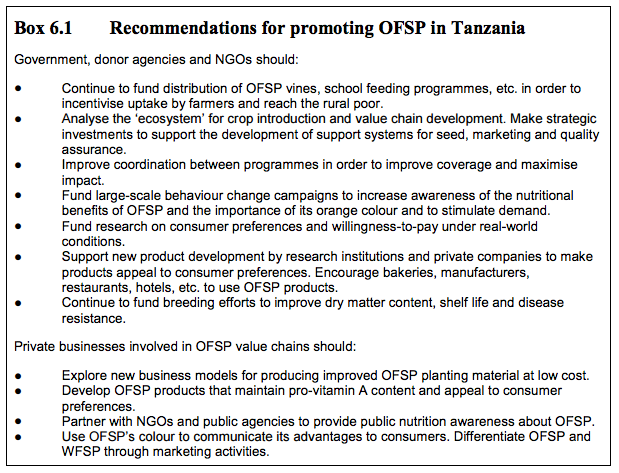
I think it would have been useful, as well as fair, for Hortinews to point out what still needs to be done, as well as what has been achieved. But maybe that doesn’t sell glossy magazines.
Nibbles: Gender myths, Cabbage myth, Deforestation, Urban ag, School gardens, Avocado disease, Tourism & conservation, African trees, European biofuels
- Hoary zombie gender myths bite the dust. Wish the same could be said of agrobiodiversity myths…
- The first cabbage, according to the ancient Greeks. A myth we can all get behind.
- WWF maps deforestation hotspots. Like the whole of Sumatra.
- Profits not the (only) point of urban farming.
- Maintaining food culture by gardening in a Native American community. See what I mean?
- After citrus greening, now comes laurel wilt. Poor Florida.
- Biodiversity conservation through tourism in Latin America. Including agrobiodiversity?
- The trees and shrubs of mopane woodlands, illustrated.
- European biofuels hit the buffers.
The rough value of genebanks
In 2012, The NPGS [the US National Plant Germplasm System] budget was approximately $47 million. Funding for the NPGS has been relatively stagnant over time. In real terms, agency funding peaked in 2003, at approximately $53 million in 2012 dollars (fig. 1). While direct comparisons between costs of a genebank and its benefits are not possible, 3 for context, we note that U.S. farmers paid $20.3 billion for seed in 2012 (USDA\National Agricultural Statistics Service, 2013). Thus, the costs of public ex situ plant conservation in the United States are a small fraction—under half of 1 percent—of the value of the eventual seed market. At the same time that budgets have decreased, demand for NPGS germplasm has reached historic highs (fig. 2).
Gotta love it when economists give up on quantitative data, and settle for qualitative comparisons.
When compared to the rather large benefits of genetic enhancement, the costs of genebank operation appear relatively small.
But do read the whole of USDA’s Using Crop Genetic Resources To Help Agriculture Adapt to Climate Change: Economics and Policy by Paul W. Heisey and Kelly Day Rubenstein. There is some data in there, and that perennial fall-back of economists, a model. The main findings, if you just want to just skip to the bottom line, were that genebanks are worth it, but that better data and some pre-breeding would help.
Nibbles: Long live genebanks, ART in Ireland, Peruvian cacao, Cacao & CC, Canadian aid & wheat, Coffee trials, Organic redux, American garden survey, Cranberry breeding, Bean breeding, Expo Milano 2015, Olive disease, Insect meal, Save cider, Garum, Asian PGR network, Fig vid, McCouch, Pastoralist Knowledge Hub
- Sexing up genebanks.
- Inventive wheat drought phenotyping. Want more?
- The Irish try out other Andean crops. Because the first one worked out so well.
- Peruvian cocoa goes up-market. Others might not get the chance.
- Latest batch of IDRC food security projects: African veggies, chickpeas, lentils… Meanwhile, back home in Canada…
- Some major coffee producers are probably in trouble. Will the International Multi-location Variety Trials help at all?
- Crop genomic data boffins say crop genomic data should be free. DivSeek unavailable for comment.
- The latest from Rodale on why organic is better. Well, it certainly affects microbial diversity.
- Smithsonian helps to preserve the Great American Garden through citizen science.
- Blimey, it takes 15 years to release a cranberry cultivar. That’s nothing, Kenyan canning bean breeders say.
- Expo Milano 2015 is coming, and Bioversity will be there in force.
- The olive is under threat. Always something.
- If you don’t want to eat insects, you can always feed them to your livestock.
- There’s a campaign to save small cider producers in the UK. which we can all get behind, I’m sure.
- Make your own garum. If you must.
- Asian countries to launch regional PGR network. What, again?
- An ode to figs.
- Gotta love
weedweeds. - FAO gives pastoralists a voice. Or a website, rather.