- The oldest pig in the world is Vietnamese-Canadian.
- Why plant scientists should tweet. And draw.
- Trifecta of apples and other heirloom fruit. Make that four.
- And nuts.
- Making civet crap coffee sustainable.
- Dutch animal genebank moves.
- Will the inmates be fed seaweed? There’s a collection of those, you know?
- More money for to make sweet potato more nutritious.
- Or, you could empower women. Or both.
- Trouble with citrus? No problem, grow peaches.
- World’s coolest garden.
- And why we need even the less cool ones.
- Testing present plants in future climates.
- Who’s who in edible insects.
- Big Food suddenly realizes it has a climate change problem.
Ethereal botany
Lots of botany in the ether today from #Bot21C #globalplants @JSTORPlants @UNESCO good to feel the inspiring and positive vibes
— Sandra Knapp (@SandyKnapp) September 23, 2014
Indeed. And thanks Sandy Knapp for keeping us all informed.
Nibbles: Australian agrobiodiversity, European forests, Eva, Brazil in Africa, Seasons in the sun, FFS, IRC2014, Shiva farrago, Tricky crops, Genome editing, Amish revolution, Thai rat, Disease spread, Coffee culture
- Bush tucker may be viable business proposition. But doesn’t it taste like crap? And do any crop wild relatives qualify?
- Europe mapping its high value forests. No word on whether crop wild relatives come into the assessment.
- Sorghum breeder reveals all.
- Embrapa supporting African agriculture with help from Gates Foundation.
- How many seasons are there anyway?
- Test yourself on Farmer Field Schools.
- Delve into abstracts for the 4th International Rice Congress (IRC2014).
- New Yorker replies to Vandana Shiva reply to her profile in the New Yorker.
- Some crops resist mechanization.
- Editing the horns from cattle genome.
- A young Amish farmer with big ideas.
- Your organic rat, sir.
- Crop pests and diseases are coming to get you.
- Fun reddit with Peter Giuliano, barista extraordinaire.
Conserving horticultural species, one at the time
Another report from one of our correspondents at the International Horticultural Congress in Brisbane, this on the symposium on Utilization of Plant Genetic Resources:
The full day symposium keynote by Dr Ehsan Dulloo of Bioversity International covered the broad topic of developing strategies for conserving plant genetic diversity. Individual presentations covered a wide range of topics and crops, including: roots/tubers (sweet potatoes, yams, cassava), aroids and breadfruit in the Pacific Islands; use of native species to restore costal landscapes impacted by cyclones in Fiji; conservation of wild temperate small fruit species such as Vaccinium in Canada (blueberries and cranberries); use of the underutilized tea tree (Melaleuca alternifolia) in Australia; conservation of mango landraces on-farm in India; characterizing the morphological and genetic diversity of baobab (Adansonia digitata) in Kenya; and the cryopreservation of clonal genetic material of apple, peach and nut trees (Juglans spp), among others. The common thread that ran though most of these presentations is that a lot of work still needs to be done to understand the genetic diversity that we have and the best way to conserve it (in situ & ex situ), such that it leads to optimal use of these important genetic resources.
There’s one more of these updates from IHC2014 in the pipeline, which we’ll probably put up tomorrow.
Global diets visualized
National Geographic’s eight-month series on food has caught up with Colin Khoury’s blockbuster paper on how many crops feed the world. The infographic on diet similarity looks ok on the printed page, I guess:
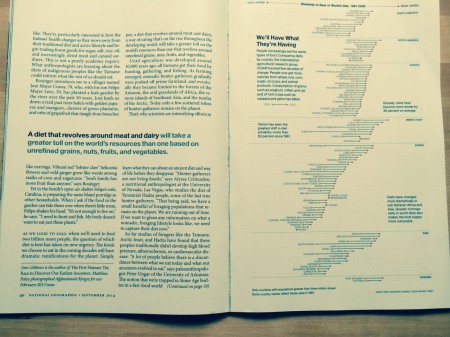
But it’s way cooler online.