- Biogeoinformatics of livestock genomic resources. Don’t forget the “geo” bit. Goes for plants as well!
- Utilization and transfer of forest genetic resources: A global review. They’ve been going on for 200 years, but we’ll need provenance trials and conventional breeding more than ever in the future. Phytosanitary risks involved in tree germplasm movement are now better managed, but the big problem in the future will be Nagoya. Molecular assisted breeding? Meh.
- Genomics and molecular breeding in lesser explored pulse crops: Current trends and future opportunities. We’re mostly still awaiting our jetpacks.
- Orchards as traces of traditional agricultural landscape in Slovakia. About half are left, but they won’t save themselves.
- A wheat phenotyping network to incorporate physiological traits for climate change in South Asia. Local checks significantly earlier than the best CIMMYT can offer. Evaluate the whole genebank?
- Genetic structure of Iranian olive cultivars and their relationship with Mediterranean’s cultivars revealed by SSR markers. The N Iran cultivars are different from everything else.
- Leaf traits associated with drought adaptation in faba bean (Vicia faba L.). Chalk up another success for FIGS.
- Large scale germplasm screening for identification of novel rice blast resistance sources. 289 out of 4246 accessions showed resistance against all five rice blast isolates. The 4246 chosen on basis of “annotated rice blast resistance information” from the IRRI genebank. No word on whether FIGS was considered.
- Genetic Variation of EPAS1 Gene in Tibetan Pigs and Three Low-Altitude Pig Breeds in China. One haplotype seems to be particularly associated with high altitude adaptation. Unclear if that is a really important objective of pig breeding around the world.
- Morpho-physiological variation of Poa alpina L. genetic resources from the Rhaetian Alps, Italy, grown in two altitude-contrasting sites. There was more variation within than among populations, and it’s ok to do seed production for high altitude sites at low altitudes. No word on whether same could be said for alpine pigs.
- Protection of Traditional Knowledge and Origin Products in Developing Countries: Matching Human Rights and IP Protection with Business Development Opportunities. It’s all in the value chain.
Follow the genebank managers’ fun
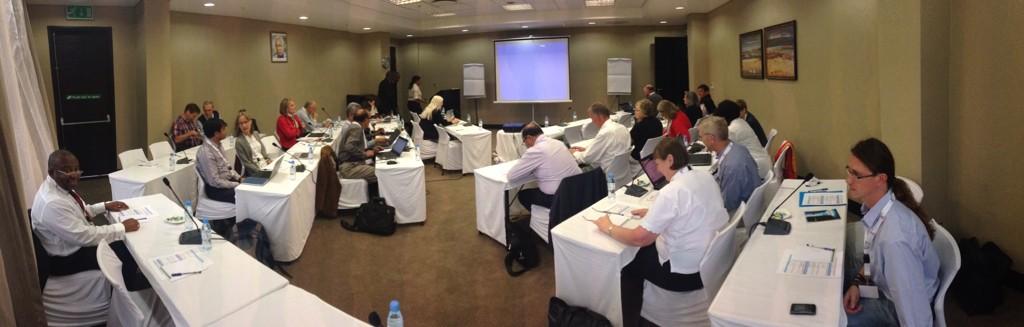
What’s the collective noun for a roomful of genebank managers? An accession? No, that can’t be right.
Whatever it is, you can follow along with the fun at the Twitter hashtag #agm2014.
Nibbles: ILRI@40, CIAT cleanup, Breadfruit factsheets, Spice book, Senegalese e-goats, Natural history collections, Seed supplies, Bean breeding, Institution building, Eat This Podcast, Phenotyping, Indian eggplant, GMO Terminator
- ILRI celebrates 40 years with a major conference.
- Keeping the CIAT germplasm collection nice and clean.
- New variety information sheets from the Breadfruit Institute.
- Review of Gary Nabhan’s new book, Cumin, Camels, and Caravans: A Spice Odyssey.
- Buying goats online.
- What would you do with one billion historical biodiversity data points?
- The tools of the seed-saver‘s trade.
- How to stress your beans, and why.
- A place for conservation organizations to hang out and share. You have to register, but this looks interesting.
- Jeremy has a second Twitter home.
- All 115 plant image analysis software solutions…
- Hyderabad’s brinjal obsession.
- A GMO terminator technology?
Nibbles: Greens, Agroecoagriculture, Nuts, Marketing
- Leafy greens MIA in India.
- Agroecology and ecoagriculture settle their differences?
- The hazelnuts of Trabzon … romantic nuts.
- “Geographical Indications, Biodiversity and Poor Communities: The opportunity of geographical indications to provide protection of traditional indigenous biodiversity products and benefits to poor agricultural communities. A Desk Study on six target countries: Cambodia, Laos, Indonesia, Vietnam, Ethiopia, Mauritania.” I kid you not. Be still my beating heart.
Mapping the European genetic resources landscape
Following an initiative tabled by the European Parliament in 2013, the European Commission (DG Agriculture and Rural Development) contracted a “Preparatory action on EU plant and animal genetic resources in agriculture”. The project was launched in July 2014 for a period of two years.
Wow. The European Parliament interested in enough in agricultural biodiversity to invest a couple million euros in a study which is going to start by “identifying and mapping existing initiatives, databases, and collections related to genetic resources, as well as relevant stakeholders,” and take it from there. Watch this space…