- The Pacific pushes out its taros.
- China holds on to its pigs.
- Vanuatu preserves its bananas.
- The world talks about yams in particular. And crop breeding in general.
- How Britain got its monkey puzzles.
- Bangladesh goes for mola culture. But not only.
- Australia puts money into beer.
- France gets into the whole baobab factsheet thing, but with a video twist.
- Virginia makes wine. With infographic goodness.
- UK tries to slow down its food.
- Canada barcodes everything.
There are apps for agrobiodiversity
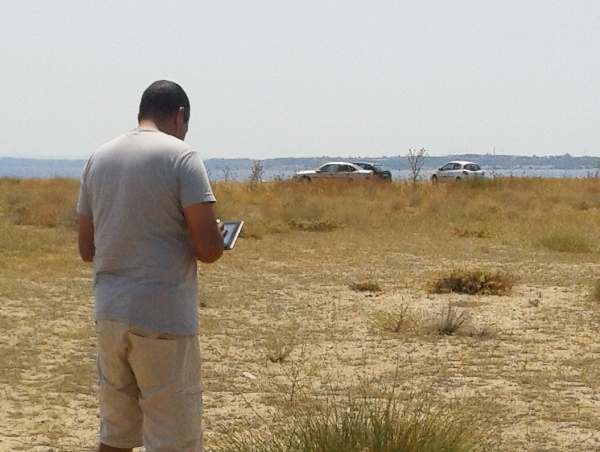 More from the IT geeks at ICARDA. We’ve heard that they’ve been testing out, for the second field season now, and very successfully, a germplasm collecting form app on a tablet equipped with a 3G SIM from a local (European country) provider. This replaced the conventional collecting expedition complement of GPS, altimeter, camera and stack of paper collecting forms, laboriously filled in pencil. It also provided additional services, such as a taxonomic spell-checker (based on the GRIN-Taxonomy database). And it can be used as a navigation device too, comparing your location from the built-in GPS with the latitude and longitude of historical collecting sites to give you directions, via Google Maps. We look forward to a more official update from our ICARDA friends in due course. By chance, we also heard today about another plant genetic resources app, this time to record phenotypes. I’m sure there’s more out there. Let us know if you come across one that you like.
Brainfood: Leafy greens, Korean rice, Molecular breeding, Poultry conservation, Tree genomes, Pathogen genetics, Grazers and CC, Sustainable rangelands, Available land, Ecosystem services
- Analysis of urban consumers’ willingness to pay a premium for African Leafy Vegetables (ALVs) in Kenya: a case of Eldoret Town. An 80% premium! But in Eldoret. And Nairobi?
- Analysis and comparison of the γ-oryzanol content based on phylogenetic groups in Korean landraces of rice (Oryza sativa L.). Some groups are browner than others.
- What is the SMARTest way to breed plants and increase agrobiodiversity? Just another name for MAS. But some crops are SMARTer than others.
- Conservation of local Turkish and Italian chicken breeds: a case study. Turks can learn from Italians. And probably vice versa, I bet, although that’s not explored as much here.
- Open access to tree genomes: the path to a better forest. Hard to argue with. The open access bit more than the genomes bit.
- Evolution, selection and isolation: a genomic view of speciation in fungal plant pathogens. Know your enemy. Easier to figure out how new species become different than how they stay that way.
- Long-Term Climate Sensitivity of Grazer Performance: A Cross-Site Study. Hotter conditions means poorer forage quality means smaller bison. And maybe cattle. All other things being equal, like genetics, and range management. Which of course they never are.
- Ecosystem function enhanced by combining four functional types of plant species in intensively managed grassland mixtures: a 3-year continental-scale field experiment. See what I mean? And more.
- Estimating the world’s potentially available cropland using a bottom-up approach. Less than you’d think.
- Spatial interactions among ecosystem services in an urbanizing agricultural watershed. Very very limited places provide multiple services, especially crop production and water quality, which means you need to protect huge areas. But they’ll be mosaics.
Nibbles: Sustainable aquaculture, Mekong fish project, Peruvian anchovetas, Ugandan fishing standards, Bangladesh fish celebrations, Beef vs fish, FAO on GIS
- Sustainable fish farming in Spain. With video goodness.
- A project to estimate the value of Mekong fish.
- Eating fish, rather than feeding them to pigs, to conserve them in Peru. The fish, not the pigs. And more on the same fish, but another place. I think it’s the same fish anyway.
- Codex Alimentarius standards are important even to Ugandan artisanal fisherfolk. Also with video goodness.
- It’s National Fish Week in Bangladesh.
- “So should we mourn that the cow is overtaken by the fish?”
- Fish need GIS too.
Saying good-bye to Gorm Emberland
Yet more bad news from USDA. Gary Kinard has just informed us of the death of Gorm Emberland. We reproduce his email below. Like Mark Bohning, who also tragically passed away only a few weeks back, Gorm worked at the National Germplasm Resources Laboratory in Beltsville, MD. He was an IT specialist, and I first met him many, many years ago, in Trinidad I think it was, during a training course on pcGRIN, a desktop version of the USDA’s genebank documentation system that he largely wrote. That had some success at the time, and led to a continuing interest on USDA’s part in supporting genebanks around the world in managing their data. The latest evidence of that is, of course, GRIN-Global. Our thoughts are with Gorm’s family and colleagues.
I am tremendously saddened to share with you the news that Gorm Emberland, an IT Specialist with the National Germplasm Resources Laboratory in Beltsville, MD, died this morning at age 54 in Georgetown University Hospital in Washington D.C. Gorm had a chronic medical condition that had worsened over the past several months; he contracted pneumonia recently and things got steadily worse over the last several days.
Gorm was a lead software developer on the Germplasm Resources Information Network (GRIN) system that is used by the U.S. National Plant Germplasm System (NPGS), and which also supports the entire ARS genetic resource collections. A significant amount of the software that is used by the NPGS today was written by Gorm. He was a productive and dedicated developer who was passionate about his career.
Gorm first started with ARS as an undergraduate student employee in 1978, working in the computer room at the National Agricultural Library. He obtained a B.S. degree in Zoology from the University of Maryland-College Park in 1981. He was captivated by the emerging field of computer science and obtained a B.S. degree in it, also from UMD, in 1986 while he concurrently worked for several local private computer companies. In 1991, he returned to ARS as an IT Specialist in the National Germplasm Resources Lab to work on the GRIN project. He was the lead developer on a project called pcGRIN that shared our information management system freely with international genebanks. Gorm was well known and highly regarded among both the U.S. and international plant genetic resource communities.
This news especially painful for those of us in the NPGS, coming less than 8 weeks after the death of another long time NGRL employee — Mark Bohning. Gorm and Mark were friends and colleagues for more than 22 years. This is a difficult time for many who knew them both, the sudden loss of 55 years of collective experience working with our Agency’s genetic resource collections, and another wonderful person to die much too young.
Gorm is survived by his wife, Dr. Joan Emberland; a daughter, Annie; and a son, Colin. In addition, the entire BARC family grieves with Chris Pooley, an IT Specialist in the BARC IT and Soybean Genomics and Improvement Lab groups, who was Gorm’s brother-in-law.