- I know you’re just dying to see a Social Network Analysis of agricultural research in Malawi.
- Big cheeses say Economic growth alone won’t end hunger.
- Wendell Berry is taking a long-term view of the long-term land “emergency” in the US.
- The heck with food, say Oz ag wonks, let’s farm carbon.
- Hey, why doesn’t somebody do this for Berry go Round? (We’re way too busy.)
Brainfood: Spanish terraces, Flower patches, Population ecology, Maize germplasm use, Seed info system, Maize and CC, Medicago predation, Species richness prediction, Rice salt-tolerance
- The genesis of irrigated terraces in al-Andalus. A geoarchaeological perspective on intensive agriculture in semi-arid environments (Ricote, Murcia, Spain). They were built very early on, on a specific soil type, by first burning the vegetation and then essentially inverting the soil profile.
- Creating patches of native flowers facilitates crop pollination in large agricultural fields: mango as a case study. Sweet.
- The ecology of plant populations: their dynamics, interactions and evolution. A whole special issue. Most intriguing is perhaps review of plant-pollinator interactions on the Galapagos. All very important for in situ conservation of crop wild relatives.
- Diversity in global maize germplasm: Characterization and utilization. Three priorities: phenotyping, phenotyping, phenotyping.
- Phytotracker, an information management system for easy recording and tracking of plants, seeds and plasmids. They could have used GRIN-Global, but I guess that doesn’t track plasmids.
- Increasing influence of heat stress on French maize yields from the 1960s to the 2030s. Any day with maximum temperature above 32°C is bad, and their recent increase has led to yield stagnation. They are going to increase further, which means that the French are going to have to find a 12% increase in base yields by 2035 or eat less maize. Do they in fact eat any maize now? What countries are now like what France will be like in 2035?
- Combined impact of multiple exotic herbivores on different life stages of an endangered plant endemism, Medicago citrina. IUCN says it’s endangered. Rabbits, mice and rats are important parts of the problem.
- Estimating species richness: still a long way off!. Bummer.
- New allelic variants found in key rice salt-tolerance genes: an association study. A couple possibly interesting mutations identified by EcoTILLING bunch of IRRI accessions. We shall see if anything comes of them. Actually, how will we find out if something does? I hope the info will go back into the IRRI genebank documentation system.
Severe, grave and philosophical
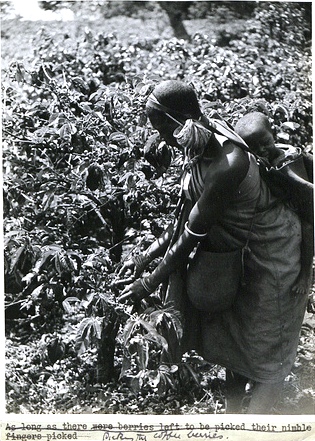 That, we are told by the BBC’s Material World presenter Quentin Cooper, is what Jonathan Swift thought coffee makes us. And I for one would agree with Mr Cooper that it is indeed also how Dr Aaron Davis, Head of Coffee Research at Kew Gardens, and global crop wild relative expert Dr Nigel Maxted, from the University of Birmingham, came over in an interview with him yesterday. It’s all because of that Kew study on the effects of climate change on wild arabica, which is really making the rounds, not least thanks to the BBC. You can download the whole podcast, but we’ve taken the liberty of filleting out the 10 minutes of the programme which feature Drs Davis and Maxted, with many thanks to the BBC. More background on crop wild relatives in Europe from the PGR Secure and the older PGR Forum project website. IUCN has a Red List. There’s a Global Portal. And a big global project on crop wild relatives too. Who says these things are not getting enough attention?
Read that paper on Arachis, Vigna and Solanum Nigel alluded to.
And dream about attending that FAO workshop he mentioned for next week.
Nibbling as the berries go round
Issue 56 of Berry Go Round – the botany blog carnival – is up at Seeds Aside. Plenty of goodies there, and here are the ones more directly related to our own interests:
- Phytophactor gives a one-word answer to the question “Can you eat flowering kale?” He also explains that “flowering” is a misnomer. To which I would add that as an ornamental, “flowering” kale is an abomination while as an edible, flowering kale is scrumptious.
- The great P.Z. Myers shares a photograph of a curcurbit tendril. And unleashes a storm of comment crap. Some people…
- And Joseph Craine has rounded up n most-important papers about N; where n=12 and N=nitrogen.
Now, why don’t you consider submitting to, or even hosting, the next Berry go Round?
Nibbles: Biodiversity economics, ICARDA social network, Beyond food miles, Heirlooms on BBC, Cannabis, Research funding, Cacao diversity, Agriculture from the air, Sustainable intensification example, Research whine, Japanese botanic garden visit, European PGR network, Tribal Glycene, Youth in agriculture
- Oxford Review of Economic Policy has special volume on biodiversity economics. Not much ag, though, settle down.
- ICARDA announces on Twitter the existence of a new Facebook page which looks a bit like the old one.
- It’s the fertilizer miles, stupid.
- Great British Food Revival does heirloom carrots. Oh and beer.
- Good news for a particular agricultural biodiversity subsector from Amsterdam and Colorado. The Dude unavailable for comment. For obvious reasons.
- If you’re from Ghana, Nigeria, South Africa, Tanzania and Uganda and are doing research on Neglected and Underutilized Species you’ll be interested in this call or research proposals from ISF.
- Bioversity deconstructs that paper on the spatial analysis of Theobroma diversity. I still don’t quite get why they didn’t do the gap analysis.
- Farming from the air. And more along the same lines. Or polygons, I suppose I should say. Can you estimate diversity from the air? I bet you can.
- Sustainable intensification in (sort of) action.
- Damn rice farmers not playing ball.
- Oxford botany geeks visit Japan, identify wood of bench in noodle bar.
- 13th meeting ECPGR Steering Committee. All the documents you’ll need. And then some.
- Soybean as a vegetable. Possibly an acquired taste.
- How to keep young people on the farm? “Perhaps the first point to recognise is that the evidence base on which to build policy and programmes is frighteningly thin.”