- Stefano Padulosi of Bioversity tweets from the IUCN conference in Korea. And here’s another way of following proceedings: The Twitter Hub.
- ICARDA forced to relocate.
- Results of survey of farmer adaptation strategies in East Africa. (And CIFOR has more examples.) So why do they need Climate Analogues then? I mean, given what we know about it and all… Oh come on, it’s not as bad as all that, look they’re even using it in Costa Rica. Nobody likes a whiny user. Ok, ok, fair enough.
- Branding not much use to farmers.
- Kenyan banker agrees with my mother-in-law on the usefulness of trees.
Illustrated catalog of potato varieties launched in Peru
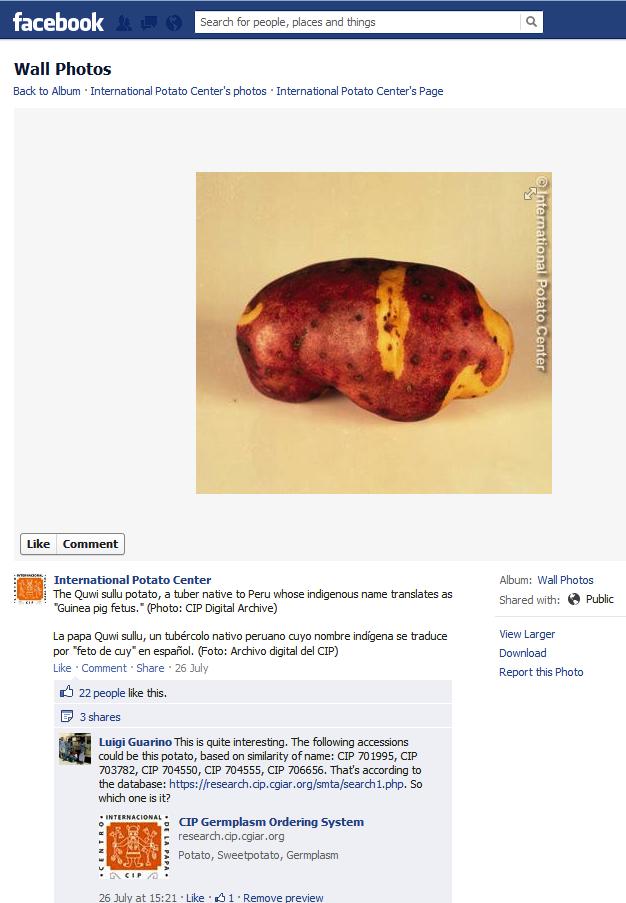 The International Potato Center has been running an Andean Potato of the Day feature on Facebook. And yes, they are potatoes, stop sniggering at the back there. Anyway, they’re really professional photos of often very weird and attractive traditional potato varieties, many of them with extremely weird names, and it made me curious as to what extent all this diversity is in CIP’s genebank. It turns out the photos were taken in 1999-2000 during a field trip into the Andes organized to provide high quality illustrations for the book “La Papa: Tesoro de los Andes.” CIP’s genebank curators were asked to help with the spelling and translation of the local names, but the photographs are of material freshly harvested from farmers’ fields, not the genebank. Most (not all, alas) of the varieties illustrated are in fact in the genebank, as you can check by searching for the local name (as I did for the “Quwi sullu” potato shown here), though it is occasionally tricky to be certain, due to variation in the spelling of the local name. This is another version of the problem we encountered in an earlier post dealing with rice, where it was not possible to be sure of the identity of material used in a particular piece of research because only the local name was quoted, rather than the accession number. Anyway, I bring all this up now because CIP has just announced the publication of an illustrated catalog of new potato varieties for Peru, with the now obligatory shout-out on Facebook. I haven’t seen the catalog yet, but I do hope it includes accession numbers.
Nibbles: Fertilizer tree, Indo-European, Human diversity, European pollinators, DNA data quality, Biodiversity maps, Organizzzzzz, Plantain
- Faidherbia albida gets another push. To quote from the recent Crops for the Future dissection of neglected/underutilized species: if it’s so good, how come it’s not used more?
- The Indo-European roots of names for pulse crops. Not nearly as boring as it sounds. Oh, and since we’re on the subject…
- Human biodiversity files: athleticism, foodism.
- Huge EU project monitors pollinators. What could possibly go wrong?
- Cleaning up DNA Sequence Database Hell.
- Nice biodiversity hotspot maps. No plants. Definitely no agrobiodiversity.
- A philosopher’s take on that organic agriculture meta-analysis.
- Not Musa, but still edible.
Nibbles: Heirloom conference, Saving plants, Aquaculture benefits, Ancient Egyptian botany, Coffee blogs, ITPGRFA, GIAH
- National Heirloom Exposition coming up. Any of our readers going? Oh come on, one of our readers must be going!
- Kew head honcho calls for a botanical New Deal.
- WorldFish head honcho calls for an aquacultural New Deal.
- A papyrus of recent botanical literature on ancient Egypt.
- Coffee blogs to follow. Oh gosh, am I blushing?
- Participants “gain more knowledge” at policy workshop. Of the ITPGRFA, that would be.
- A couple of Chinese agricultural systems gain recognition as Globally Important Agricultural Heritage.
Organic farming: what is it good for?
Organic produce and meat typically is no better for you than conventional food when it comes to vitamin and nutrient content, although it does generally reduce exposure to pesticides and antibiotic-resistant bacteria, according to a US study.
Organic farming is generally good for wildlife but does not necessarily have lower overall environmental impacts than conventional farming, a new analysis led by Oxford University scientists has shown.
Time for a meta-meta-analysis?