- No bananas without soil nutrients.
- Perhaps the back story to the banana genome can fix that.
- Coupla big Moringa meets coming up in November.
- Britain goes for gold in the jumping-on-the-Olympic-bandwagon-to-solve-global-hunger event.
- And CEO of Cargill offers coaching: be flexible, try harder.
- Deforestation in Guatemala and Belize. I love it when I can see geopolitics from space.
- Help Kew digitise its diversity.
- FarmAfrica celebrates non-timber forest products in Tanzania.
- Which could be of interest to Tanzanian farmers who have experienced the future of climate change.
- Nepali farmers say they’ve been hit hard by climate change.
- But it is not the reason for the climb of the desert ceanothus.
- Americans about to embrace colourful potatoes. Aren’t they always?
- The 2013 Vavilov-Frankel Fellowships are now open. Apply here.
- Seth Roberts says “I want to take this! Harvard class on fermented food.” Me too.
“Am I going to have to fight my Audi for lunch?”
The Colbert Report
Get More: Colbert Report Full Episodes,Political Humor & Satire Blog,Video Archive
Watch this for two reasons:
- It explains briefly and in an easy-to-understand way just some of the ramifications of the drought in the US. Note that the downside is almost all the result of using corn as feed for intensive livestock production.
- It is a masterclass on how to communicate simply and directly.
Major kudos to Bruce Babcock.
P.S. What would happen to prices if Colbert’s Audi was not a competitor for corn?
Berry-Go-Round comes around again
Danny Chamovitz is hosting the latest Berry-Go-Round blog carnival at The Daily Plant. Lots of cool stuff, go see for yourself.
Mexican maize biodiversity documented
 Via El Cuexcomate, news that CONABIO now has information on the maize races of Mexico on its website, including photos and distribution maps. It’s all part of a huge project to document native maize diversity (including the wild relatives) which was stimulated by fears 1 about the influx of GM maize. And since we’re on the subject of maize, today also saw an informative post on pellagra, complete with very dramatic illustrations.
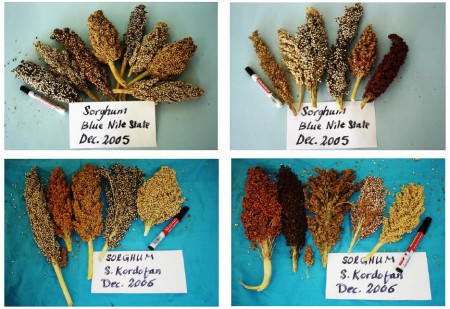
Sudanese sorghum by the numbers
The Plant Genetic Resources Unit of the Agricultural Research Corporation (ARC) of Sudan has just published a catalog of its sorghum collection. It mainly contains reams of characterization data, which of course will be easier to explore in their digital form, but it’s always good to have illustrations to go with the numbers. Would be great to see the data eventually make their way to Genesys.