- Edible weeds, anyone?
- Nope, Slate says the answer is tubers. And they may have a point.
- But Evo Morales thinks it’s quinoa.
- Meanwhile, Ms. Kimble cultivates her vegetable garden.
- And Luigi enticed by new mapping tool to explore deforestation on Sumatra.
Nibbles: Pests & Diseases, Cichorium, Agroforestry etc, Heritage oranges, Shepherds, ITPGRFA news
- Diversity protects against pests and diseases, especially when it is needed most.
- Amateur enthusiast cracks chicory biodiversity.
- Conservation Agriculture With Trees; it’s the new big thing in Africa.
- Saving the last orange grove in Orange County from destruction.
- Shepherds of the world; a slideshow from The Guardian.
- And — Oh Boy! — you can jump through some hoops to get a newsletter on the International Treaty of Plant Genetic Reso0urces for Food and Agriculture.
Nibbles: Big cheese, Perennials, Maize, Plant breeding, Tiny corn, Communicators, Traditional Foods, Forest peoples, Guar
- IFAD’s organic Moldovan cheese wins big.
- Advice for Rwandan coffee and banana farmers to cope with climate change.
- Advice from Mexico’s campesinos on how to cope with climate change.
- Do they – or you – need to participate in plant breeding? This toolkit could help.
- These folks don’t … From little corn plants, big efficiencies grow. I think.
- Newly trained press officers to support agriculture on Indian Ocean islands.
- Hurrah! A conference on traditional foods, with street food seminar accompaniment. h/t CFF.
- The diversity of forest peoples, united in their dependence on forests.
- Alternatives to guar: “Even though all the ingredients are acquired from food suppliers, the CleanStim fluid system should not be considered edible.”
Brainfood: Barcoding, DArT for beans, SNOPs for Cacao, Aquaculture impacts, Cassava GS, Cereals in genebanks, Symbiosis
- A critical review on the utility of DNA barcoding in biodiversity conservation. Not bad, but not by itself.
- A whole genome DArT assay to assess germplasm collection diversity in common beans. It works, and can distinguish Andean from Mesoamerican accessions.
- Optimization of a SNP assay for genotyping Theobroma cacao under field conditions. It works, and is being used in Ghana.
- A Global Assessment of Salmon Aquaculture Impacts on Wild Salmonids. Meta-analysis shows farming salmon and trout in an area has in general been bad for their wild relatives there.
- Genome-wide selection in cassava. High correlations between SNPs and several phenotypic traits of interest to breeders mean that selection time could be cut by half. Could.
- Cereal landraces genetic resources in worldwide GeneBanks. A review. We don’t have enough data. On so many different levels.
- Coevolutionary genetic variation in the legume-rhizobium transcriptome. Wait, does this mean we should be conserving Rhizobium too?
The final word on why biodiversity loss is bad
There’s a pile of papers on my desk. In a corner of my desk, actually, where I don’t have to look at them too often. Here are their titles:
- Minimal increase in genetic diversity enhances predation resistance.
- Plant diversity improves protection against soil-borne pathogens by fostering antagonistic bacterial communities.
- High plant diversity is needed to maintain ecosystem services.
- The functional role of producer diversity in ecosystems.
- Why intraspecific trait variation matters in community ecology.
- Does plant diversity benefit agroecosystems? A synthetic review.
- Genotypic richness and dissimilarity opposingly affect ecosystem functioning.
I just added one yesterday: “Meta-analysis at the intersection of evolutionary ecology and conservation.” You’ve spotted the trend, right? I was planning to write about the whole bunch of them together, a mega-post on the latest thinking on the relationship between biodiversity on the one hand and ecosystem health on the other. They’ve been there for months. I just haven’t been able to get round to them, what with one thing and another. Like work, mainly. And maybe a bit of laziness.
But there’s an upside to prevarication. You wait long enough to do something, if the thing is really important, you’ll find someone does it for you. And so it has proved on this occasion, because “Biodiversity loss and its impact on humanity” has just come out in Nature, and it provides a comprehensive review of the sort of papers that have been sitting in that corner of my desk, lots of them, going back years.
Which means all I need to do here is further summarize the already admirably succinct synthesis that the authors provide. 1 And that I think I can do in a few bullet-points:
- Loss of biodiversity (really loss of diversity in functional traits) decreases the efficiency and stability of ecosystems.
- The impacts of biodiversity loss on ecosystem functioning are big, accelerating and predictable.
- Biodiversity is predictably positively correlated with the provisioning of some ecosystem services, but the data in the case of other services is either mixed, insufficient or runs counter to expectation.
And yes, the dataset included crops, and here’s the snippet of the summary table that deals with agrobiodiversity and ecosystem services: 2
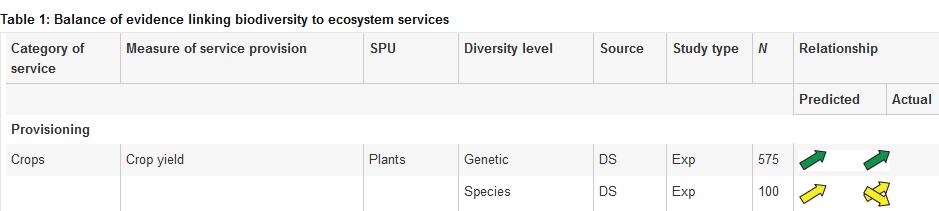
No doubt about the importance of genetic diversity to yield, though surprisingly mixed results for species diversity. But look at the numbers of data points involved (N): 575 data syntheses (DS) for genetic diversity and 100 for species diversity. Makes that pile of papers I’ve been avoiding look rather puny. And me not just a bit lazy.