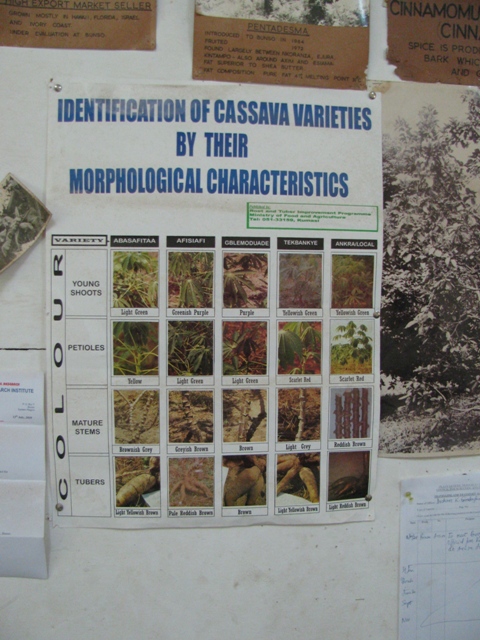
 Call me old-fashioned, but I have a soft spot for this kind of poster. This particular example was at CSIR’s Plant Genetic Resources Institute, Bunso, Ghana. Beats an SSR dendrogram thingie any time.
Nibbles: Small farmers, Wild bananas, Titan arum, Fish for diversity, Tenure, Treaty, Australian genebank, Mexican genebank, Mexican drought, Potato record, Khat and fodder in Ethiopia
- On my signal, unleash the potential of small farmers and food producers worldwide. Has a return ring to it.
- More than anyone could reasonably want to know about wild banana relatives in Thailand.
- Big stinky flower with its own webcam. Must be a wild relative of something.
- Better in many ways to catch a diversity of fish species than to focus on one.
- Could probably do with some guidelines for access to fisheries, though, right?
- International Seed Treaty secretariat knocks ‘em dead down under. “THREE-quarters of the world’s crop biodiversity has been irrevocably lost since 1900.”
- Of course it has. Did Dr Bhatti visit this place during his tour of Oz, I wonder? If not, maybe he’ll visit Mexico next and see this place. And speaking of Mexico…
- Mexico sneezes, US grain exports catch a cold?
- World record potato harvest in Bihar; there’s a lot that’s fishy about this story.
- “Khat cultivation in Ethiopia fuels economy, reduces deforestation.” And makes people sick, but who’s counting.
- Ah but here’s a possible alternative. Now, if only CIFOR and ILRI would talk together about this.
Nibbles: Treaty in Malaysia, Vavilov in Sardinia, Vegetative crops, Aquaculture, Indian AnGR, Seed Savers, Ancient Egypt and thereabouts, Quinoa in Chile
- Michael Halewood in Genebank Policy Hell.
- Vavilov in Genebank Database Hell.
- A guide through Clonal Crops Conservation Hell.
- Pakistan contemplates genebank for carp “pure line and improved stairs for SAARC countries.” Bicycles next, I suppose. But will Ghana follow suit?
- Meanwhile across the border, India is putting resources into livestock conservation at both national and state level.
- Italian broccoli variety moves to Florida and makes the big time.
- And ancient Egyptian gardens make the big time in Amsterdam. Too bad it wont be possible to exchange seeds.
- I bet those ancient Egyptians had taro. They certainly had wheat and barley.
- But not quinoa, alas, despite what Thor Heyerdahl might have thought.
A diversity of nibbles
Got held up with sickness and overwork, so rather than nibbling, which takes work, 1 how about a kinda narrative thang?
Starting off with a piece from Agriculture for Impact asking does planting trees compete with planting food?. “It depends,” natch. Richer farmers tend to do well in the particular scheme, which was based on payments for carbon sequestration. The one comment on the post – Planting trees is more profitable than planting food crops – puts in a nutshell the difficulties of improving local food security. Can you buy as much nutrition as you could grow on the same land? Is sequestering carbon considered in the USDA’s new Economic Research Report Rural Wealth Creation: Concepts, Strategies, and Measures? I’ve no idea. Also, on prices and wealth, Marcelino Fuentes calls the do-gooders for their volte-face on high food prices. Surely they’re good for poor farmers? Not any more. and how I remember the squirming when this very topic came up at the FAO in 2008.
In the wake of The Economist’s encomium to Svalbard, the Western Farm Press links that fine safety backup seed bank to the Pavlovsk Experiment Station, calling it “the oldest global seed bank”. Pavlovsk is still under threat, which Svalbard presumably is not, so point taken. But c’mon, people, it is not a seed bank.
And speaking of seeds, Garden Organic in the UK has a new guide to exotica, serving the needs of communities new to the English Midlands who want to grow the stuff they’ve always eaten. I’d have thought they already knew how, but maybe the real point is to harvest that knowledge.
All those communities moving around the place have been known to muddy the linguistic waters around the things they eat; your rocket is my arugula, and neither of us knows what rughetta might be. There’s long been an on-again off-again project at Melbourne University, to compile a multilingual, multi script plant name database, which is useful if you have specific questions. Now comes something that might be altogether more provocative of interesting work: on open data standard for food. I’m not geeky enough to know exactly how it will be useful – for example in citizen science, or global surveys – but I am geeky enough to believe that it will indeed be useful.
Waxing lyrical about heirloom grains
Yes, of course this is a self-indulgent bit of film. But fun for all that. They’ve tried to pack too much in — does everyone out there watching actually know what Carolina Gold is, or recognise those panicles? — and at times fitting it all in works against clarity. I got very distracted trying to see whether the chef’s tattoo was what I thought it was. And it was.
Found it here.