I’ve been travelling so I missed the announcement a couple of days ago on their blog that our friends at CCAFS 1 have a new all-singing, all-dancing platform called the Adaptation and Mitigation Knowledge Network. 2 Which is annoying because the issue of changes in the suitability of the climate for potato cultivation came up in the discussions at the meeting I’m attending here in Baku. And I would quite happily have stolen something else from CCAFS for my presentation. 3 The conference is called “Diversity, characterization and utilization of plant genetic resources for enhanced resilience to climate change” and it was hosted by the Azerbaijan Genetic Resources Institute with support from a number of CGIAR Centres active in the region and FAO, which provided funding for the project of which the meeting is one of the activities.
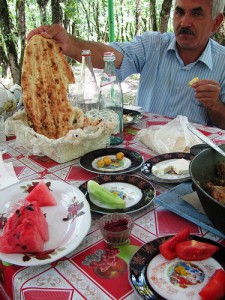 There were researchers from pretty much all of the countries of the Central Asia and Caucasus (CAC) region, plus Turkey, Iran, Ukraine and Russia to boot. Many of the presentations brought home to me — and not for the first time — what a tremendously rich part of the world this is for agricultural biodiversity: wild asparagus with stems five meters long; grape varieties sporting bunches almost as long as your arm; strange interspecific wheat hybrids with branched spikes; medicinal plants for every ailment you can think of; wheat landraces phenomenally high in zinc and iron. And that’s just the lunch. Fortunately, the place is also rich in talented researchers busy studying their agrobiodiversity, conserving it, and using it for health, nutrition and food security.
 Sure, they have problems. Where do they not? But there seems to be a real commitment to getting the job done, enthusiasm even. I was particularly struck by the relatively close linkages between genebanks and breeding programmes in many of the CAC countries. That you certainly don’t see everywhere. I wonder if it’s a legacy of the VIR system. They could do with more collaboration, coordination and sharing of responsibilities at the regional level, not to mention better integration with the rest of the world. But maybe this meeting will help. Anyway, all the presentations, abstracts and final recommendations will be online soon. I’ll post something when they’re up and you can make up your own minds.