- Concentrating management practices on conserving a particular plant species may have bad consequences for other bits of biodiversity. Lessons for crops wild relatives?
- Benin’s farmers ennoble wild yams.
- A Lebanese lunch is an educational experience. Right.
- Paddyomics video. Nothing to do with the Irish. It’s about how IRRI is automating, er, everything about its phenotyping.
- Tamarind’s environmental niche is, in fact, er, niches?
- Different wheat genomes generate distinct protein profiles.
- Phylogenetic relationships of a new Mediterranean lupin.
- Betel nut chewing endangers coral. Kinda. Traditional and all that, but an unpleasant habit nonetheless.
- Our friend Bhuwon and others tell the story of the participatory improvement and formal release of Jethobudho rice landrace in Nepal.
- CGIAR elicits comment on the Agriculture for Improved Nutrition and Health megaprogramme. Until August 1.
- Bacterial diversity boosts maize yields.
Announcing a symposium on Biodiversity and Sustainable Diets
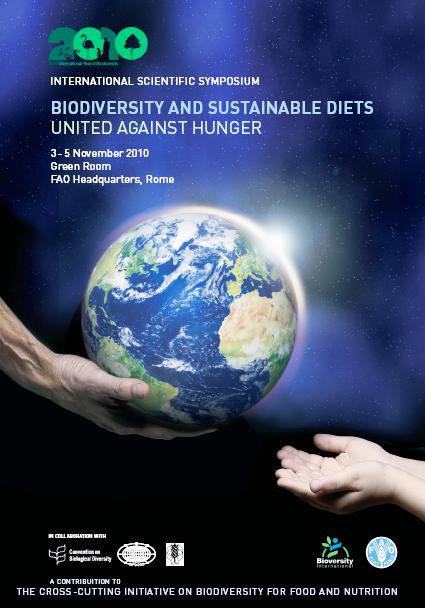 The first announcement and call for abstracts for the International Scientific Symposium on Biodiversity and Sustainable Diets is out. The symposium will take place 3-5 November 2010 at FAO Headquarters, Rome. But that’s all I know because the link to the announcement on FAO’s website is broken. (I’m writing this on Saturday: hopefully they’ll fix it on Monday.)
Wednesday: The link now goes to a Word document.
Nibbles: Grain ID, Garlic ID, Funding, Pest control, Sorghum, Grains, Cowpeas
- How to identify small grains.
- Can you identify a garlic?
- “You can’t expect a starving person to save a tree.” I s’pose not. But is that any reason to endow a chair in conflict resolution and development?
- “A farmer needs to let the garden get wild in order to protect it from the wild.” Course she does.
- Sorghum a huge success in Kitui, Kenya.
- Field trip to a grower of old grain varieties.
- New cowpea varieties selling like hotcakes, FARA told. And the old cowpeas?
Nibbles: Cassava virus, Peru’s Potato Park, Marula, Taimen, Meetings, Cornish fruits and veg
- New cassava varieties saving Zanzibar. Good to hear, though as ever one worries about what’s happened to the local landraces.
- Alder’s photos of the Potato Park. Do follow her travels around South America in search of agrobiodiversity.
- Namibia looks for other marula products.
- Saving the taimen in Mongolia. That would be a fish. A mighty fish.
- Interesting Indian symposia: wild fruits; “lifestyle floriculture.” Oh, to have more information.
- “Gariguette strawberries are an old variety and are non-licensed.” Crazy, eh?
Looking for leimotifs in the early history of wheat and rice
 There are two papers out just now which review in detail archaeobotanical and genetic data to elucidate the early history of crops. Dorian Fuller and numerous co-authors do it for Asian rice (Oryza sativa) 1, Hakan Özkan and others do it for emmer wheat (Triticum dicoccoides). 2 And Fuller actually also comments on the emmer paper on his blog. 3
In such situations, my first instinct is to look for commonalities, rather than get lost in the specifics. 4 Certainly, the occasional difficulty of reconciling archaeobotanical and genetic data comes up in both reviews. Actually there’s a third paper out which looks at that too, suggesting that “genetic and archaeological studies represent complementary perspectives on domestication, each highlighting a different facet of this complex problem.” 5 Complexity is a word that recurs a lot, in fact. Here’s Fuller: “Asian rices have had a complex history.” And here’s Özkan: “The spread of domestic emmer would have been extremely complex…”
But the really interesting question to me is whether there are similarities within the complexity. As Tolstoy might have asked, are the early histories of different crops complex each after their own fashion? Fuller summarizes the emmer story as one of “multiple starts of cultivation, gradual domestication, but the possible predominance of one domesticated line at the end of the process,” and there certainly are some echoes of that in rice. But I want to focus on one little series of events or processes that occurs in both rice and emmer, in each case with its peculiarities, but nevertheless comparable.
Cultivated emmer (Triticum dicoccon) was developed from its wild progenitor (T. dicoccoides) in south-eastern Turkey. 6 It then spread to the north-east, where it came into contact with wild Aegilops tauschii. Somewhere in the corridor between Armenia and the Caspian Sea, hybridization between the two gave rise to hexaploid bread wheat from tetraploid emmer. Well, something kind of similar also happened in rice. Fuller’s paper has a nice diagram summarizing the relationship between japonica and indica rices. Simplifying wildly, japonica arose in China from wild Oryza rufipogon. It was then taken to India, where it came into contact with cultivated proto-indica rices and also the wild species from which that was derived (O. nirvana). Hybridization and back-crossing eventually led to fully indica varieties. A crop develops in one place, then moves somewhere else, where it interacts with something, leading to the development of a somewhat different crop.
Now, I’m not sure whether the differences in this process, in particular the fact that polyploidy was involved in the emmer case but not rice, are more important than the similarities. But I wonder if the domestication and spread of crops can perhaps be broken down into a series of similar tropes, or maybe leitmotifs, I’m not sure what one would call them. At the very least it might help people like me make sense of — and try to remember, and keep straight — the complexities.