The Communications Team in the CGIAR Secretariat launched a new blog a few weeks ago called “Rural Climate Exchange: Connecting Agricultural and Environmental Science to the Climate Agenda.” It looks nice. It seems to have all the requisite bells and whistles. You can subscribe to an RSS feed or email notifications. We’ll be keeping an eye on it, and contributing as appropriate. Welcome to the blogosphere, Nathan, Danielle, Amelia et al.!
Monitoring plants of “Community interest” in Europe
There’s been an item in the news the last couple of days to the effect that “[a] report by the European Commission shows that habitat and wildlife protection targets across Europe will be missed…” Digging a bit deeper into that seemingly simple statement led me to a hitherto unknown (to me) world of EU rules and regulations and reporting requirements.
Let’s start at the beginning. There’s a thing called the Habitats Directive (1992). This requests all Member States “to monitor habitat types and species considered to be of Community interest.” It’s unclear to me how they were selected (perhaps someone out there can tell us), but these species are listed in various annexes to the Directive, though that sounds more simple than it is:
Where a species appears in this Annex but does not appear in either Annex IV or Annex V, the species name is followed by the symbol (o); where a species which appears in this Annex also appears in Annex V but does not appear in Annex IV, its name is followed by the symbol (V).
Anyway, Article 17 provides for regular reports on implementation of the Directive, and the report “for the period 2001-2006 for the first time includes assessments on the conservation status of the habitat types and species of Community interest.”
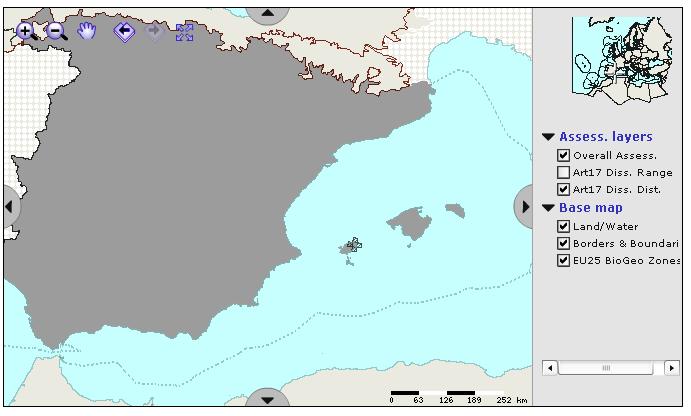
The website which houses the Article 17 reports is, well, complicated, but well worth exploring. The most interesting bit from an agrobiodiversity perspective is the page from which you can get species reports. These include all kinds of information about the status of those “species considered to be of Community interest,” country by country (there’s also an overall summary). Some of these species “of interest” are crop wild relatives such as Allium grosii, an endemic to the Balearic Islands (click the map to enlarge it).
There’s a few more CWRs in those annexes, though not all that many. A Hungarian Pyrus, for example. Any chance to get a few more on there? The bureaucratic infrastructure and mechanism for regular monitoring and early(ish) warning of any threats would seem to be well and truly in place, European Union-style.
Federal audit of scientific collections remembers agrobiodiversity
President Bust Bush apparently ordered a review and audit of Federally held scientific collections back in 2005. The report is just out. The article in the Washington Post about this dismisses genebanks in a few words (“rare seeds stockpiled by the Agriculture Department”), but the actual report has a bit more, including a box highlighting the National Center for Genetic Resources Preservation at Ft Collins and making a reference to Svalbard (p 23), and a paragraph on GRIN (p 31). I think that’s pretty good going. The recommendations (starting on p 29) are a fun read. They’re directed at scientific collections of all types in the US — of seeds, herbarium specimens, stuffed animals, rock samples etc. But basically, if you applied them to genebanks globally, you wouldn’t go far wrong.
Keeping their heads – and crops – above water
The BBC has a multi-media feature from Bangladesh called “Life above the Floods.” It looks at how the people of Char Atra, a low-lying silt island in the middle of the Ganges, cope with the yearly ravages of the monsoon’s flooding. Which will no doubt get worse as sea levels rise due to global climate change. I hate to say it, but there’s really not much that agricultural biodiversity will be able to do to help these people adapt to the effects of a global 2 degree C increase in temperatures.
Agricultural biodiversity and its perception, then and now
Hanging around the library today, I happened to pick up the March 2009 issue of Economic Botany, and was rewarded with a couple of really interesting papers on people’s perceptions of agrobiodiversity, and how it can be different to what you might think.
The first paper looked at knowledge of apple diversity among cider-makers in the United Kingdom and the United States. 1 The working hypothesis was that cider makers with a long history in the business would know more apple variety names that comparative neophytes. The results of semi-structured interviews with about 30 informants in Washington State, England, Wales and Northern Ireland suggested that this was not in fact the case. Experienced cider makers do indeed know more apple varieties, but not necessarily by name. They keep track of diversity in other ways, by taste, smell and ecology. The art of cider making lies in the blending, so the maker needs to know what each apple tastes like, on its own and in combination.
Cider makers who have a sense of rootedness to their land often know intricate details about trees in their orchards. They may know the rate at which they bloom, which trees do better in which conditions, or what the sugar levels of fruits will be on a given year. With all this knowledge, why would names have significance?
This would seem to contradict the findings of other studies which suggested that there’s a high degree of correspondence between number of local names and genetic diversity. Names might be lost, but the knowledge of diversity — and, at least for now, the diversity itself — is still there.
The second paper looks at how diversity in grapevines was perceived in the past. 2 Its subject is the Baroque altarpieces in Galicia, and in particular the twisted columns known as Solomonic. These often feature grapevine leaves, and the authors measured various morphometric variables on these representations, as well as on the real leaves of numerous varieties maintained in a local genebank. You know the kind of thing. The angle between this and that vein. The depth of the nth lobe.
They found that the representations were often very faithful, and could be used to identify specific local varieties. With a more extensive dataset (that is, more characters, and more altarpieces), it might be possible to reconstruct the history of cultivation of various now rare or extinct local cultivars. Another example of the imaginative sources of data people are looking at to get a handle on genetic erosion.